
(Exploring Your Mind) Laughing at memes in the current circumstances isn’t an act of frivolity. A sense of humor is more necessary than ever. It relieves stress and also makes us feel more united by identifying with the same situations and common problems.
psychology
COVID-19: Five Psychological Effects of Confinement and How to Manage Them

(Exploring Your Mind) The psychological effects of confinement may become more severe as the days go by. You need to know what strategies and mental approaches to apply in order to cope better with this situation and help others at the same time.
Solving Problems: Why Do We Always Do Things the Same Way?

(Exploring Your Mind) When you have a problem, have you noticed how you often apply the same solutions over and over again, even if the results aren’t effective? Why do we do this? More importantly, how can we stop doing it?
Fatherly Wisdom You Might Not Like Hearing But Need to Hear (Video)

Fatherly Wisdom You Might Not Like Hearing But Need to Hear (Video)
How our Mind Plays a Critical Role in Healing our Body
(Arjun Walia) Multiple studies and experiments have demonstrated that the mind does have an ability to heal, or assist with healing and recovery. How powerful is our mind? Why do some people still regard this thought as ‘pseudoscientific’ when there is a lot of statistically significant research that’s available with regards to the mind/matter mind/body connection?
A Clear Conscience Is Better Than Happiness (Video)

A Clear Conscience Is Better Than Happiness (Video)
Study: Men Can Smell When a Woman is Sexually Aroused

(Neuroscience News) University of Kent research suggests that men can distinguish between the scents of sexually aroused and non-aroused women.
Revenge, Brain Science: The Neural Processes Behind Our Desire for Revenge

(Neuroscience News) New insight on the neural processes that drive a desire for revenge during conflict between groups has been published today in the open-access journal eLife.
How to be Productive When You’re Tired

(Hugo Huyer) We all have those days when we’d much rather go back to sleep. We may feel tired, exhausted, worn out, fatigued, and no amount of coffee seems to help. But work needs to get done, so how do you increase your productivity when you’re running on an empty tank?
The Secret Weapon That Will Improve All of Your Relationships — Health Effects of Socialization

(Les Parrott, PhD) Prior to 1960, the residents of the little town of Roseto, Pennsylvania, had superpowers. Roseto was highly resistant to the biggest killer in the United States. Even today, it accounts for well over 600,000 deaths a year. Yet, Roseto had a fraction of the deaths compared to nearby towns.
Sharing Truth With Dignity and Respect: Psychology of Correcting a Person Who Maintains a Wrong Idea

(Exploring Your Mind) Finding a suitable (and respectful) way to correct a person who maintains a wrong idea is something everyone should learn to do. After all, fake news abounds, meaning it’s very easy to take them as facts. What’s truly complex and what you should fight against is that disease that afflicts so many people in the world: the need to be right.
Science: Music and Exercise – A Great Pair

(Exploring Your Mind) Thanks to the analysis of 139 available studies, today, we can affirm that music can improve exercise by optimizing performance, delaying the feeling of tiredness, and making physical activity a lot more enjoyable.
Study: Why Parents Hold their Babies by Their Left Side

(Exploring Your Mind) A fun fact: a study examined 477 pictures of the Virgin Mary with her child and she’s holding him on her left side in 373. This is consistent with what you see nowadays: babies calm down when they’re held on the left side. That’s why 80% of mothers do it instinctively.
There Is Good Evidence That Clutter Causes Anxiety & Stress
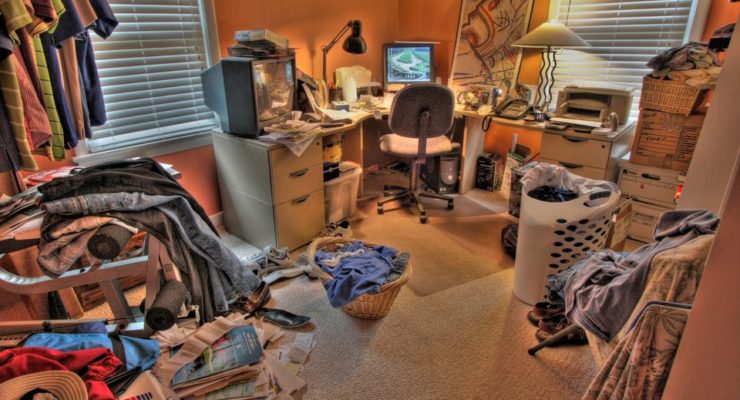
(Richard Enos) Clutter in our home or office certainly does cause stress, according to an article in Psychology Today. Psychologist Sherrie Bourg Carter lists the following 8 reasons that stress may ensue from a cluttered environment:
Study: Sitting Still Linked to Increased Risk of Depression in Adolescents

(UCL) Too much time sitting still – sedentary behavior – is linked to an increased risk of depressive symptoms in adolescents, finds a new UCL-led study.