
(Neuroscience News) For many, déjà vu is just a fleeting, eerie sensation that “I’ve been here before.” For others, it gets even eerier: In that moment of unsettling familiarity, they also feel certain they know what’s going to happen next – like, a girl in a white shirt is going to pass me on the left.
neuroscience news
Stressed to the Max? Deep Sleep Can Rewire the Anxious Brain
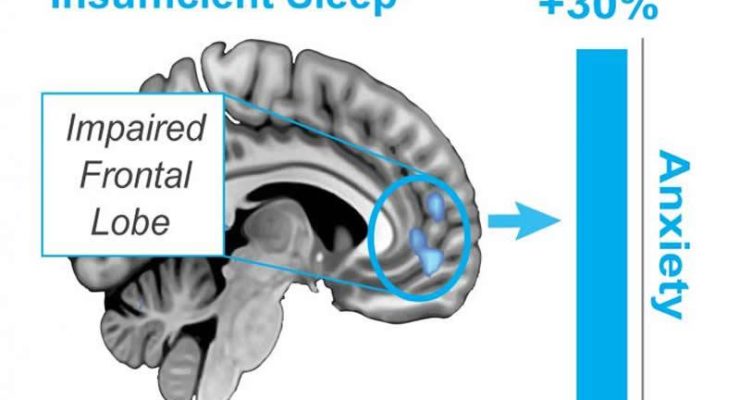
(Neuroscience News) When it comes to managing anxiety disorders, William Shakespeare’s Macbeth had it right when he referred to sleep as the “balm of hurt minds.” While a full night of slumber stabilizes emotions, a sleepless night can trigger up to a 30% rise in anxiety levels, according to new research from the University of California, Berkeley.
How Much Do We Lie When We Have Sex on the Brain?

(Neuroscience News) In a world of seemingly endless opportunities for finding a mate, competition for a partner can be fierce. Not all that glitters is gold, as the old adage goes. If you’ve long suspected that people fudge the truth when it comes to presenting themselves to a potential partner, here’s the research to back you up.
The Fetal Brain Possesses Adult-like Networks

(Neuroscience News) The fundamental organization of brain networks is established in utero during the second and third trimesters of fetal development, according to research published in Journal of Neuroscience. The finding lays the groundwork for understanding how the prenatal period shapes future brain function.
Screen-Based Media Associated with Structural Differences in Brains of Young Children

(Science Daily) A new study documents structural differences in the brains of preschool-age children related to screen-based media use.
Bacteria in the Gut May Alter Aging Process

(Justin Deschamps) Aging is related to how the body repairs itself. This self-repair ability is tied to gut bacteria due to the fact these microorganisms are instrumental in the production of nutrients along with the mechanism by which we absorb vitamins and release toxins in the digestive tract. The following study looked at the effect of transferring healthy gut bacteria to an unhealthy subject, observing that changes took place that reduced the effects of aging.
CBD and THC Use During Early Pregnancy Can Disrupt Fetal Development

(Neuroscience News) A new study published in Scientific Reports, a Nature Research journal, shows how a one-time exposure during early pregnancy to cannabinoids (CBs) – both synthetic and natural – can cause growth issues in a developing embryo. This is the first research to show such a connection in mammals.
Study: Narcissism Might Be a Dark Trait But It Can Lower Stress Levels and Reduce Chances of Depression

(Neuroscience News) While narcissism may be viewed by many in society as a negative personality trait, Dr Kostas Papageorgiou, who is Director of the InteRRaCt Lab in the School of Psychology at Queen’s, has revealed that it could also have benefits. He has published two papers on narcissism and psychopathology in Personality and Individual Differences and European Psychiatry. […]
A New Theory of Brain Organization Takes Aim at the Mystery of Consciousness

(Neuroscience News) Consciousness is one of the brain’s most enigmatic mysteries. A new theory, inspired by thermodynamics, takes a high-level perspective of how neural networks in the brain transiently organize to give rise to memories, thought and consciousness.
How Our Brains Remember Things Depends upon How We Learn Them

(Neuroscience New) Oxford University researchers have discovered that learned knowledge is stored in different brain circuits depending on how we acquire it.
Babies Understand Counting Years Earlier than Believed

(Neuroscience News) Babies who are years away from being able to say “one,” “two,” and “three” actually already have a sense of what counting means, Johns Hopkins University researchers have discovered.
How Jazz Improvisation Affects the Brain

(Neuroscience News) Jazz artist Louis Armstrong once said, “never play a thing the same way twice.” Although musical improvisation — composing new passages on the spot — is not unique to jazz, it’s perhaps the genre’s most defining element. While improvised jazz solos are spontaneous, there are rules, says Martin Norgaard, associate professor of music […]
Why, Sometimes, We Don’t See What We Actually Saw

(Neuroscience News) Crashes in visual processing occur when neurons processing one image are tasked with processing another too quickly. This results in either one or both images being unable to reach our conscious awareness.
Even the Fetus Has Gut Bacteria

(Neuroscience News) Both human and mouse fetuses have their own microbiome, which is transmitted from the mother. Findings provide new avenues for interventions during pregnancy to stimulate the fetal microbiome when the mother shows risk of premature birth.
Research Worth ‘Bragging’ About: Three Types of Arrogance Identified

(Neuroscience News) A study reports arrogance and narcissism are on a spectrum. Researchers identify three types of arrogance and reveal the associated implications.