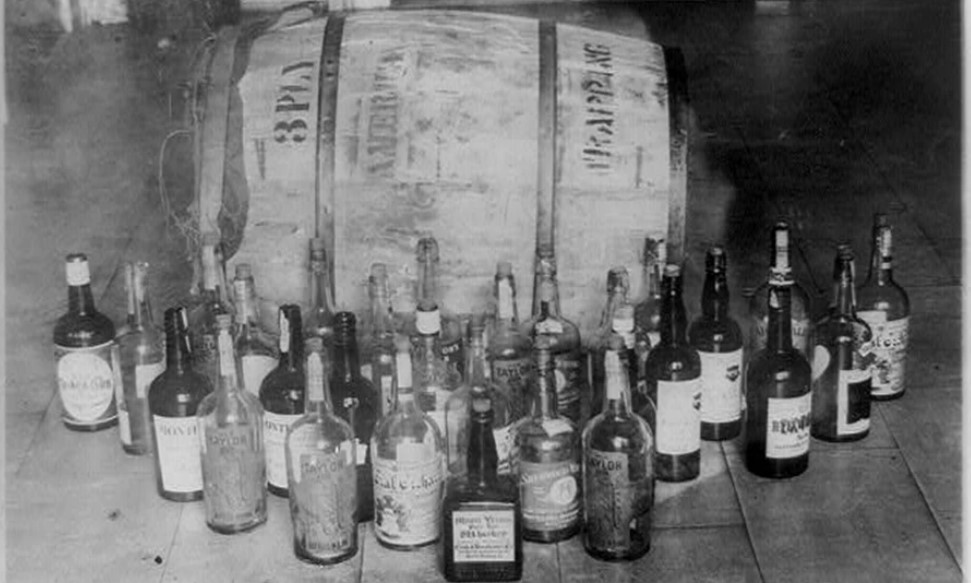
(Jon Miltimore) I was recently invited to speak to a student group about alcohol prohibition. During the course of my talk, I shared with them perhaps the most chilling historical account of America’s failed experiment to ban the sale of alcohol.
Related Lockdown Created 1 Million New Alcoholics in England
by Jon Miltimore, April 4th, 2022
The Prohibition Era (1920 -1933), which began with the passage of the Volstead Act, had many problems. Virtually overnight, millions of Americans became criminals for the “crime” of having a drink. Instead of people trading money for a jug of beer or a bottle of gin, they had to make their own or turn to the black market. It resulted in a surge of organized crime and the rise of many of the most notorious gangsters in history, including Al Capone, Dutch Schultz, and Charles “Lucky” Luciano.
“In the absence of Prohibition, we wouldn’t have had the kind of syndicated criminality that occurred. Prohibition was the catalyst,” explains Howard Abadinsky, professor of criminal justice at St. John’s University and the author of the book Organized Crime.
One might think the surge of organized crime—which resulted in a corresponding surge of law enforcement to suppress it—would be the darkest consequence of Prohibition. It was not.
‘Our National Experiment in Extermination’
On Christmas Eve in 1926, a mysterious thing happened.
A man stumbled into New York City’s Bellevue Hospital claiming Santa Claus was chasing him with a baseball bat. He soon died, but another man celebrating Christmas soon followed with similar symptoms. He died as well. And then another.
Hospital staff counted no fewer than 60 people who arrived that night severely ill from alcohol, eight of whom died. Citywide, the total soon reached 23 dead. How this happened is no mystery.
Professor Deborah Blum, a journalist, director of the Knight Science Journalism program at MIT, and and author of The Poisoner’s Handbook: Murder and the Birth of Forensic Medicine in Jazz Age New York, described it all in a 2010 Slate article. Progressive bureaucrats were intentionally poisoning alcohol to encourage compliance.
“Frustrated that people continued to consume so much alcohol even after it was banned, federal officials had decided to try a different kind of enforcement. They ordered the poisoning of industrial alcohols manufactured in the United States, products regularly stolen by bootleggers and resold as drinkable spirits. The idea was to scare people into giving up illicit drinking. Instead, by the time Prohibition ended in 1933, the federal poisoning program, by some estimates, had killed at least 10,000 people.”
The “chemist’s war of Prohibition” is all but forgotten today, but it remains one of the darkest and strangest law enforcement programs in US history. Perhaps most shocking is how transparent and callous central planners were about their program. Blum notes that Charles Norris, New York City’s chief medical examiner during the ’20s, casually noted the poisoning program was “our national experiment in extermination.”
Penetrating ‘the Fog of Lies’
During my talk, I asked students to raise their hand if they had ever heard of the poisoning program. Not one did. (The teacher also told me he had not heard about the program.)
Some students, frankly, looked skeptical. They aren’t the only ones who found the story hard to believe. (I certainly did.) Indeed, enough people have questioned the story’s veracity that USA Today issued a fact-check asserting the poisoning program is no myth.
This invites two important questions: 1) How did this atrocity happen? 2) Why are so few Americans aware of the government’s poisoning program?
I believe the answer to the first question is clear. The federal poisoning program was a result of government straying from its original and true moral purpose. In the classical liberal tradition, government is a necessary evil. The only reason this “social contract” exists at all is for a specific purpose: to protect life, liberty, and property.
“Each of us has a natural right – from God – to defend his person, his liberty, and his property,” 19th century economist and philosopher Frédéric Bastiat explained in The Law, echoing thinkers such as John Locke, Montesquieu, and Thomas Jefferson. In Bastiat’s view, the purpose of law is to uphold these rights.
The greatest atrocities in modern history—from slavery and eugenics to the Holocaust and Stalin’s Five-Year-Plans and beyond—all occurred as the result of people using the law for reasons other than its only true moral purpose. Prohibition sought to protect Americans from vice; but vices are not crimes, and this perversion of the law resulted in great social harms, including the federal poisoning program.
The second question is more difficult to answer: why are so few Americans aware of the government’s poisoning program? The students in my classroom were not an outlier. I received two degrees in history and never heard about the poisoning program—which killed exponentially more Americans than Japan’s attack on Pearl Harbor, according to some estimates—until I read Blum’s article.
The answer, I think, can perhaps be found in an essay written by Murray Rothbard in favor of revisionist history (questioning the standard interpretation of historical events). For many, revisionist history is viewed with skepticism and distrust; indeed, for many years, at least, I would have considered myself in this camp.
Rothbard, however, convincingly argued that revisionism may be necessary because of the state’s vast influence, which allows it to “bamboozle the public into accepting and celebrating the rule of its particular State.”
“The noble task of Revisionism is to de-bamboozle: to penetrate the fog of lies and deception of the State and its Court Intellectuals, and to present to the public the true history of the motivation, the nature, and the consequences of State activity,” Rothbard wrote. “By working past the fog of State deception to penetrate to the truth, to the reality behind the false appearances, the Revisionist works to delegitimate, to desanctify, the State in the eyes of the previously deceived public.”
In other words, the federal government’s poisoning program does not fit neatly into the effort—conscious or subconscious—to celebrate the rule of the state. To simply ignore it and pretend the event never happened may be part of the “bamboozling” process Rothbard describes.
Ten years ago, I would have said Rothbard’s take was oversimplified and too cynical. I wouldn’t describe it as such today (though I’ll admit there are other plausible explanations as to why Americans may not have heard about the feds’ poisoning program).
Regardless, the federal government’s poisoning program is important history that deserves to be taught and scrutinized for many reasons—not least of which is this: it’s a vital reminder of what can happen when humans stray from the true and moral purpose of the law.
Organic Lion’s Mane Mushroom, proven to grow new brain cells and synapses. Guard against Alzheimer’s, dementia, and mental decline. Save 10% and get free shipping with a subscription!“I can feel my mind getting sharper with Lion’s Mane. I put it in my coffee.”
Get your Lion’s Mane from Ascent Nutrition, one of the most pure and potent in the industry.

About The Author
Jonathan Miltimore is the Managing Editor of FEE.org. His writing/reporting has been the subject of articles in TIME magazine, The Wall Street Journal, CNN, Forbes, Fox News, and the Star Tribune.
Stillness in the Storm Editor: Why did we post this?
The news is important to all people because it is where we come to know new things about the world, which leads to the development of more life goals that lead to life wisdom. The news also serves as a social connection tool, as we tend to relate to those who know about and believe the things we do. With the power of an open truth-seeking mind in hand, the individual can grow wise and the collective can prosper.
– Justin
Not sure how to make sense of this? Want to learn how to discern like a pro? Read this essential guide to discernment, analysis of claims, and understanding the truth in a world of deception: 4 Key Steps of Discernment – Advanced Truth-Seeking Tools.
Stillness in the Storm Editor’s note: Did you find a spelling error or grammatical mistake? Send an email to [email protected], with the error and suggested correction, along with the headline and url. Do you think this article needs an update? Or do you just have some feedback? Send us an email at [email protected]. Thank you for reading.
Source:
Support our work! (Avoid Big Tech PayPal and Patreon)DIRECT DONATION
Leave a Reply