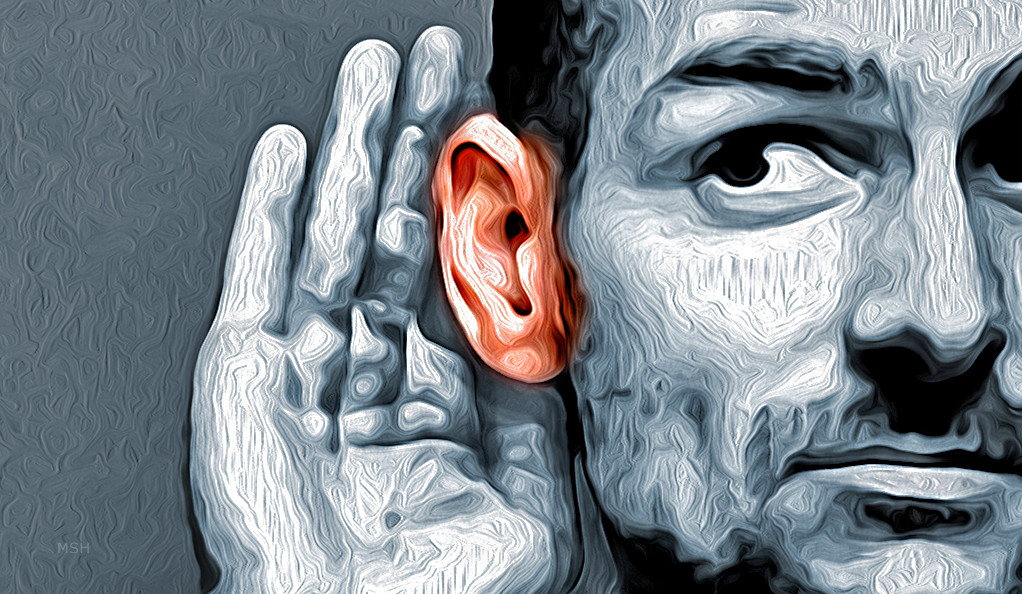
(Science Daily) Some people suffering from severe mental illness, particularly schizophrenia, hear “voices,” known as auditory hallucinations. This symptom, which afflicts more than 80% of patients, is among the most prevalent and distressing symptoms of schizophrenia.
Related New Johns Hopkins Study Reveals Broccoli Sprouts Compound as Possible Schizophrenia Treatment
by Staff Writer, October 2nd, 20129
Patients “hear voices” speaking to them or about them without anyone actually being there. Auditory hallucinations, which usually begin in adolescence and young adulthood, “sound” very real to patients and can have a devastating impact on their quality of life because the “voices” are typically distressing and distracting, sometimes compelling the sufferer into suicidal or violent actions. Uncovering the biological origins of auditory hallucinations is essential for reducing their contribution to the disease burden of schizophrenia.
To investigate the biological origins of hearing “voices” in patients with schizophrenia, a team led by researchers at the Icahn School of Medicine at Mount Sinai used ultra-high field imaging to compare the auditory cortex of schizophrenic patients with healthy individuals. They found that schizophrenic patients who experienced auditory hallucinations had abnormal tonotopic organization of the auditory cortex. Tonotopy is the ordered representation of sound frequency in the auditory cortex, which is established in utero and infancy and which does not rely on higher-order cognitive operations. The study findings, which appears this week in the Nature Partner Journal NPJ Schizophrenia, suggest that the vulnerability to develop “voices” is probably established many years before symptoms begin.
Buy Book The Compassionate Instinct: The Science of Human Goodness
“Since auditory hallucinations feel like real voices, we wanted to test whether patients with such experiences have abnormalities in the auditory cortex, which is the part of the brain that processes real sounds from the external environment,” says Sophia Frangou, MD, PhD, Professor of Psychiatry at the Icahn School of Medicine at Mount Sinai. ”
Specifically, the research team used an ultra-high field scanner with a powerful 7 Tesla magnet to obtain high-resolution images of brain activity while study participants listened passively to tones across a range of very low to very high frequencies. In healthy brains, these sounds are processed in a very organized fashion; each frequency activates a specific part of the auditory cortex forming a tonotopic map. The team obtained tonotopic maps from 16 patients with schizophrenia with a history of recurrent auditory hallucination and 22 healthy study participants. They found that patients showed greater activation in response to most sound frequencies. Additionally, the mapping of most sound frequencies to parts of the auditory cortex appeared “scrambled” in patients with schizophrenia, suggesting that the normal processes for the organized representation of sound in the brain are disrupted in schizophrenia.
Buy Book The Whole-Brain Child: 12 Revolutionary Strategies to Nurture Your Child’s Developing Mind
“Because the tonotopic map is established when people are still infants and remains stable throughout life, our study findings suggest that the vulnerability to develop “voices” is linked a deviance in the organization of the auditory system that occurs during infancy and precedes speech development and the onset of psychotic symptoms by many years. This is particularly exciting because it means that it might be possible to identify potential vulnerable individuals, such as the offspring of schizophrenia patients, very early on.”
According to the authors, in addition to helping doctors spot people who are likely to experience hallucinations before the symptoms appear or become severe, the auditory cortex may be an area of consideration for novel neurmodulation methods to help patients who already have symptoms.
Looking ahead, Dr. Frangou’s research team will replicate and expand the current observations in larger samples to determine their relevance to hallucinations across diagnoses and to quantify the association of tonotopic disruption to auditory cortical activation and connectivity during actual hallucinatory experiences.
Materials provided by The Mount Sinai Hospital / Mount Sinai School of Medicine. Note: Content may be edited for style and length.
Journal Reference:
- Gaelle E. Doucet, Maxwell J. Luber, Priti Balchandani, Iris E. Sommer, Sophia Frangou. Abnormal auditory tonotopy in patients with schizophrenia. npj Schizophrenia, 2019; 5 (1) DOI: 10.1038/s41537-019-0084-x

Stillness in the Storm Editor: Why did we post this?
Psychology is the study of the nature of mind. Philosophy is the use of that mind in life. Both are critically important to gain an understanding of as they are aspects of the self. All you do and experience will pass through these gateways of being. The preceding information provides an overview of this self-knowledge, offering points to consider that people often don’t take the time to contemplate. With the choice to gain self-awareness, one can begin to see how their being works. With the wisdom of self-awareness, one has the tools to master their being and life in general, bringing order to chaos through navigating the challenges with the capacity for right action.
– Justin
Not sure how to make sense of this? Want to learn how to discern like a pro? Read this essential guide to discernment, analysis of claims, and understanding the truth in a world of deception: 4 Key Steps of Discernment – Advanced Truth-Seeking Tools.
Stillness in the Storm Editor’s note: Did you find a spelling error or grammar mistake? Send an email to [email protected], with the error and suggested correction, along with the headline and url. Do you think this article needs an update? Or do you just have some feedback? Send us an email at [email protected]. Thank you for reading.
Source:
https://www.sciencedaily.com/releases/2019/10/191002160415.htm

What if hearing voices isn’t always schizophrenia? I wonder how many schizophrenics have been misdiagnosed. Some of them could be voice to skull technology (voice of God) or perhaps the person is open to hearing disembodied spirits simular to EVP (electronic voice phenomenon). Sometimes things are not as they seem to be. Just saying…