(Neuroscience) Acute pain, e.g. hitting your leg against a sharp object, causes an abrupt, unpleasant feeling. In this way, we learn from painful experiences to avoid future harmful situations. This is called “threat learning” and helps animals and humans to survive. But which part of the brain actually warns other parts of the brain of painful events so that threat learning can occur?
by Staff Writer, May 16th, 2019
We’ve known for a while that a brain area called amygdala is important for threat learning. But now, scientists from the lab of Ralf Schneggenburger at EPFL have discovered that the insular cortex sends such “warnings”. The insular cortex, folded deep within the lateral sulcus of the brain, is known to code for feelings about our own body. Moreover, neurons in the insular cortex connect to neurons in the amygdala, but the function of this brain connection was previously little studied.
The insular cortex being similar between mice and men, the scientists turned to mice for their study. The researchers used light-activated ion channels that were genetically engineered into specific neurons in the brains of mice. This allowed them to switch off the electrical activity of neurons in the insular cortex by shining brief pulses of laser-light during the threat-learning behavior.
Buy Book Psychology (Comprehensive Book on Psychology and Science)
By switching off the insular cortex during the painful event, the scientists found that mice became essentially fearless against a mild electric shock to the foot. In addition, the ability of the mice to learn from the painful event was greatly reduced.

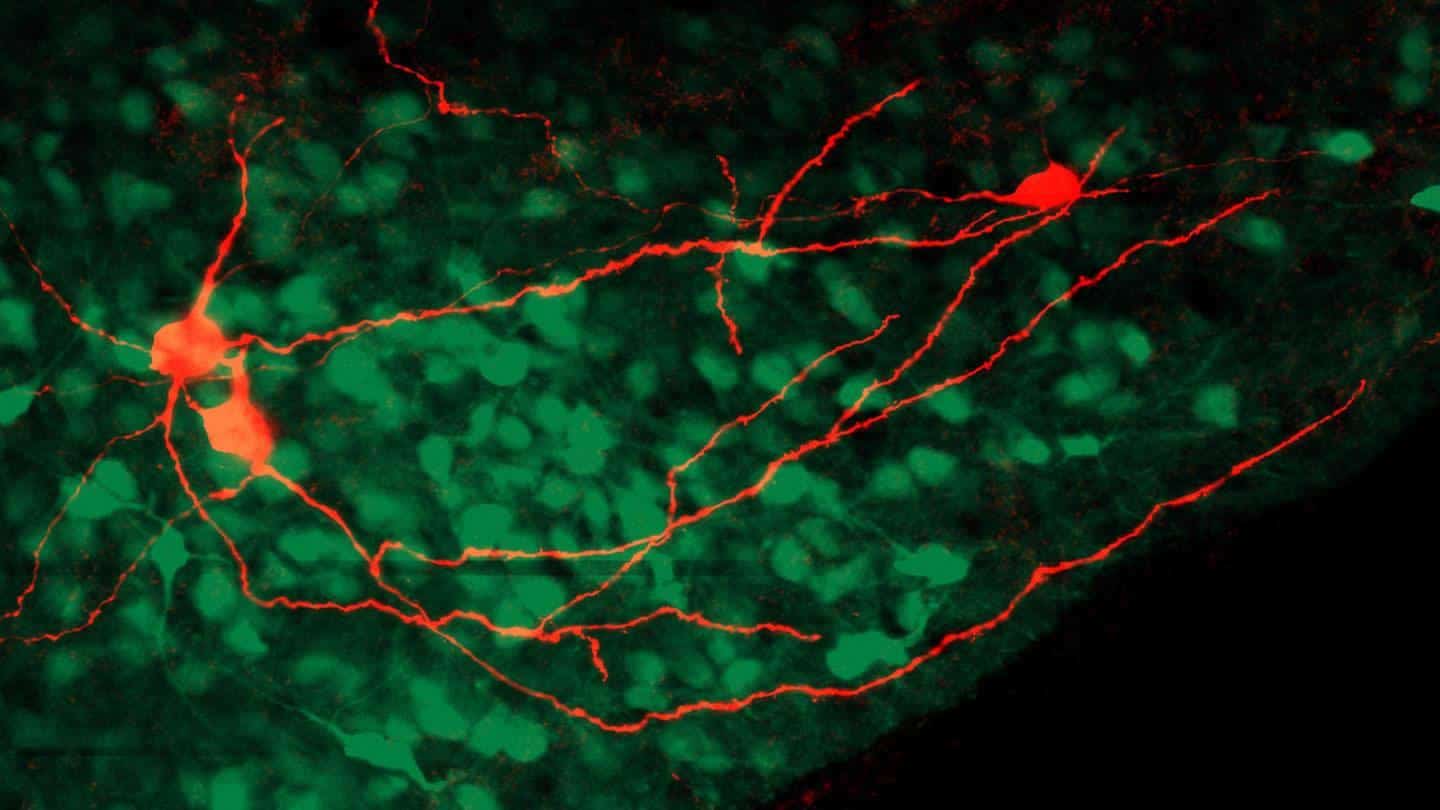
These are neurons and their synapses in the mouse brain. The image is credited to Aiste Baleisyte (EPFL).
The study demonstrates that, besides informing our brain about bodily states, the insular cortex can send a strong warning signal to other brain areas involved in forming a memory of the unpleasant event. “Because silencing the insular cortex takes away the unpleasant feeling normally associated with a painful event, our study suggests that neurons in the insular cortex cause the subjective feeling of pain, and induce learning about the pain in other brain areas,” says Schneggenburger.
“Because of this, activity in the insular cortex could have powerful consequences on shaping brain connectivity in other brain areas, which fits with studies that show aberrant activity in the insular cortex in humans with certain psychiatric diseases. Thus, our study of the neuronal mechanisms of how pain is encoded in the brain – together with future studies of the underlying plasticity mechanisms – might be relevant for the development of treatments for psychiatric diseases such as anxiety and post-traumatic stress disorders.”
Buy Book Invisible Heroes: Survivors of Trauma and How They Heal
Stillness in the Storm Editor: Why did we post this?
Psychology is the study of the nature of mind. Philosophy is the use of that mind in life. Both are critically important to gain an understanding of as they are aspects of the self. All you do and experience will pass through these gateways of being. The preceding information provides an overview of this self-knowledge, offering points to consider that people often don’t take the time to contemplate. With the choice to gain self-awareness, one can begin to see how their being works. With the wisdom of self-awareness, one has the tools to master their being and life in general, bringing order to chaos through navigating the challenges with the capacity for right action.
– Justin
Not sure how to make sense of this? Want to learn how to discern like a pro? Read this essential guide to discernment, analysis of claims, and understanding the truth in a world of deception: 4 Key Steps of Discernment – Advanced Truth-Seeking Tools.
Stillness in the Storm Editor’s note: Did you find a spelling error or grammar mistake? Send an email to [email protected], with the error and suggested correction, along with the headline and url. Do you think this article needs an update? Or do you just have some feedback? Send us an email at [email protected]. Thank you for reading.
Source:
https://neurosciencenews.com/insular-cortex-learning-pain-14015/
I think the programming to run from pain instead of bravely face and surmount it is actually a detriment. People can do amazing things when they are able to not be intimidated and subjugated by pain/fear.
It is actually the transformative work we do with pain and fear that liberated us from the power the 3D has over us.
An MD who taught some of the western science courses in acupuncture school said that the best thing we can do to reverse a heart attack as it’s coming on is to laugh.
Anyone who has done Vipassana meditation also knows that ‘higher mind’ over matter breaks the 3D matrix’s grasp over our consciousness.