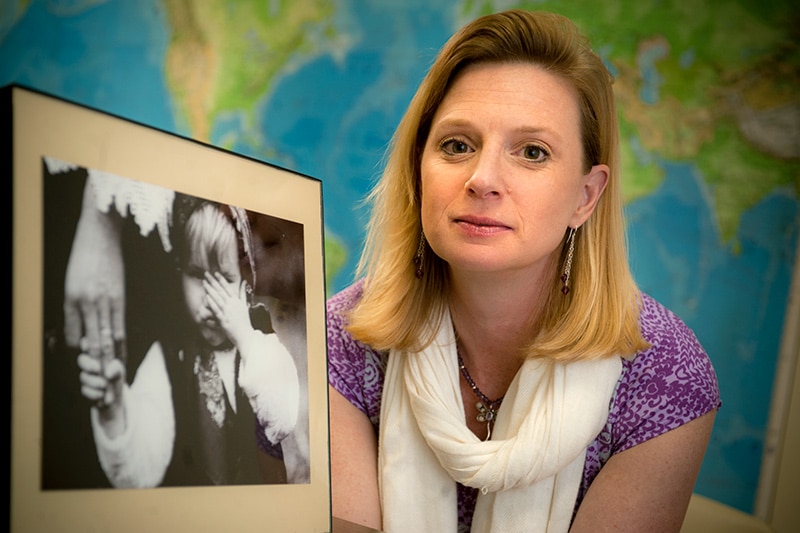
(Keith Brannon) The American Academy of Child and Adolescent Psychiatry (AACAP) has selected Tulane child psychiatry professor Dr. Stacy Drury to receive the 2018 Norbert and Charlotte Rieger Award for Outstanding Scientific Achievement.
by Keith Brannon, August 17th, 2018
The award recognizes the most significant paper published in the Journal of the American Academy of Child and Adolescent Psychiatry by a child and adolescent psychiatrist within the last year. It’s a record fourth time a Tulane child psychiatrist has won the prestigious award for groundbreaking research in the field. Representing more than 9,000 child and adolescent psychiatrists worldwide, the AACAP is the leading authority on children’s mental illnesses.
Buy Book Peaceful Parent, Happy Kids: How to Stop Yelling and Start Connecting (The Peaceful Parent Series)

The academy singled out Drury’s research into how early childhood trauma can have negative health consequences that seep across generations. The research showed that a biological marker of an infant’s ability to regulate stress was influenced not only by the amount of stress the child’s mother experienced during pregnancy but also by a mother’s life course experiences with stress. Her paper, “Thinking Across Generations: Unique Contributions of Maternal Early Life and Prenatal Stress to Infant Physiology,” was published in November.
“It is a sign of the quality of work that these transdisciplinary, across-school collaborations can build.”
Dr. Stacy Drury
“It’s a tremendous honor to be recognized by the American Academy of Child and Adolescent Psychiatry. One of the things I’m most excited about is that this research was truly a collaboration between the School of Public Health and Tropical Medicine, the School of Science and Engineering and the School of Medicine,” said Drury, the Remigio Gonzalez MD Endowed Professorship of Child Psychiatry. “So while it is given to me, it really was a very collaborative work that had students and junior and senior faculty from all the schools. It is a sign of the quality of work that these transdisciplinary, across-school collaborations can build. That thought process led people to look at things with a different perspective.”
Co-authors on the research include Katherine Theall, Cecile Usdin Professorship in Women’s Health at the School of Public Health and Tropical Medicine and, from the School of Science and Engineering, Sarah Gray, assistant professor of psychology, neuroscience doctoral student Christopher Jones and psychology doctoral student Erin Glackin.
Drury and collaborators recruited mothers during pregnancy to try and understand how a mother’s experiences, both before and during pregnancy, influence their infants’ development. Mothers reported on their stress during pregnancy as well as their own adverse childhood experiences before the age of 18. At four months of age, Drury’s research team measured the infant’s respiratory sinus arrhythmia (RSA) during an interaction with their mother. RSA is a marker of the parasympathetic nervous system and considered an indicator of how well one can adapt to changes in the environment. RSA is the variation in heart rate we experience when we breathe and differences in RSA are linked to lifespan mental and physical outcomes. For the most part higher RSA suggests an individual is more able to adapt to changes and stressors in their environment.
“People who have high RSA or a lot of RSA reactivity when stressed tend to be more adaptable or resilient,” Drury said. “What our study showed was that moms’ adverse childhood experiences took away some of that flexibility in babies. It showed that things that happened even before a mom gets pregnant can leave lasting traces in her child and, what is really new about this study, is that we showed that these are different than prenatal stress.”
The study showed that a mom’s early life adversity set a lower baseline for RSA, while prenatal stress resulted in less variation over a stressor.
“It is a bit nuanced in that adverse childhood experiences really lowers baseline or starting point of a child’s RSA, while prenatal stress influenced the change in RSA, or what we call reactivity,” Drury said.
Buy Book The Boy Crisis: Why Our Boys Are Struggling and What We Can Do About It
Researchers are studying whether early childhood interventions can recalibrate an infant’s RSA stress response.
Drury noted that it is unprecedented for one school to be recognized for more than a quarter of the Rieger awards given within the last 15 years. Past recipients include Tulane child psychiatry faculty Dr. Charles H. Zeanah (2016), Dr. Mary Margaret Gleason (2011) and Dr. Michael Scheeringa (2003).
“For a small research group, this is huge,” she said. “It shows that Tulane is producing the highest quality research.”
Stillness in the Storm Editor: Why did we post this?
Psychology is the study of the nature of mind. Philosophy is the use of that mind in life. Both are critically important to gain an understanding of as they are aspects of the self. All you do and experience will pass through these gateways of being. The preceding information provides an overview of this self-knowledge, offering points to consider that people often don’t take the time to contemplate. With the choice to gain self-awareness, one can begin to see how their being works. With the wisdom of self-awareness, one has the tools to master their being and life in general, bringing order to chaos through navigating the challenges with the capacity for right action.
– Justin
Not sure how to make sense of this? Want to learn how to discern like a pro? Read this essential guide to discernment, analysis of claims, and understanding the truth in a world of deception: 4 Key Steps of Discernment – Advanced Truth-Seeking Tools.
Stillness in the Storm Editor’s note: Did you find a spelling error or grammar mistake? Send an email to [email protected], with the error and suggested correction, along with the headline and url. Do you think this article needs an update? Or do you just have some feedback? Send us an email at [email protected]. Thank you for reading.
Source:
‘How Trauma Seeps Across Generations’… Excellent, now let’s get back to what we are interested in: how do you really and effectively treat this, remove this trauma from mother and child, because this is what’s most important for all of us, the rest is just theory.