
The official history of the 20th century tells us that the Allies defeated the Axis powers in a grand coordinated effort. Nazi Germany in particular, we are told, was completely dismantled so that it could never again rise to power and wreak havoc on the planet.
But according to declassified documents and several high-level whistleblowers, a secret group within the German government broke away for the official body, developing incredibly advanced technology that allowed them to eventually settle in Antarctica as well as venture out into the solar system.
Related Cosmic Disclosure Season 2 – Episode 1: Contact Is Made – Summary and Analysis | Corey Goode and David Wilcock
Corey Goode is a secret space program whistleblower and insider that has been disclosing information that rewrites some of modern history. One of the more sensational items of importance described by Goode is the infiltration of the American military industrial complex by a faction of this advanced German group during a 20 year period after the end of World War II.
This same German group formed its own secret space program prior to the start of the war. They accomplished this via a series of contacts made with at least two separate races. One was the Draco, a race of advanced reptilian extraterrestrial humanoids that have a long history of activity in our solar system, that are in a service to self-orientation. And the Agarthans, a race of Nordic-like humanoids which at one time claimed to be extraterrestrial but are in fact an ancient breakaway civilization of the Earth.
When a sect of a society advances to the point where it gains material and logistical independence from the main population, then that group has the potential to form a breakaway civilization. According to Goode, there are countless examples in Earth’s deep history of groups on the surface forming breakaway civilizations, often settling within the Inner Earth or venturing out into the stars. The German group which settled in Antarctica is one such example.
The Agartha Network, as it is called by some of these groups, live in incredibly ancient underground cities. This group, along with the Draco, possess advanced technology and high-level mental abilities, which they used to contact the Germans in the early part of the 20th century.
The Germans, via occult societies known as the Vril and Thule, established contact with these two groups, which helped advanced the German secret space program to the point where they had developed craft capable of traversing the globe, pole to pole, in minutes. When the Germans began to realize that they would lose the overt war with the Allies, they began developing contingency plans, one of which was to expand the settlement program of Antarctica, which according to their Agarthan allies, was well suited for secret underground military bases. This program was already well underway before the war started.
Related Antarctic Tunnels as Tall as the Eiffel Tower Found | Connections to Operation Highjump and Secret German Bases?
Related Are there really Pyramids in Antarctica?
When the Germans arrived there, they found huge abandoned cities under the ice, some of which were apparently from the distant past. The Germans built several large bases, and by the end of World War II, a group had settled there.
Here is a passage from the below-linked article that seems to confirm that a group of Germans did in fact escape the Allies.
It is interesting to note that at the end of the war the Allies determined that there were 250,000 Germans unaccounted for, even taking into account casualties and deaths. This would be quite a population base for a fledgling colony, and provide the essential degree of skill, expertise, and pure manpower for an industrial base of any sort, let alone the production of, even by today’s standards, extremely high technology. (Emphasis added)
If this number is accurate, a 250,000 strong force with the aid of advanced technology could have easily settled in the southern pole, and even on the Moon and elsewhere. According to Corey Goode, this is exactly what transpired.
The American military industrial complex, during this time, was developing their own secret space program. Unlike the Germans, they were far behind their German counterparts as World War II raged. But by the end of the war, the Americans learned of some of the German advances, and in an effort to bolster their own program, moved many high level German scientists to the states during Operation Paperclip.
Related Cosmic Disclosure Season 2 – Episode 4: Breakaway Begins – Summary and Analysis | Corey Goode and David Wilcock
The Germans managed to hide most of their best technology from the Americans, but to satisfy the Americans, the Germans provided their lower level technology to the Americans, which they developed prior to making greater advances through their Agarthan and Draco contacts. Alien Reproduction Vehicles, as they are called, were based off ancient vimana reverse engineered by the Germans during the 1920’s and 30s.
The corporate interests backing the American military industrial complex bit off more than they could chew, as shortly after Operation Paperclip was completed, the Germans now in the states, began to infiltrate the American group. The Americans must have discovered that the Germans were in contact with their comrades in Antarctica, and as a result Admiral Bird was sent to Antarctica to invade the icy continent and put an end to the German problem.
By the beginning of the 1960s, after Operation Highjump had ended, the American group had been completely taken over by the Germans. Apparently the famous UFO flyover of Washington DC in 1952 was actually this German group threatening to dismantle the delicate secrecy program of the Americans, as it related to extraterrestrials, unless they signed treaties with the Germans, allowing the industrial might of the United States to be exploited for their space conquest plans in the solar system.
President Dwight D Eisenhower made his famous speech in the early 1960’s shortly after a series of treaties were signed with various groups, one of which was apparently the Germans.
The following article details much of the history after World War II and what Admiral Bird encountered as he traveled to Antarctica in an effort to deal with the German force there. What is suggested by all this historical data is that the Germans didn’t actually lose the war, as the official history books would tell us. Instead, it appears that the US and its allies have become part of a hidden fourth Reich, one that continues to dominate the planet, and beyond, to this day.
Related Operation Highjump Photographs: Spacecraft and Bases in Antarctica
by Erich J. Choron
from GreyFalcon Website

Interestingly, the Pine Island (AV-12), one of the seaplane tenders involved in the expedition, has a rather colorful history. The USS Pine Island, a Currituck Class Seaplane Tender, was laid down, 16 November 1942, at Todd Shipyard Corporation, in San Pedro, California. It was launched, 26 February 1944, and given the commissioned name, USS Pine Island on 26 April 1945.
But… here’s where the story gets interesting… The USS Pine Island was struck from the Naval Register, on an unknown date… Her title was transferred to the Maritime Administration for lay up in the National Defense Reserve Fleet… on an unknown date… and… the ship’s final disposition is unknown… Now… how does one go about “losing” a major surface ship, over 640 feet long, almost seventy feet wide, with a displacement of over 15,000 tons? [see Rejoinder below]
As a federal employee with immediate access to the NDRF (National Defense Reserve Fleet) archives, which are all unclassified, let me provide additional information as it relates to the subject story of 3/15.
Mr. Choron states:
“The USS Pine Island was struck from the Naval Register, on an unknown date… Her title was transferred to the Maritime Administration for lay up in the National Defense Reserve Fleet… on an unknown date… and… the ship’s final disposition is unknown… “
Here’s what I can tell you: PINE ISLAND was delivered to Zidell Explorations in Portland, OR (now Zidell Marine) on 3/7/72 under a standard scrapping contract. Zidell paid $166K for the ship, which would be typical. In 1971 PINE ISLAND was towed to Bremerton to be stripped out by the Navy, which is not uncommon for a ship to be scrapped. The fact that she (nor the other AVs) is not listed on the Naval Vessel Register is strange, but probably just an oversight on the Navy’s part (as is not uncommon). Should you E-mail the nice folks running the NVR today, they would probably thank you for pointing out the ommission and add the missing ships.
Now, all this is not a refutation of OPERATION HIGHJUMP; that will be left up to others.
On 5 March, 1947 the “El Mercurio” newspaper of Santiago, Chile, had a headline article “On Board the Mount Olympus on the High Seas” which quoted Byrd in an interview with Lee van Atta:
“Adm. Byrd declared today that it was imperative for the United States to initiate immediate defense measures against hostile regions. Furthermore, Byrd stated that he “didn’t want to frighten anyone unduly” but that it was “a bitter reality that in case of a new war the continental United States would be attacked by flying objects which could fly from pole to pole at incredible speeds”.
So… who was the enemy that owned or flew these flying objects? Germany was apparently defeated, and there was no evidence that the new emerging enemy, Russia, certainly had such superior technologies. They were, like the United States, only on the verge of the “rocket age”, and totally dependent upon technology, and expertise captured from Germany at the end of the War. There was no other known threat could that could account for the United States’ invasion of Antarctica nor for the development of any craft that could fly “fly from Pole to pole with incredible speeds.”
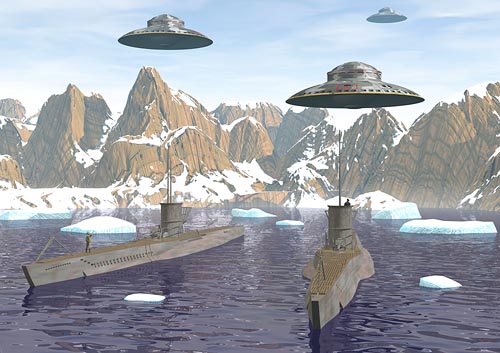
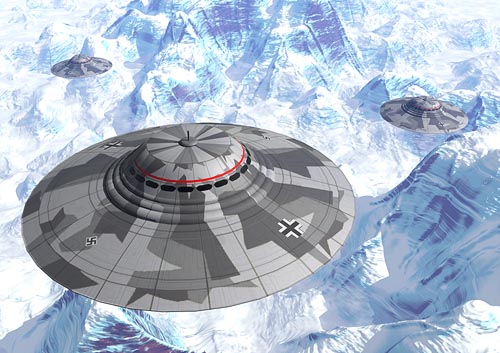
All Unidentified Flying Object researchers are, of course, aware of the multitude of reports concerning sightings of ‘flying saucers’ with swastikas or iron crosses on them, ‘aliens’ speaking German, etc. Most have also heard of abductees who have been taken to underground bases with swastika emblems on the walls, or as in the case of noted abductee Alex Christopher, have seen “Reptiloids” and “Nazis” working together aboard antigravity craft or within underground bases.
Another noted example is the American Reinhold Schmidt, a man whose father was born in Germany, and who tells in his book “Incident At Kearney”, that he was taken on a ‘flying saucer’ on several occasions. Schmidt states that “the crew spoke German and acted like German soldiers”. He also stated that they took him to the “Polar” region.
Now, one must admit that if a person were making up such a story, why would they claim to be taken, of all places, to the pole? Of course, one must also realize that at the time of Schmidt’s comments, the rumors of “secret Nazi bases” at the poles were already fairly common… After returning he was allegedly subjected to persecution by the U.S. Government. In his defense, it must be noted that his description of the aerial discs, as he called them, matched pictures captured from the Germans in the final days of the Second World War.
In 1959, three large newspapers in Chile reported front-page articles about Unidentified Flying Object encounters in which the crew members appeared to be German soldiers. In the early 1960s there were reports in New York, and New Jersey, of flying saucer ‘aliens’ who spoke German, or English with a German accent. Nor, can it be neglected to mention that in one of the most spectacular legal cases of the Twentieth Century… the “atomic espionage” trials… Julius and Ethel Rosenberg spoke of “warships of space.”
So… now we get to the point…
At this point, one must ask why, exactly, the United States, and, in fact, her allies, suspected that German activity at the pole was continuing, after the conclusion of the Second World War… The answer, quite honestly, has nothing at all to do with Unidentified Flying Objects… That part of the story came to light from a completely different set of sources…
The presence of such boats, all late construction Type XXI and Type XXIII U-Boats, with the “snorkel” that allowed them to make the entire passage from Germany submerged… was no secret.

The question arises, of course, why these men would make such a perilous crossing. It must surely be seen as a act of either desperation or fanaticism, or both… and such men as crewed U-Boats were neither. Nor, were the scientists and military officers who were their passengers. The fact is, it would seem that most of those who fled the ruin of Germany to the far South, were scientists and engineers, and their dedication sprang from the project on which they were working…
While the occupants of the two craft were completely unrelated, the technology involved, seems to have been strikingly similar. Also, the outcome of the recovery effort, undertaken by Germany, just as a similar recovery effort was undertaken by the United States, had strikingly different results.
The Bavarian crash of 1938, seems to have yielded an functioning, or almost functioning and repairable (with the technology of the time) power plant, and a nearly completely destroyed, or unrepairable airframe. The Roswell crash resulted in exactly the opposite… a nearly intact airframe and a ruined power plant. Because of this, the German research, which was to follow, took a vastly different turn from that which was undertaken in the United States, some ten years later… Germany needed an airframe which was capable of supporting the “engine” (for lack of a better term), while the United States would eventually need an “engine” capable of giving maximum performance to the airframe.
This, of course, would explain the vast array of “experimental” aircraft… of extremely “unique” design… to literally pour out of the design bureaus of Messerschmidt, Focke Wulf, Fokker and a multitude of smaller firms in the period between 1939 and 1945. The most notable, of course, is the Sänger “Flying Wing” which was later copied by the United States, and is, of course, the ancestor of today’s “stealth” bomber and fighter designs… notably, the B-2 Heavy Bomber.
It is also beyond doubt that both Unidentified Flying Object recoveries are the initial impetus for the long standing and ongoing research in “anti-gravity” propulsion seen in work of current aircraft manufacturers such as Boeing and Lockheed in the United States, and PanAvia in Europe.
In any case, it was the work on “reverse engineering” the downed Bavarian Unidentified Flying Object that was the catalyst for the “exodus” to the South in the final days of the Second World War. Germany was in ruins, and the research was viewed, by those conducting it, as vital… vital enough to risk packing up all that they had and risking a perilous submerged crossing of the Atlantic.. to an isolated experimental and research base on a frozen continent…
Speculation exists, with much to support it, that at least one of the boats in the valiant little fleet contained the biggest prize of all… at least one living survivor of the 1938 crash… an Extraterrestrial… a literal Human Being… not a “Grey”… born on a distant planet. The best evidence indicates that there were several survivors of the crash, and that they worked, and are most likely still working, with the original German scientists and engineers, or their descendants, in an effort to construct a viable “flying disc”.
These are not the “Grey Aliens” of Roswell. These beings, biologically, completely human, are described as “Aryan” in appearance, and completely human, although at least two to three generations more advanced, technologically than Earth born Human Beings. While their technology is similar to that of the Grays in general theory, it is somewhat different, apparently, in application.
In any case, Operation Highjump, began… The task force of over 40 ships, included the flagship “Mount Olympus”, the aircraft carrier “Philippine Sea, the seaplane tender “Pine Sea”, the submarine “Senate”, the destroyer “Bronson”, the ice breaker “Northwind”, and other tanker and supply ships. An armed contingent of 1400 sailors, and three dog sled teams were also on board.
It seems incredible that so shortly after a war that had decimated most of Europe and crippled global economies, an expedition to Antarctica was undertaken with so much haste (it took advantage of the first available Antarctic summer after the war), at such cost, and with so much military hardware – unless the operation was absolutely essential to the security of the United States.
At the time of the operation, the US Navy itself was being taken apart piece by piece as the battle-tested fleet was decommissioned with its mostly civilian crew bidding farewell to the seas forever. The Navy was even reduced to further recruitment to man the few remaining ships in service.
Tensions across the globe were also mounting as Russia and America edged into a Cold War, possibly a Third World War that the US would have to fight with “tragically few ships and tragically half trained men.” This made the sending of nearly 5,000 residual Navy personnel to a remote part of the planet where so much danger lurked in the form of icebergs, blizzards and sub-zero temperatures even more of a puzzle. The operation was also launched with incredible speed, “a matter of weeks.”
The official instructions issued by the then Chief of Naval Operations, Chester W. Nimitz were:
Some facts, however, are well known… There were three divisions of Operation High Jump: one land group with tractors, explosives, and plenty of equipment to refurbish “Little America”, and make an airstrip to land the six R-4D’s (DC-3’s), and two seaplane groups. The R4-D’s were fitted with jet-assist takeoff bottles (JATO) in order to takeoff from the short runway of the aircraft carrier “Philippine Sea”.
Following its arrival at Antarctica, the force began a reconnaissance of the continent. Byrd himself was onboard the first of the planes to take off on 29 January 1947.
“From the vibration of the great carrier”, Byrd later wrote, “I knew when the captain had got the ship up to about 30 knots (35 mph… maximum, full emergency speed for such a vessel).We seemed to creep along the deck at first and it looked as if we would never make it but when our four JATO bottles went off along the sides of the plane with a terrific, deafening noise I could see the deck fall away. I knew we had made it.”
“Officially”, it was stated that he had “lost an engine” and had had to throw everything overboard except the films themselves and the results of magnetometer readings in order to maintain altitude long enough to return to Little America. If we are to believe the published and private accounts of what actually took place, this is almost certainly the time when he met with representatives of the “Aryan” Extraterrestrials, and a contingent of the German scientists working on the reverse engineering and construction of “flying discs”…
Over the next four weeks the planes spent 220 hours in the air, flying a total of 22,700 miles and taking some 70,000 aerial photographs. Then the mission that had been expected to last for between six to eight months came to an early and faltering end. The Chilean press reported that the mission had “run into trouble” and that there had been “many fatalities”.
In the end, the task force came steaming back to the United Sates with their data, which then, immediately became classified “top secret”. Secretary of the Navy (by this time, Secretary of Defense)James Forrestal retired… and started to “talk”…. not only about Highjump, but about other things, as well… He was put in Bethesda Naval Hospital psychiatric ward where he was prevented from seeing or talking to anyone, including his wife… and… after a short while he was thrown out the window while trying to hang himself with a bed sheet.
This much is certain… As incredible as it may sound, there is considerable supporting evidence for these claims about a German base in Antarctica… On the very eve of the Second World War, the Germans themselves had invaded part of Antarctica and claimed it for the Third Reich.
In fact Hitler had authorized several expeditions to the poles shortly before WWII. Their stated objective was to either to rebuild and enlarge Germany’s whaling fleet or test out weaponry in severely hostile conditions. Yet, if true, all of this could have been achieved at the North Pole rather than at both poles and been much closer to home.
A further expedition took place in the early years of the twentieth century in the ship the Gauss (which became embedded in the ice for 12 months), and then a further expedition took place in 1911 under the command of Wilhelm Filchner with his ship the Deutschland.
Between the wars, the Germans made a further voyage in 1925 with a specially designed ship for the Polar Regions, the Meteor under the command of Dr. Albert Merz.
Then, in the years directly preceding the Second World War, the Germans laid claim to parts of Antarctica in order to set up a permanent base there. Given that no country actually owned the continent and it could not exactly be conquered as no-one lived there during the winter months at least, it appeared to the Germans that the most effective way to conquer part of the continent was to physically travel there, claim it, let others know of their actions and await any disagreements.
Captain Alfred Ritscher was chosen to lead the proposed strike. He had already led expeditions to the North Pole and had proved himself in adverse and critical situations. For the mission Ritscher was given the Schwabenland; a German aircraft carrier that had been used for transatlantic mail deliveries by special flightboats, the famous 10 ton Dornier Super Wals since 1934.
These Wals were launched by catapult from the Schwabenland and had to be accelerated to 93mph before they could become airborne. At the end of each flight a crane on the ship lifted the aircraft back on board after they landed in the sea.
The ship was refitted for the expedition in the shipyards of Hamburg, and around one million Reichsmark, nearly a third of the entire expedition budget – was spent on this refit alone.
The crew was prepared for the mission by the German Society of Polar Research and as these preparations neared completion, the organization invited Admiral Byrd to address them, which he did.
The Schwabenland left the port of Hamburg on 17 December 1938 and followed a precisely planned and determined route towards the southern continent. In little over a month the ship arrived at the ice covered Antarctica, dropping anchor at 4B0 30B” W and 69B0 14B” S on January 201939..
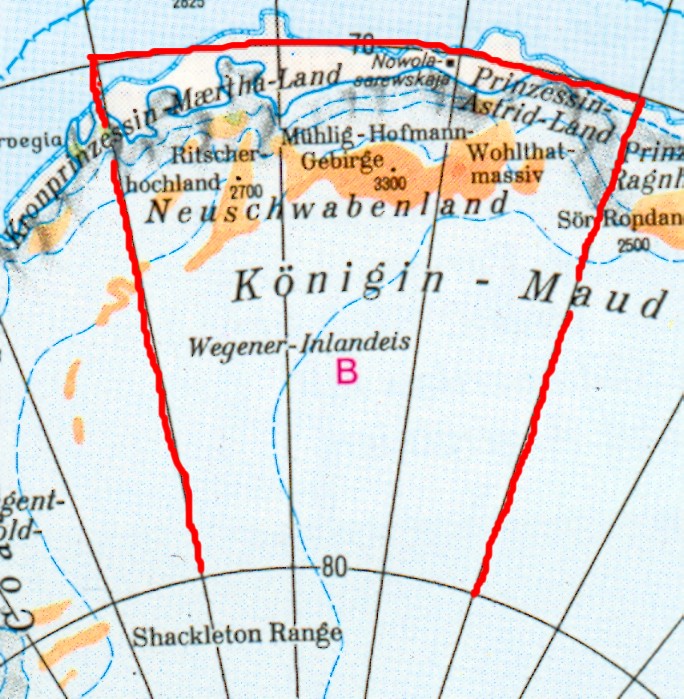
The expedition then spent three weeks off Princess Astrid Coast and Princess Martha Coast off Queen Maud Land. During these weeks, the two Schwabenland aircraft, the Passat and Boreas, flew 15 missions across some 600,000 square kilometers of Antarctica, taking more than 11,000 pictures of the area with their specially designed Zeiss Reihenmess-Bildkameras RMK 38b.
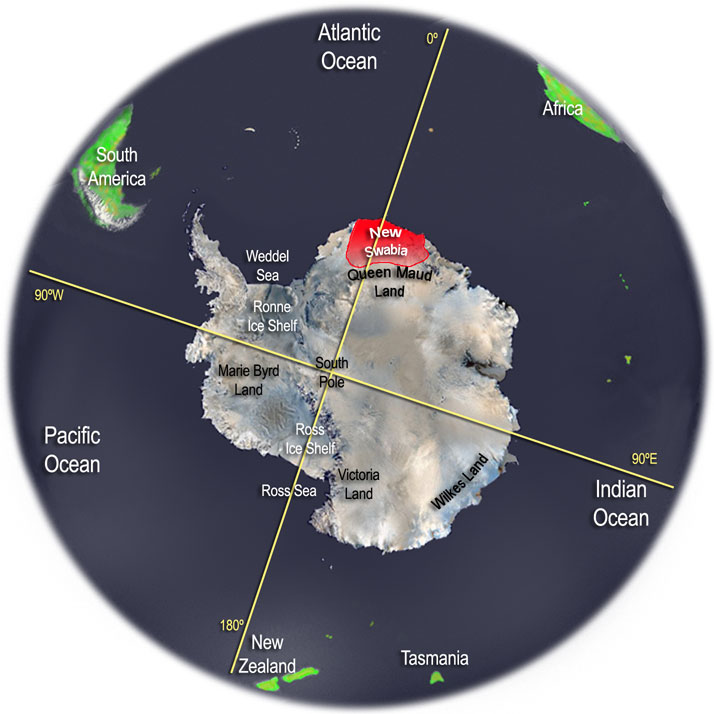
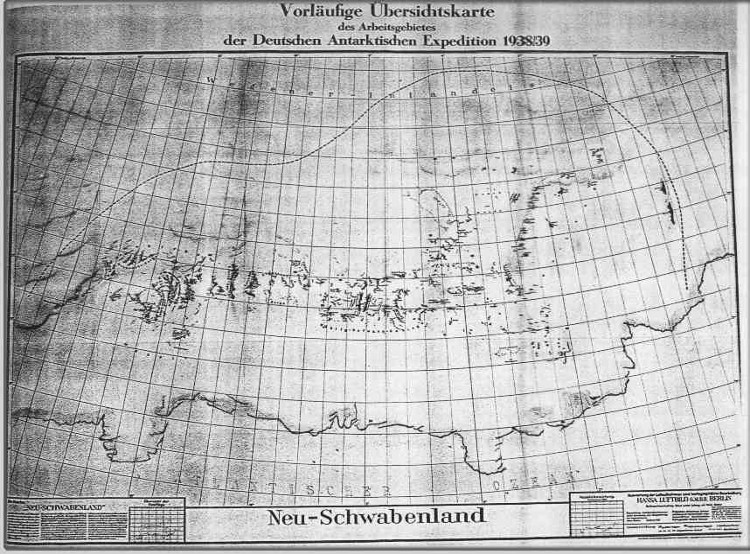
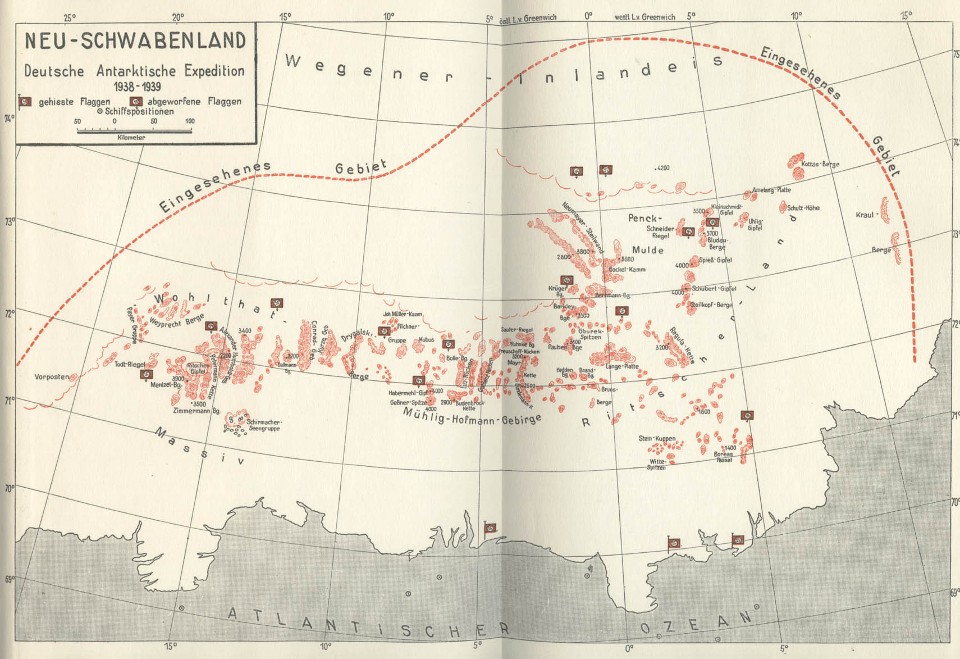
Nearly one fifth of Antarctica was reconnoitered in this way and, for the first time, ice-free areas with lakes and signs of vegetation were discovered. This area was then declared to be under the control of the German expedition, renamed Neu-Schwabenland and hundreds of small stakes, carrying the swastika, were dumped on the snow-covered ground from the Wals to signal the new ownership. Ritscher and the Schwabenland left their newly claimed territory in the middle of February 1939 and returned to Hamburg two months later, complete with photographs and maps of the new German acquisition.
Now bear in mind that all of this took place before the recovery of the Unidentified Flying Object, in the Bavarian Alps, in 1938… There is no conceivable reason, at least on the surface, for such an intense interest in the South Polar regions… unless something else had already transpired to make such an investigation worthwhile… The true purpose of this expedition has never been satisfactorily explained; there is merely a series of puzzles, related reports and snippets of information that are no longer open to verification. What is not open to doubt however, is that in the decade preceding the Second World War, the Germans did almost nothing that did not put the entire structure of the country on a war footing.
This activity affected all aspects of German life; military, civilian, economic, social and foreign policies, engineering, industry etc. Given that the seizing of Neu-Schwabenland occurred on the very eve of the war, it can only be concluded that that the polar expedition was of major importance and significance to the goals and development of the German nation.
Nor did activity end with the outbreak of the war… In fact, it intensified… The South Atlantic, including South Polar waters became quite active…
Between 1939 and 1941, well after the outbreak of war in Europe, Captain Bernhard Rogge of the commerce raider Atlantis made an extended voyage in the South Atlantic, Indian and South Pacific Oceans, and visited the Iles Kerguelen between December 1940 to January 1941. 
The Atlantis is known to have been visited by an RFZ-2 (the UFO style craft which had served as a reconnaissance aircraft since late 1940.) The ship then adopted a new disguise as Tamesis before being sunk by HMS Devonshire near Ascension Island, on 22 November 1941 (the Atlantis was also known as Hilfskreuzer 16 and was, at various times, disguised as Kasii-Maru or Abbekerk.)
Although the activities of the German ship Erlangen, under the captaincy of Alfred Grams, do not appear to be of consequence during 1939-40, the same cannot be said of the Komet which was commanded by Captain Robert Eyssen.
The Pinguin itself under the command of Captain Ernst-Felix Kruder was a commerce raider that operated chiefly in the Indian Ocean. In January 1941 she captured a Norwegian whaling fleet (factory ships Ole Wegger and Pelagos, supply ship Solglimt and eleven whale catchers) in about 59B0 S, 02B0 30W. One of these catchers (renamed Adjutant) remained as a tender and the rest were sent to France. This ship also made anchorages at the Iles Kerguelen and may have landed a party on Marion Island.

Then in 1942 Captain Gerlach in his ship the Stier investigated nearby Gough Island as a possible temporary base for raiders and a camp for prisoners.
This ship activity does not appear considerable, however the level of U-boat activity in the South Atlantic was much higher. The exact nature and extent of how high will probably never be known, however some insight might be gleaned from the fact that between October 1942 and September 1944 16 German U-boats were sunk in the South Atlantic area. And… some of these submarines did appear to be engaged in covert activities.
A fine example of this would be that of U-859 which, on 4 April 1944 at 04.40hrs, left on a mission carrying 67 men and 33 tons of mercury sealed in glass bottles in watertight tin crates. The submarine was later sunk on 23 September by a British submarine (HMS Trenchant) in the Straits of Malacca and although 47 of the crew died, 20 survived.
Although Germany surrendered unconditionally to the Allies, on 8 May 1945, events after that date suggested something was happening that did not form a part of recognized world history. Something fuelled by a statement made by German Grand Admiral Karl Dönitz…
Certainly there are records of continued German naval activity in the area after the war had apparently ended. For example, on 10 July 1945, more than two months after the cessation of known hostilities, the German submarine U-530 surrendered to Argentine authorities. The background to this event is puzzling. It is known that the boat had left Lorient in France on 22nd May 1944 under the captaincy ofOtto Wermuth for operations in the Trinidad area, and after successfully rendezvousing with the incoming Japanese submarine I-52, it headed for Trinidad before finally returning to base after 133 days at sea.
The boat’s official record states that between October 1944 and May 1945 it formed part of the 33rd Flotilla and on Germany’s surrender Otto Wermuth’s captaincy and the submarine’s career came to an end. Yet two months later it arrived in Rio de la Plata in Argentina and surrendered to the authorities there on 10 July 1945.
The future may well reveal that fate of more of these submarines; however given the French and South American reports, and the number of missing U-boats, it may not be unreasonable to conclude that at least some of them relocated to the South Polar area.
History also gives us further clues as to a German-Antarctica connection, for it records that Hans-Ulrich Rudel of the German Luftwaffe was being groomed by Hitler to be his successor. It is known that Rudel made frequent trips to Tierra del Fuego at the tip of South America nearest Antarctica. And…one of Martin Bormann’s last messages from the bunker in Berlin to Dönitz also mentioned Tierra del Fuego.
Then there are also claims about Rudolf Hess, Hitler’s best friend who went to England and was arrested as a war criminal on 10 May 1941. Following his arrest, Hess was held in Spandau Prison in isolation until his death. Such unique treatment is suggestive that he had information that the Allies considered dangerous.
“was entrusted with the all-important Antarctic file. Hess, himself, kept the Polar file.”
For the moment, however, let’s return to Operation Highjump… which seems to have been an attempt to ferret out a remaining German base on the Antarctic continent, and perhaps, to determine where, exactly the sudden rash of Unidentified Flying Object activity of the past eighteen months, had originated, and, exactly who/what was behind it… There would have, of necessity, been two prerequisites for a mission of this type.
Both of these criteria were met…
Both the Eastern and Western Groups of Operation Highjump had been active around Neu-Schwabenland. So was a Russian boat that “proved to be unfriendly”. The Eastern group were frustrated in their efforts to make a reconnaissance of the area, despite incredible efforts to secure photographs for later examination.
“it was very late in the season … The sun had only been briefly glimpsed in the past few weeks, but everyone could tell that the continually grey skies and clouds were darkening daily. In another month all light would be gone from Antarctica. The waters girdling the continent would begin to freeze rapidly, binding unwary ships in a crushing embrace.Dufek [the commander] was loath to surrender. He ordered his ships northwards away from the pack. Perhaps one or two more flights might be possible. But on the morning of 3 March virgin ice was seen to be forming on the water’s surface [and the] Eastern group steamed out of Antarctica.”
“a land of blue and green lakes and brown hills in an otherwise limitless expanse of ice”.
Several days later, Bunger returned to the area, and found that the water was warm to the touch and the lake itself was filled with red, blue and green algae giving it a distinctive color. Bunger filled a bottle with the water which later “turned out to be brackish, a clue to the fact that the lake was actually an arm of the open sea”.
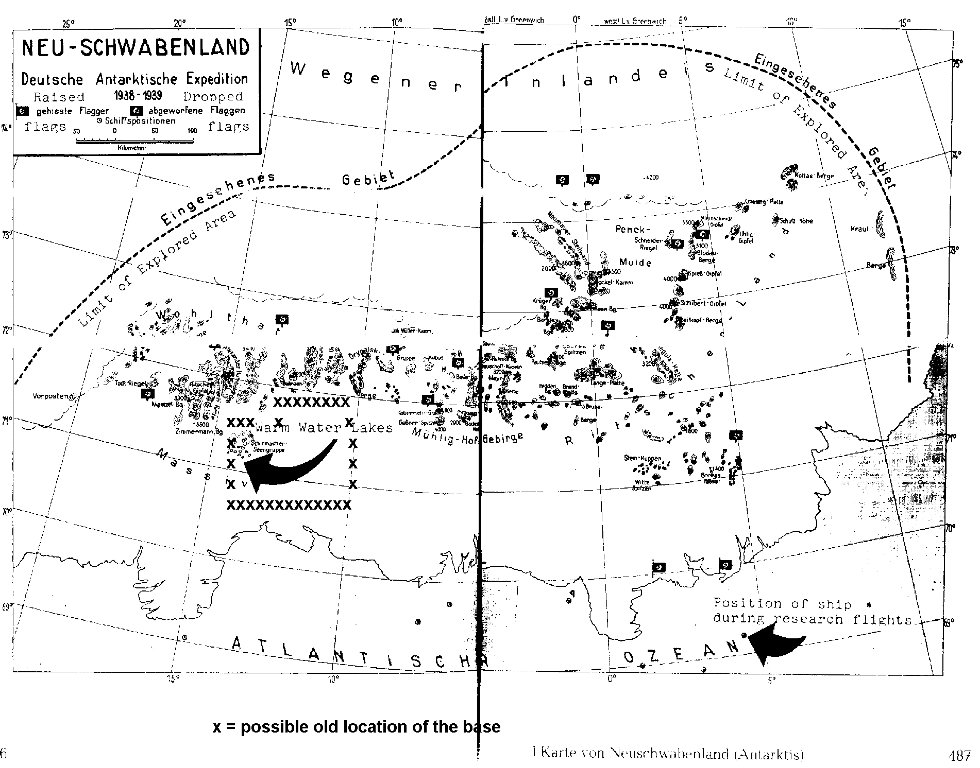
This is important for two reasons; warm, inland lakes connected to the surrounding oceans would be perfect for submarines to hide within, and similar lakes have been noted in Neu-Schwabenland, the site of the alleged German (and suspected Alien) base.
While there is, still, no conclusive evidence of a German/Alien base on Antarctica, It is beyond doubt that something highly unusual was happening on, or around, the frozen continent. In general, it appears that the probability for such a base to have existed… and perhaps continue to exist, to this day, are rather high…
Bender ran an organization called the International Flying Saucer Bureau (IFSB) a small UFO organization based in Connecticut, USA and he also edited a publication known as the Space Review which was committed to the dissemination of news about UFOs. In truth, the organization had only a small membership and the publication circulated amongst hundreds rather than thousands, but that its members and readers valued it was in little doubt. The publication itself advocated that flying saucers were spacecraft of extraterrestrial origin.
However… in the October 1953 edition of Space Review, there were two major announcements.
A source which the IFSB considers very reliable has informed us that the investigation of the flying saucer mystery and the solution is approaching final stages. This same source to whom we had referred data, which had come into our possession, suggested that it was not the proper method and time to publish the data in ‘Space Review’.
The mystery of the flying saucers is no longer a mystery. The source is already known, but any information about this is being withheld by order from a higher source. We would like to print the full story in Space Review, but because of the nature of the information we are very sorry that we have been advised in the negative.
We advise those engaged in saucer work to please be very cautious.
Bender might very well have known “what the flying saucers” were, at least a portion of them… but he later revealed in a local newspaper interview that he was keeping his knowledge a secret following a visit by three men who apparently confirmed he was right about his Unidentified Flying Object theory, but put him in sufficient fear to immediately close down his organization and cease publication of the journal.
It has been argued that the story of being visited by three strangers and being warned off was a front to close a publication that was losing money, however the fact that Bender had been “scared to death” and “actually couldn’t eat for a couple of days” was verified by his friends and associates. It is also widely known that such “stories” are often spread by the United States, and other governments to discredit those who might just have the truth, or at least a portion of it.
In 1963, a full decade after his visit from the three strangers, Bender was seemingly prepared to reveal more of his story in a largely unreadable book entitled Flying Saucers and the Three Men in Black. The book was scant on facts, however, it described extraterrestrial spacecraft that had bases in Antarctica.
This was apparently the truth Bender was terrorized into not revealing.
| Ernst Zündel was NOT a ‘Paperclip Scientist’:
I realized that North Americans were not interested in being educated. They want to be entertained. The book was for fun. With a picture of the Führer on the cover andflying saucers coming out of Antarctica it was a chance to get on radio and TV talk shows. For about 15 minutes of an hour program I’d talk about that esoteric stuff. Then I would start talking about all those Jewish scientists in concentration camps, working on these secret weapons. And that was my chance to talk about what I wanted to talk about.  |
Ernst Zündel, a German scientist turned author (known for his internet “ZGrams”) who had entered the US under Operation Paperclip, a United States Army/CIA program to bring German scientific talent into the United States in spite of any so-called “war crimes” which they were alleged to have committed… at the end of the war and who worked at Wright Field (later Wright Patterson AFB where the Roswell debris were eventually housed), also made claims about the nature of the activity in Antarctica.
In the 1970s Zündel’s book UFOs: Nazi Secret Weapons? made the claim that at least some Unidentified Flying Objects were German secret Weapons which were developed during the Second World War, and that some of them had been shipped out towards the end of the war and hidden at the poles.
Zündel, who was one of the first of the “revisionist” historians of the Second World War, was actually only really interested in promoting his holocaust theory, described in his book Did Six Million Really Die? However, he found that his Unidentified Flying Object and Hollow Earth ideas proved a greater attraction to television producers. The idea seized hold of the popular imagination and took on a life of its own. Zündel’s publishing company, Samisdat, started to make a name for itself by issuing newsletters and books on the subject. An expedition to Antarctica itself was even proposed to seek out Hitler’s UFO bases there.
The fact is that such claims would have died out had they not been based on at least some real events…
Now, keep in mind that South America has always been a “hotbed” of Unidentified Flying Object activity. Many of the reports coming out of the area are unverified, and unverifiable… However, many have credence. The claims that something extremely unusual was taking place around the foreboding reaches of the frozen continent took a major leap forward in the 1960s when the Argentine Navy was charged with the official investigation into strange sightings in the sky.
A 1965 official report prepared by Captain Sanchez Moreno of the Naval Air Station Comandante Espora in Bahia Blanca stated that,
“Between 1950 and 1965, personnel of Argentina’s Navy alone made 22 sightings of Unidentified Flying Objects that were not airplanes, satellites, weather balloons or any type of known (aerial) vehicles. These 22 cases served as precedents for intensifying that investigation of the subject by the Navy.”
“Unidentified Flying Objects do exist. Their presence in Argentine airspace is proven”.
“their nature and origin are unknown and no judgment is made about them”.
“For the first time in history, an official communiqué has been published by a government about the flying saucers. It is a document from the Argentine Navy, based on the statements of a large number of Argentine, Chilean and British sailors stationed in the naval base in Antarctica.The communiqué declared that the personnel of Deception Island (left) naval base saw, at nineteen hours forty minutes on 3 July, a flying object of lenticular shape, with a solid appearance and a coloring in which red and green prevailed and, for a few moments, yellow. The machine was flying in a zig-zag fashion, and in a generally western direction, but it changed course several times and changed speed, having an inclination of about forty-five degrees above the horizon. The craft also remained stationary for about twenty minutes at a height of approximately 5,000 meters, producing no sound.
The communiqué states moreover that the prevailing meteorological conditions when the phenomenon was observed can be considered excellent for the region in question and the time of year. The sky was clear and quite a lot of stars were visible. The Secretariat of the Argentine Navy also states in its communiqué that the occurrence was witnessed by scientists of the three naval bases and that the facts described by these people agree completely.”
“during the bright Antarctic night, we saw flying saucers, one above the other, turning at tremendous speeds. We have photographs to prove what we saw .”
During January 1956 another major Unidentified Flying Object “event” was witnessed by a group of Chilean scientists who had been flown by helicopter to Robertson Island in the Wendell Sea to study geology, fauna and other features.
“At the beginning of January 1956, during a period of stormy weather, the party suddenly became aware of something which, in other circumstances, could have been very grave for them. This was that their radio had mysteriously ceased to function. This was not too worrying a disaster in so much as it was firmly settled that the helicopter would return to take them off again on January 20.”
“metallic, cigar-shaped objects in verticular positions, perfectly still and silent, and flashing vividly the reflected rays of the sun”.
“At about 9.00am object No. 1 (the nearest to the zenith) suddenly assumed a horizontal posture and shot away like a flash towards the west. It had now lost its metallic brightness and had taken on the whole gamut of visible colors of the spectrum, from infrared to ultra-violet.
“Without slowing down it performed an incredible acute-angle change of direction, shot off across another section of the sky and then did another sharp turn as before. These vertiginous maneuvers, the zig-zagging, abrupt stopping, instantaneous accelerating, went on for some time right overhead, the object always following tangential trajectories in respect to the Earth and all in the most absolute silence”.
Due to the nature of their mission, the group had with them two Geiger-Miller counters of high sensitivity, one of the auditory and the other of the flash-type. When the two objects had finished their dance and reassumed their stations in the sky, someone discovered that the flash-type Geiger counter now showed that radioactivity around them had suddenly increased 40 times… far more than enough to kill any organism subjected long enough to it. The discovery greatly increased the anxiety felt by the four men.
Although they had no telescopic lens, they did have cameras with them, and managed to take numerous photographs of the objects, both in color and black and white. The report does not state what became of these photographs, but it is safe to assume that they are in the possession of the Chilean Government, and there is no reason to assume that they have not been shared with that of the United States, as well as others.
Of course… no names are given in this report, but… it has the ring of truth, and is consistent with any number of similar sightings… Would that we knew their names! It is one of the exasperating facts of Unidentified Flying Object research that so many of the South American and South Atlantic sightings are attributed to “anonymous sources” or the names of the witnesses involved, have been expunged from the “official” records.
Yet another documented account of a UFO sighting over Antarctica is by Rubens Junqueira Villela, a meteorologist and the first Brazilian scientist to participate in an expedition to the South Polar region, and now, a veteran of eleven expeditions to Antarctica (two with the US Navy, eight with the Brazilian Antarctic Program and another on the sailing ship Rapa Nui).
Speculation went wild. Some thought the object to be an incoming missile. Others thought it to be a meteor.
“Trying to describe the light which appeared over Almirantado Bay” he told interviewers, later, “wasn’t easy b& I wrote in my diary: Positively the colors, the configuration and contours of the object, as a bodied light, with geometric forms, did not seem to be from this world, and I did not know what could possibly reproduce it”.
The US Navy officially registered the incident as “a meteor or some other natural luminous phenomenon” according to the report submitted by the Glacier’s captain, Captain Porter. However, this is a common practice, and has been, ever since the inception of the Unidentified Flying Object cover-up, under the auspices of the Majestic 12 group.
Villela, on the other hand, easily dismissed the official line.
“How could they mistake a meteor with an object carrying antennae, completely symmetrical and followed by a tail without any sight of atmospheric disturbance?”
The list of sightings in the South Atlantic area is practically endless. It is, and has been, particularly since the end of the Second World War, one of the most active areas on earth with respect to Unidentified Flying Object activity. Another classic sighting took place on 16 January 1958 when the Brazilian naval vessel Almirante Salddanha was escorting a team of scientists to a weather station on Trindade Island. As the ship approached the island (or rather an outcrop of rock) an Unidentified Flying Object reportedly flew low, over the water, past the ship, circled the island, then flew off in front of dozens of witnesses.
One of the witnesses to this particular event, the expedition photographer, took a number of photographs of the object. Later, the film was handed over to the military by the Captain. Amazingly, after the initial analysis, the Brazilian government released the film stating that they were unable to account for the images.
Why did the United States Government, in late 1947, only months after the famous Roswell Incident, send a naval task force to Antarctic including Admiral Nimitz, Admiral Krusen and Admiral Byrd, called “Operation Highjump”. As we observed earlier, the operation was said to be an expedition to find “coal deposits” and other valuable resources, but… the facts indicate otherwise…
For years, rumors have circulated as to why German submarines… U-Boats… would operate in South American and Antarctic waters long after the end of the Second World War, in Europe.
Everyone has heard stories of vast amounts of gold or other valuables being “smuggled” out of Germany in the last days of the war… secreted away to South America… to support so-called “criminals” abroad. So far, none of those stories has shown any sign of merit. If they were so, then men such as Eichman would not have worked on the assembly line in a Volkswagen plant. Müller would not have run a chicken farm, and Mengele would not have been dependent upon the generosity of his wealthy family.
There is a story floating around that this said U-boat commander worked on some highly classified US National Secrets after the war, and that his boat was operating in the far South… He was reported to have been a commander of a VIIC or IXC U-boat in the Atlantic during the war, named Otto Schneider. This theory is also easy to disprove…
The fact is, Unidentified Flying Object researchers are well aware of strange sightings of ‘flying saucers’ with swastikas or iron crosses displayed on them.
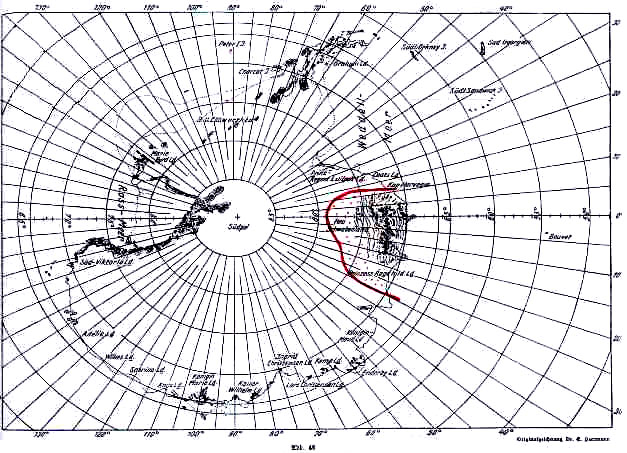
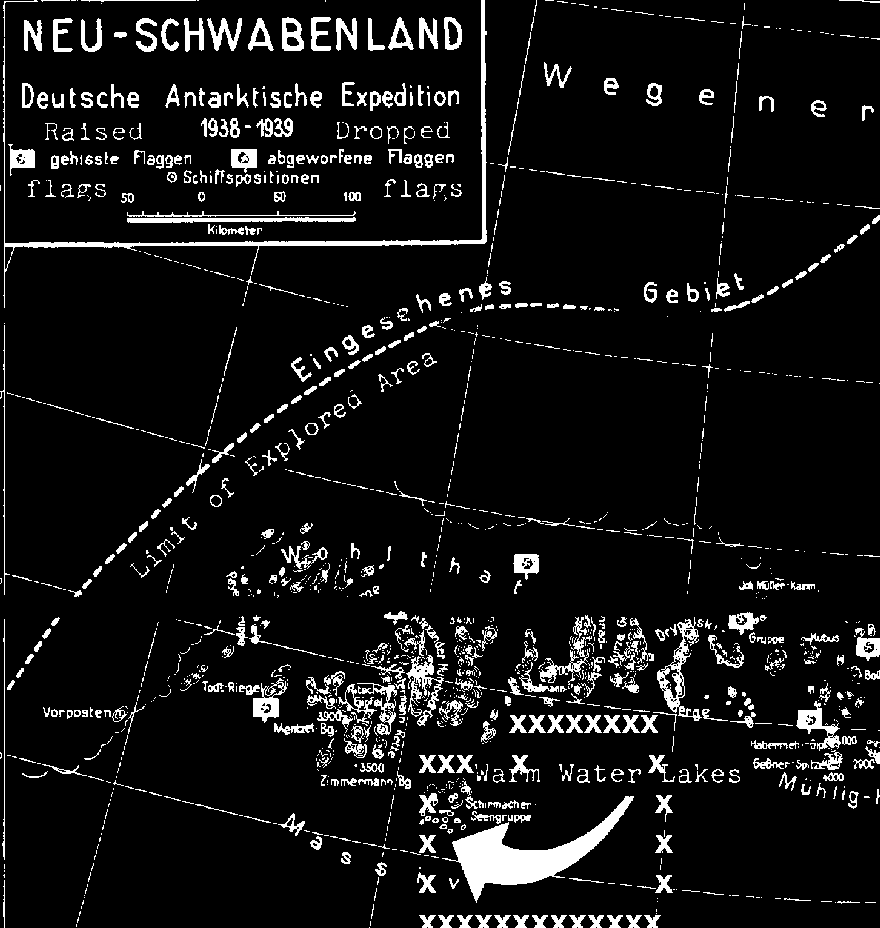
The map of Neu Schwabenland that cannot be exhibited in Germany, on penalty of imprisonment…
 |
 |
 |
 |
 |
 |
 |
A Secret U.S. Post Office operated in Antarctica 1946-1948 causing speculation about the real reason behind two concurrent U.S. expeditions…
Finn Ronne was a Norwegian immigrant who later joined the United States Navy and was a member and officer in Admiral Byrd’s earlier expeditions to Antarctica. In 1946-8, he led a privately-financed expedition to Antarctica, following upon the heels of Operation Highjump.
Writing in his book entitled “Antarctic Conquest”, he stated:
Although no one knew it, I had been operating a United States Post office too, but for reasons of state (emphasis added) had been compelled to keep it secret.
The web is abundant with sites setting forth information about suspected and actual German involvement in Antarctica possibly dating back even to the late 1800’s. It does make one wonder if there were in fact, covert or as they say today, “black-ops” reasons for one or more of the Byrd Expeditions (including Operation Highjump for this discussion) as well as the private expedition of Captain Ronne.
Many online sources are available with information concerning what I have dubbed the “Byrd Conspiracy”, which was not a conspiracy by Admiral Byrd, rather what may have been an apparent conspiracy by the government to keep particular information that he had uncovered during Operation Highjump as a secret. I am not passing judgment at this time, as I am still investigating the whole thing to my satisfaction.
However, lending credence to this conspiracy theory is the observation that Admiral Byrd does in effect seem to “disappear” from public view shortly after his return from Operation Highjump in 1947– until approximately 1955 when he organized Operation Deep Freeze I, and he was reported to have been hospitalized (in a mental ward) shortly after his return in 1947.
NOTE: If Op HJ had continued to its full expected duration of six to eight months, they would have still been in Antarctica at the time of Roswell. The expedition headed back to the U.S. in early 1947, well short of its expected ending. Some would say “limped back”, after suffering great losses of personnel and equipment. The official record only sets forth a limited loss of life and aircraft, but conspiracists feel the record has been doctored or we are not being told the full story.
The polar regions and his expeditions were his very reason for existence; he had said from the time he was a child that he felt destined to be a polar explorer. He had a passion for all things polar, especially exploration, that could scarcely be contained.
The little tidbit mentioned above that Ronne forked us in his book, only begins to tell us why the Oleana Base, Antarctica postmark is one of the rarest polar cancels that exist. With this being the first American post office established on the Antarctic continent, it is a shame that the cancel was not used more often. Is there perhaps a larger reason why this post office was kept secret? We do know that many countries, including Britain, had concurrent secret bases and or expeditions in the same general time period, notably Port Lockroy on the Antarctic peninsula.
Operation Tabarin was the beginning of Britain’s permanent presence on the Antarctic continent, and was built to serve as a southern outpost and to keep an eye on suspected Nazi presence on the ice. In a 2001 BBC interview, one of the last remaining survivors of that secret expedition, Gwion Davies, noted that the posting of mail from their secret base was a way of their laying claim to, or establishing that section of Antarctica as British sovereign territory.
While the United States did not then, and does not now, recognize any country as having specific territorial claims upon Antarctica, for Ronne to have allowed his expedition members to have open mailing of letters from Oleana Base would have served a similar purpose as with Port Lockroy, but for some reason, he would not allow that to be done.
The “Holy Grail” of Antarctic Covers
The Oleana Bay covers are most commonly seen with a date of March 12, 1947, which was the date the expedition arrived at Marguerite Bay, Antarctica.In this instance, the cover illustrated above is extraordinary in that it is on a printed envelope from the Byrd II Antarctic Expedition, postmarked with the less common hand cancellation from that mission; then repost marked at Oleana Base in 1947, with the addition of Captain Ronne’s “corner card” and the IGY Ellsworth Station octagonal cachet, and the best part of all, Ronne’s signature in which he adds the word “Postmaster”, rounding it out to make a splendid cover!A cover like this would fare extremely well in a polar auction. I would go so far to term it as the “Holy Grail” of a polar collection; only very few covers I can think of would be more collectable, in my opinion.

Stillness in the Storm Editor’s note: Did you find a spelling error or grammar mistake? Do you think this article needs a correction or update? Or do you just have some feedback? Send us an email at [email protected]. Thank you for reading.
Source:
http://www.bibliotecapleyades.net/antarctica/antartica11.htm
Leave a Reply