| Image Source. |

(Stillness in the Storm Editor) In the evolutionary process of discovering abstract truth, drama or stories are needed. Morality, justice, fairness, goodness, fellowship, loving service, compassion, and more are all abstract things that have no wholly physical expression. As a result, minds young in experience cannot comprehend them without exemplification. Archetypal deities, like the Egyptian pantheon, played a role in helping the individual understand the non-material realms of morality and virtue. Today, we tend to think the ancients took these stories literally, and perhaps they did. But we also know that within the myths, legends, and epoch tales of antiquity rests a treasure trove of knowledge that people today are increasingly taking an interest in—knowledge that if properly understood, would solve almost all the problems we face as a people.
For many, the idea of studying ancient cultures seems boring and pointless—what could these things have to do with my life now?
But there are quintessential or archetypal truths that all people, all throughout history had to face. One of these truths is the reality of morality, justice, and personality evolution—the epic struggle of create a free and just society.
The concept of an archetype is very useful.
If one were to boil down a common experience shared by everyone and render it into a form, then this would be an archetype. For example, the common shape that all human beings share is that of a man or woman with two arms, legs, a head and so on. Thus, the image of a human being is an archetype—an abstract symbol that grounds or acts as a focal point for thought.
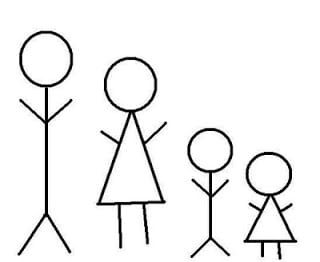 |
| Image Source. Archetypal image of a family, all people can identify with. |

What makes archetypes so powerful is that all people can recognize them at some level.
As a result of making contact with an archetype—whether an image or idea—a person’s consciousness is catalyzed or activated, producing meanings and insights. This helps organize everyday experience into a coherent understanding or model—a method of living one’s life so as to be productive, prosperous, and fulfilled. Another term for this non-physical fruit born out of archetypes is philosophy—the way we view and make sense of the world.
Related Vlog: On Evolution and Philosophy, Spirituality vs Nihilism — Justin Deschamps
Although in the world today, especially in the West, most people dismiss the idea of personality evolution (spirituality)—almost everyone secretly fantasizes about it.
One of the reasons why Hollywood and movies, TV shows, comic books, and the like are such a sensation is that they are often replete or filled with archetypal stories and images. These dramas allow us to explore ideas we normally won’t, like the evolution of the soul, but also morality and the struggles of human life.
Related Awakening Your Force | Science Fiction and Psychology – Star Wars, Ancient Tibet, and Jedi Training
The following articles discuss an Egyptian archetype of truth, justice, and morality: Ma’at. She is the wife of Thoth, the male Archetype of wisdom and knowledge.
What is empowering and useful about these stories and systems of thought—provided one has properly contextualized the information—is that they can be analyzed for their ideational or conceptual content and learn much about oneself and the world in the process. Again, for most of us, it is difficult to contemplate abstract concepts like morality, justice, and fairness. But it is far easier to sift through these ideas when given a form in a story or narrative. This is one reason why we tend to enjoy drama’s in films.
The story and concepts presented below should hopefully make you aware of the fact that there is a richness of information hidden in between the lines of ancient works.
If one looks through the lens of time properly, they will see that the struggle for life, liberty, and justice is ever present, across all walks of life. And that the individual and their consciousness is what holds back the waters of destruction and chaos. Each individual, in this sense, is an agent of divine intervention, a singular point of order that restores balance and in the process imparts wisdom.
We each have this opportunity, but before we can be the world healers that are so desperately needed, we must continue our cosmic training to become self-mastered wise beings, the personification of the high ideals of the universe expressed so beautifully in symbolic works of old.
(Bryan Hilliard) Maat, also known as Ma’at or Mayet, was a female goddess in the ancient Egyptian religion who represented truth, justice, balance and morality. The daughter of the Egyptian sun deity Ra and wife of the moon god Thoth, she served a kind of spirit of justice to the Egyptians. She decided whether a person would successfully reach the afterlife, by weighing their soul against her feather of truth, and was the personification of the cosmic order and a representation of the stability of the universe. The earliest writings where she is mentioned date back to the Old Kingdom of Egypt more than 2,300 years ago.
Related The Real ISIS has something to say – A Message to those Seeking the Truth
Source – The Event Chronicle
by Bryan Hilliard, April 3rd, 2017
The Egyptian culture was centered on order, everything had its due place in the world. This included religion, society and seasonal changes. The goddesses Ma’at came to represent the concept of balance and order because many Egyptians needed to explain the world around them. She was the one that kept the stars in motion, the seasons changing and the maintaining of the order of Heaven and Earth. The opposing force of this was known in ancient terms as “isfet” or chaos. Ancient Egyptians considered the desert beyond the Nile River to be chaotic; whereas, the area close to the Nile was considered orderly. Together, these two forces brought balance to the world in which they lived and was an important part of everyday Egyptian life.
Related The Emerald Tablets of Thoth the Atlantean – Full Text Pdf
Ma’at is usually depicted in the form of a woman seated or standing with outstretched wings attached to both her arms. In other instances she is seen holding a scepter in one hand and an ankh (the symbol of life) in the other. Her statue was a stone platform depicting a stable foundation on which order was built. A common symbol associated with her is an ostrich feather, which she is almost always shown as wearing in her hair. Often, the Feather of Ma’at was a distinctive feature of her headdress. Less frequently images of the goddess showed her without a head, instead replaced by the feather. In other images the feather alone conveyed her presence. This feather has come to symbolize her being, as well as the representation of balance and order, it became a hieroglyph for “truth.”
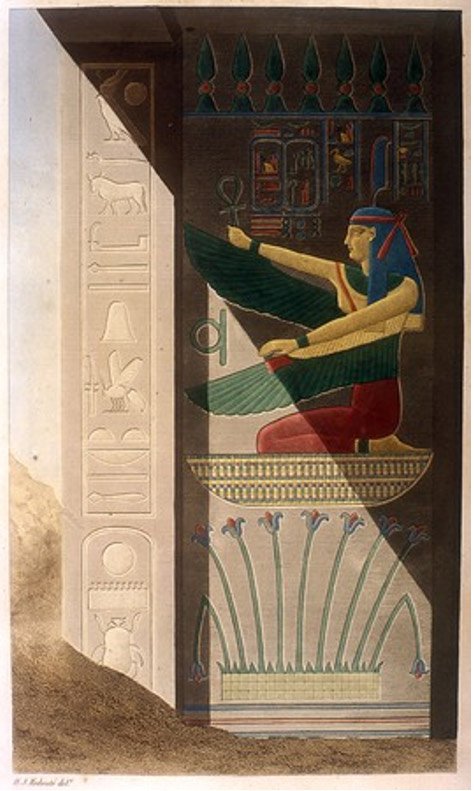 |
| Names of Ramses III; winged Ma’at kneeling over lilies of Upper Egypt. Scene from tomb of Ramses III. By Artist Tresea Dutertre, 1842. (Wikimedia Commons) |
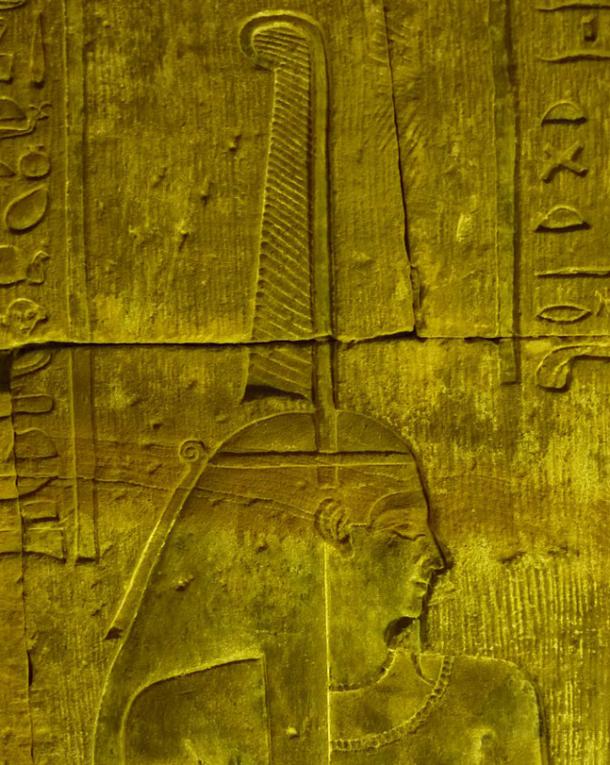 |
| Wall relief of Maat in the eastern upstairs part of the temple of Edfu, Egypt. The ostrich feather can be seen on top of her head. (Wikimedia Commons) |
Ma’at was associated with the law in ancient Egypt. From the 5th dynasty (c. 2510-2370 BC) onwards, the Vizier responsible for justice was called the Priest of Maat and in later periods judges wore images of her. The ‘Spirit of Maat’ was embodied by the chief judge in charge of the Egyptian law courts. He had a dual role, serving as both a priest and working directly in the law courts and justice system. The “Priest of Ma’at” began court hearings whilst wearing the feather of Ma’at and all other court officials wore small golden images of the goddess as a sign of their judicial authority, also as a symbol that their judgement would be balanced and fair. Priests drew the Feather of Ma’at on their tongues with green dye, so that the words they spoke were truth. The priest would rule on the earthly punishment according to the nature of the law that had been broken. Punishments included imposing fines, corporal punishment and in extreme cases capital punishment. It was considered a crime against Ma’at if a person engaged in jealousy, dishonesty, gluttony, laziness, injustice, and ungratefulness. The guilty Egyptian was deemed to have violated the Spirit of Ma’at and would face a further judgment in the Underworld during the ceremony of justification in the Hall of the Two Truths. The ‘Spirit of Ma’at’ detailed in the wisdom literature contained practical guidance with examples and some rules applied in previous law cases. These kinds of instructional texts have been described as “Ma’at Literature”.
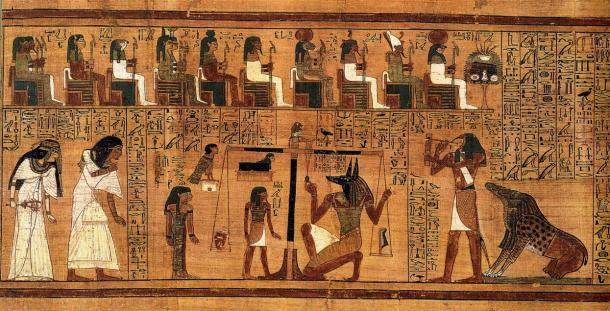 |
| Excerpt from the ‘Book of the Dead’, written on papyrus and showing the “Weighing of the Heart” using the feather of Maat as the measure for the counter-balance. Created by an unknown artist C.1300 BC (en.wikipedia.org) |
The Book of the Dead is a collection of funerary texts and spells from ancient Egypt designed to assist a person’s journey through the underworld, into the afterlife. Without these spells, it was believed a person could not proceed. In the book is a spell called the “Forty-Two Declarations of Purity” or the “Negative Confessions”. This spell is comprised of confessions the tomb owner believed he committed throughout his life. It was believed that any crimes committed against Ma’at should be written down as they could easily be forgiven. In the Hall of Ma’at is where the judgement of the dead was performed in which Ma’at played an important role. The ceremony, called the “Judgment of Osiris,” was named after Osiris, the god of the dead. When the dead were judged, it was the feather of Ma’at that their hearts were weighed against. If a balanced scale was struck, the deceased was deemed worthy to meet Osiris in Paradise. The weightlessness of their hearts indicated that their souls were not burdened with sin and evil. If the heart of the deceased was found to be heavier than the feather of Ma’at, it would be devoured by Ammit, the soul-eating monster depicted with the head of a crocodile, the forequarters of a lion and the hindquarters of a hippopotamus. Other gods in the judgement hall who were part of the tribunal overseeing the weighing of the heart were also pictured holding a feather but the scales always represented Ma ́at.
Ancient Egyptians worshipped many gods, one was certainly Ma’at, although Egyptian archaeologists now believe she was perhaps more of a concept or an ideal. It’s reasonable to assume her principles aided the people of Egypt in being better individuals and that she could be compared to the conscience of a person. There was a small temple dedicated to Ma’at by Hatshepsut, the fifth pharaoh of the Eighteenth dynasty of Egypt, Egypt’s first female pharaoh, at the Karnak temple complex in Luxor Egypt. Largely in ruins, it still preserves inscriptions of some of the viziers of Ramesses III and XI. A previous Ma’at temple existed in this area, indicated by reliefs and stelae belonging to the reign of Amenhotep III. The temple is inside the Precinct of Montu, the smallest of three enclosures at Ipet-Isut.
[Second article about Ma’at after reference list.]
References
“Ancient Egyptian Gods | Ma’at.” Ancient Egyptian Gods | Ma’at. http://www.kingtutone.com/gods/maat/
“Ma’at, Goddess of Egypt.” Egyptian Goddess Maat ***. http://www.landofpyramids.org/maat.htm
Seawright, Caroline. “Ma’at, Goddess of Truth, Balance, Order.” Ma’at, Ancient Egyptian Goddess of Truth and Order.
“Ancient Egypt: The Mythology – Feather.” Ancient Egypt: The Mythology – Feather. http://www.egyptianmyths.net/feather.htm
“Ancient Egypt: The Mythology – Ma’at.” Ancient Egypt: The Mythology – Ma’at. http://www.egyptianmyths.net/maat.htm
Featured Image: This artwork, realized in 1998 by the Veronese painter Davide Tonato, is an interpretation of the traditional attributes of Maat, Egyptian Goddess of the justice. (Wikimedia Commons)

by Thierry Benderitter, 2015
Justice and truth, order and equity: maat is the foundation of Egyptian civilization. It is present in the religious, cosmic, political, social and personal spheres, so that, as Jan Assmann has stated, “Speaking of maat is to make an oversight of Egyptian civilization as a whole.” It is convenient to first distinguish two aspects to the concept of maat: earthly maat (with a small m) and the goddess Maat (with a capital M) – an orthographic distinction often overlooked in practice.
The origin of the word is still debated; it refers to the verb “maâ”, “to direct”, which belongs to nautical vocabulary that is related in the texts with the breath or the north wind, with a vital connotation (vital breath) and properly maintained course (righteousness).
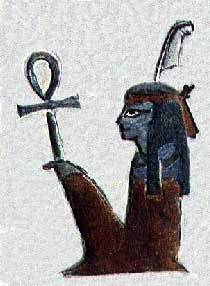
Maat is at the heart of understanding Egyptian civilisation in its entirety, and is the foundation of its longevity. It is bound to and confused with ethics (including justice and truth), with universal order (cosmic order, social order and political order) and with social integration based on communication and confidence.
The foundation of Egyptian cultural identity, maat is the great creation of the thinkers of the Old Kingdom. It is she who ultimately offers an ideological setting to the Pharaonic State, both at the level of justification of its existence and in that of the rules which define good government.
But we would not know what this principle covers if a break had not occurred. This break, which is the decomposition, at the end of the Old Kingdom, of the centralised unity of the country embodied by the king. Then the emergence of multiple local power which shared the territory during a couples of centuries (the First Intermediate Period).
The disorder and social anarchy which resulted from it profoundly marked the Egyptian imagination. Through necessity it was clear to formulate and to explain what was obvious in the previous period.
These thoughts are found in literary genre, whose first steps date back to the 3rd Dynasty, and which concern the conduct of individuals: the sapient literature, with its teachings.
It also expresses itself through a new literature type, appropriate for the difficult crossing period: the laments or pessimistic literature. This last more concerns society than that of actual individuals. It is the same for a third kind which are king’s writings to his son’s and which express, for the first time, concrete suggestions on the government of men.
MAAT, BASIS OF SOCIAL CEMENT
The Middle Kingdom will be seen to reconstitute the political and social unity of the Double Country, reunified around the central concept of maat. It is the “Tale of the Oasian” (or The Eloquent Peasant) which best summarises the maat at this time.
In the nine supplications, which he addresses to his judge, a peasant who has been flown, provides the three fundamental attitudes of a behaviour compliant to the maat: There is no yesterday for the lazy person, no friend for the one who is deaf to maat, no festival day for the greedy.
(1) Laziness – To make maat.
Laziness, is the absence of action, inertia. For the Egyptian, all action must induce a reaction in a intermeshed joining of past actions (yesterday) to present actions. It is necessary to act for the one who acts and that, for a very clear reason: in order to advise him to remain active.
In a society where the subsistence of the individual is made day to day, in a complex relational maze, the slightest disorder can compromise the survival of the people or the functionality of the administrative machine. Not to forget the good which has been made, it is the basis of confidence. It is a solidarity of survival, based on interdependence, embodied by maat.
(2) Deafness in maat – To tell the maat.
The greatest wisdom according to Ancient Egypt, is to know how to listen in the silence, to meditate the received word and to consequently act. It is not surprising when one knows the importance of language, of the uttered words which are a living substance, a true food. Social life is only possible by the exchange of harmonious speech, which only permits the integration of one and the other in dynamics based on the confidence of actions which will be achieved.
The deaf who do not listen to the other, are the insensible, the indifferent. Therefore, he has no friend and is not integrated into society. When one doesn’t communicate anymore, at the level of the individual or society, it is violence and the law of the strongest which is installed. It is well illustrated in the “dialogue of the desperate man and his soul”, another classic text of the Middle Kingdom.
(3) Greed
It is a property of the heart for the Egyptian on which there is no ascendancy; it is, say the sages, an incurable illness.
It is doubly negative:
– for the individual: indeed, during his life, man accumulates a subtle “energy” notably at the time of the festivals, which seem to be in relation to the joy of living. He nourishes his Ka, his intangible double. The one who cannot be happy carries harm to his own ka.
– for society: selfishness, the desire of possessions and jealousy, entail the destruction of social relations. The one who despoils those who worked for him, removes from them their means of subsistence, puts them in peril and this fact, is an inducer of violence.
In addition, while trying to remove his dependence on the other, to individualise himself, the man breaks the dynamic system of interaction of society and there again will generate violence. maat is honesty, charity, the absence of jealousy, the exactly remunerated work.
MAAT AND THE TOMB
The goal of the Egyptian of high society is to become a tomb owner, an imakhu (what is, in itself, the tangible expression of his social statute of “well provided”). It requires that several conditions are met:
– A remunerative function (“a well paid job”) and royal authorisation.
– An expensive post-mortem cult supposing either a filiation, or of specialised priests, in any case of important income.
– A good record in the society. Three pawls of security are thus put in place to morally constrain the man to behave well :
– The functions of experience have been correctly filled in order to have enjoyed royal favour.
– A will must have been written and goods of the deceased passed to his heir; it is not automatic. It is necessary that the will is approved (sealed) by the vizier himself who can disinherit if goods were ill-gotten.
– The good record left with the group, so that the chapel is maintained and is not damaged, and the formulas of life uttered.
It is necessary to have been well beloved by his living (it is not about liking each other !). This arduous task supposes that one followed the way of solidarity recommended by maat.
The biographies in the tombs well specify that one gave to the one who had need (bread, clothes, boats …) that one didn’t commit the sin of language (scandal-mongering, slander …) and that one rendered good justice.
It is about an impersonal portrait which translates the conformity to the general rule, maat, and which is distinct from the “professional” career.
EVOLUTION OF CONCEPTS
These concepts evolved during the various periods of history.
(1) In The Old Kingdom.
Maat is merged with the will of the king who assumes the service of men. It is not the career, since it is spontaneous and bound to ambition. Career in the service of the sovereign and maat are therefore distinctly separated, but form an indispensable complement.
(2) In the First Intermediate Period
After the fall of the monarchy of the Old Kingdom, there is no longer a career in the king’s service. A virtuous life compliant to maat can alone lead to immortality.
However, the very word of maat, which remains identified by the Egyptians with the king, with the State, disappears from the inscriptions.
Man’s virtue is now the real monument: a good character is a monument; it is a monument to being good; man’s monument is his virtue.
Greater need for a tomb or royal career. Could it be that the economic difficulties also played a part in this new vision, because very few people could have access at an authentic monument during this period.
(3) In the Middle Kingdom.
Thanks to literature known as “propaganda” (an unsuitable term, but close enough), the monarchy reintroduces the traditional notion of maat – service to the king, as a necessity of survival.
It is added to the necessities of virtue and the tomb. The tomb and maat become inseparable.
(4) Thereafter, and especially during the New Kingdom.
After the fall of the Middle Kingdom and the invasion of the Hyksos, the Second Intermediate Period showed that it was not possible to be assured of a stable terrestrial world where maat could reign without sharing. This has a major consequence concerning the beyond: it can no longer be a simple continuation of terrestrial life. The deceased cannot be content anymore with surviving. He must pass in another state, the one of an immortal living God into the kingdom of Osiris.
For this, the dead acquires his new state, rituals of passage are necessary: these will be the “Judgement of the Dead” (among others, for the funeral, the Opening of the Mouth, … are also rituals of passage).
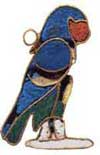
The Judgement of the Dead constitutes an important initial ritual because it is a divine court which allows the passage to the immortal part of the man, represented by his Ba (unsuitable, but for lack of better, translated as soul). Moving between the worlds, the Ba is represented as a bird with a human head.
The teachings of Merikare gives us several basic pieces of information on the court: “the court is not indulgent, yet it is for eternity, that which is there and the one who arrives there without offence to his credit, will be there as a god”.
This new image translates as one in which the man becomes responsible for his own actions through what is dictated for him by his heart.
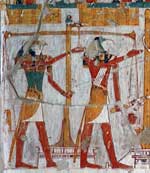
In the traditional funerary text, going back as far as the Old Kingdom, magic plays a dominant role, one proceeded to the shaping of actions having to do with maat. One thus systematically codified them, giving the famous Chapter 125 of the Book of the Dead, the one which contains the famous “Declaration of Innocence”.
This “Declaration of Innocence” summarises in the form of a list of negatives, all actions considered as non compliant with maat, being a matter for Isfet (“Chaos”), the opposite of maat.
It is about, among other things, not to have killed, stolen, mistreated, blasphemed, transgressed the taboos, etc. So the deceased can “be separated from his sins”, to purify himself.
If his heart is in equilibrium on the balance with the feather of maat, he then becomes capable to be introduced into the world of the gods; he becomes a “maa-kheru”, which means “Just of voice”, but also one Provided, someone for whom on Earth someone still acts.
Notice that the heart must not be lighter than the feather, otherwise it would signify that there was an absence of action during the terrestrial life, a “transgression” as serious as the accumulation of bad actions.
Why was the ostrich feather (hieroglyph Gardiner H6  ) chosen as a symbol of the goddess maat? Because it’s the only bird feather that is of equal width on both sides of its central axis (Larousse.fr), suggesting equity; and the slightest movement or breath of wind will animate it. This last feature is equally made it in fact an attribute of the god Shu, which represents the space between heaven and earth, the atmosphere (the name of a feather in Egyptian, “shut”, also suggests this comparison).
Notice also that Osiris and the divine court are only ratifying the judgement which society related to the deceased by letting him provide himself with a tomb, a Book of the Dead and the whole additional material things. As maat integrated the man into human society, it integrated him into divine society; he becomes a member of the community of the gods and has access to bread – beer of the table of Osiris.
maat thus becomes an essential condition, not only to ba a success in terrestrial life, or to leave a trace in the collective memory, but equally to pass the examination of the balance of the last judgement.
The great idea which arises, and is really new, is that it will be necessary to justify his actions in the beyond.
It is this moral foundation which will be resumed by the Judeo-Christian tradition, even though it won’t hear it in precisely the same way.
MAAT THE GODDESS
Present since the texts of the pyramids, Maat becomes to the 18th Dynasty the daughter of Atum-Re, merged with Tefnut, the formidable solar lioness.
Maat thus represents, in one of her aspects, a dangerous goddess. Maat-Tefnut and her brother Shu are principles who precede at one time and then appear at the same time as the creator god Atum-Re. In a passage from the Sarcophagus Texts, the god says : “the one who lives, Tefnut is my daughter, who will exist with her brother Shu. He is called Life. She is called Maat”. Maat organises the world while justifying her emergence.
Maat represents the permanent success of the cosmos who expresses its renewed presence every day at the prow of the solar barque. This perpetuity supposes a continuous effort, requiring a collaboration of the gods and men through the intermediary of the king. The union of Re and Maat, of which the uraeus notable testifies, explain the continual embrace of the sun, while presenting maat as food, drink and ointment of the supreme god. In short everything which is beneficial to him and permits him to live, is Maat.
So Maat, daughter of Atum-Re returns to her father that which he gave her. It forms the foundation of the Egyptian offering: one returns to the god that which he gave.
One “brings into being” Maat by the divine recitation of prayers in an unceasing effort where one listens to one another, where one acts one for the other. Thus social life and cosmic life inter-twine: they are the reflection one of the other.
If civil society no longer functions according to the norm, it is the whole universe which is threatened. So Apophis, who is always the personification of menacing chaos, is not annihilated in the beyond, it is civil society which will be disorganised (war, rebellion …) and monarchy destabilised.
MAAT AND THE PHARAONIC STATE
The structure of the divine world as the one of the human world is pyramidal.
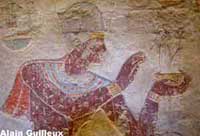
As the creator sun organiser of the sky must answer to Pharaoh, organiser of the land. The king is installed to achieve (se-kheper), to establish (se-mn) maat and to annihilate Isfet (“chaos”). He thus assures the conditions, so that the simple mortal can, at his level, speak of and accomplish maat, which is indispensable for the terrestrial life.
However to establish maat is not a natural phenomenon, because the spontaneous tendency of things is deterioration, entropy, isfet. This is manifest in the disorder, violence, the law of the strongest, the absence of indispensable organisation to render a viable and prosperous country of Egypt.
It is the role of the Pharaoh and the State to fight by all means against this spontaneous tendency to become disorganised.
This Egyptian State, thus presented, which may seem to us stifling, has therefore the aim of making the life of men and gods possible.
This is why the main offering which the king makes to the gods and which is represented so often, concerns the offering for maat. In a very traditional concept of reciprocation, he returns nourishment to the divinity who in his turn justifies his function by it.
During the time of Amarna, the significance which Akhenaton gave to maat changed. I approached this aspect some time ago in my article on Akhenaten and his time, I return you there.
THE TYRANNY OF MAAT?
Maat contributed much to constructing a human world and appears to us as a very high ideal, of which the emergence at such a remote period is extraordinary.
But maat doesn’t only have a positive side, at least from our modern point of view in the west. Indeed one could call the tyranny of maat the globalising and anti-individual tendency which transports this idea.
Maat, it is the absolute conservator, the negation of all social evolution; it is the obedient man who remains to his place. The individual doesn’t appear as such. He was only one link of a global social fabric where he was asked to fuse himself. Any attempt at modification of the state of the things is not only dangerous for society but for the cosmos itself. maat, as a concept corresponds therefore perfectly to Egyptian social reality, composed of subjects (and not of citizens) dominated by an omnipresent State.
MAAT AND PERSONAL PIETY
As of the end of the New Kingdom, a period of trouble restarts in Egypt.
The texts show that it is a period of instability and great anguish, which damages the idea of the traditional maat.
The individual destiny of the man in front of his god is then gradually supplanted by the destiny of the man integrated into an ideal society.
During later times, the appearance of the notion of a personal god and especially of personal piety is going to sound the knell for maat, because the two notions are incompatible.
Indeed, man no longer dependent of his relations with others, but on the will of the god. It is this last and not the king, who establishes maat which now appears like a divine gift. Man now places God in his heart, say the texts. He is responsible in front of him, but more before the community. Thus the individual appears to be alone face to face with god, a radical negation of the traditional maat who fought the tendency of individualism.
Finally, it is religion in the Judeo-Christian sense of the term, the irruption of transcendence, which results in the disappearance of maat.
This departure can appear as regrettable, and it will have a major consequence: henceforth, to maintain social cohesion, another invention will be necessary but that will not be Egyptian : brotherhood.
Bibliography
Many numerous works make reference to maat. Here are some of the recent and easily accessible. You will find a more detailed list in their own bibliographic pages.
– ASSMANN Jan : “Maât, l’Égypte et l’idée de justice sociale”, Julliard, 1989
– ASSMANN Jan : “The search for God in Ancient Egypt”, Cornell University press, 2001
– ASSMANN Jan : “Mort et au-delà dans l’Égypte Ancienne”, Le Rocher, 2003
– GOYON Jean-Claude : “Rê, Maât et Pharaon, ou le destin de l’Égypte antique”, A.C.V., 1998
– GOYON Jean-Claude : “Rituels funéraires de l’ancienne Égypte”, Cerf, 2004
– MEEKS Dimitri, FAVARD-MEEKS Christine : “La vie quotidienne des dieux égyptiens”, Hachette, 1993
– MENU Bernadette : “Maât, l’ordre juste du monde”, Michalon, 2005
– REDFORD B (& al) : “The Oxford Encyclopedia of Ancient Egypt”, AUPC, 2001
– RENAUD Odette : “Le dialogue du désespéré avec son âme”, Cahiers de la société d’Egyptologie, vol , Genève, 1991
– WALLIS BUDGE E.A. : “The Gods of the Egyptians”, Dover publications, 1969 (2 vol)
– WILKINSON Richard : “Reading Egyptian art”, Thames & Hudson, 1992
– WILKINSON Richard : “The complete Gods and Godesses of Ancient Egypt”, Thames & Hudson, 2003
_________________________
Stillness in the Storm Editor’s note: Did you find a spelling error or grammar mistake? Do you think this article needs a correction or update? Or do you just have some feedback? Send us an email at [email protected] with the error, headline and url. Thank you for reading.
Leave a Reply