
See these other articles regarding economic developments:
End of the Dollar as Global Reserve Currency? | China Has Announced Plans For A ‘World Currency
World Bank & IMF Announce Transition to Asset-Backed Currencies; Via Karen Hudes
Euro spirals toward 1:1 parity with USD
Derivatives Bubble to Implode U.S. Dollar?
Source – The Economic Collapse Blog
By Michael Snyder, on March 11th, 2015
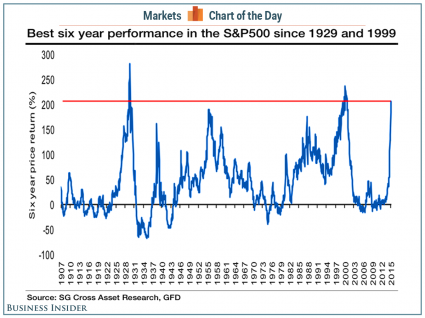
Just a few days ago, the bull market for the S&P 500 turned six years old. This six year period of time has been great for investors, but what comes next? On March 9th, 2009 the S&P 500 hit a low of 676.53. Since that day, it has risen more than 200 percent. As you will see below, there are only two other times within the last 100 years when the S&P 500 performed this well over a six year time frame. In both instances, the end result was utter disaster. And as you take in this information, I want you to keep in mind what I said in my previous article entitled “7 Signs That A Stock Market Peak Is Happening Right Now“. What we are witnessing at this moment is classic “peaking behavior”, and there is a long way to go down from here. So if historical patterns hold up, those with lots of money in the stock market could soon be in for a whole lot of trouble.
“Such a strong six year run up in US equities has only been seen twice since 1900, i.e., back in 1929 and 1999, neither of which ended well,” Lapthorne wrote.
On Aug. 12, the S&P 500 dipped to 102.42, setting the stage for the third-biggest bull market in stocks since 1929. Inflation and unemployment fell. In 1984, President Reagan would cruise to reelection with an ad telling voters “It’s morning again in America.” By 1987, the stock market had tripled. Shareholders who were able to see beyond the gloom of the early 1980s reaped a huge return.
Mr Odey is best known for his big macroeconomic calls, including foreseeing the 2008 global credit crisis; piling into insurers in the wake of September 2001 attacks; and picking the recent oil price rout. He famously paid himself £28 million in 2008 after shorting credit crisis casualties, including British lender Bradford & Bingley. Mr Odey’s fund returned 54.8 per cent that year.“The market’s reaction to all of this is leave it to the professionals, leave it to those great guys, the central bankers, because they saved the day in 2009,” he said. “These guys are kind of relying on central banks pulling a rabbit out of a hat.”The risk is that this time, monetary policy may be ineffective: “We need the crisis to reformulate policy. Central banks are not all singing and all dancing, they cannot basically avoid the natural consequences of what we are doing.”An inadequate supply-side response to the plunge in commodity prices as the resources industry declines to reduce production was in effect stimulating supply into falling demand.“The trouble is today the players, whether they are the miners or the oil companies or the Saudis or anybody else, they are not doing the right things. This is the first time in my career where economics 101 doesn’t work at all.”But it was also true that the world has not had a major recession for 25 years and thanks to frequent interventions, “there is a sensation we don’t have a business cycle”. Stocks are enjoying a six-year bull market but he also hinted at liquidity issues bubbling under the surface.“I just think that you and I have got grandstand seats here [to an imminent market shock] and my point is having found myself in the second quarter of last year selling a lot of equities and starting to go short, I found out just how illiquid it all was. You never actually see it until people try and get out of these things.”It was unclear to Mr Odey what central banks could do to prevent a crash.
_________
Leave a Reply