

The occurrence of an Eclipse and an Equinox is a very rare event.
Given the importance the powers that should not be place on astrological events one wonders what this year will have in store; re Occult Meanings of Winter Solstice and Christmas | AstroTheology. Already there is a great deal occurring within the financial arena. The Euro has lost a considerable amount of value, and many nations are flocking to join the BRICS and the China Bank.
As the eclipse plunges the UK and other places into darkness this Friday, two other rare if less spectacular celestial events will be taking place, too: a Supermoon and the Spring equinox.

A Supermoon, or perigee moon, happens when the full or new moon does its closest fly-by of the Earth, making it look bigger than it normally does. And the spring equinox refers to the time of the year when the day and night are of equal duration, mid-way between the longest and shortest days.
READ MORE: WHEN TO LOOK OUT FOR THE ECLIPSE ON FRIDAY
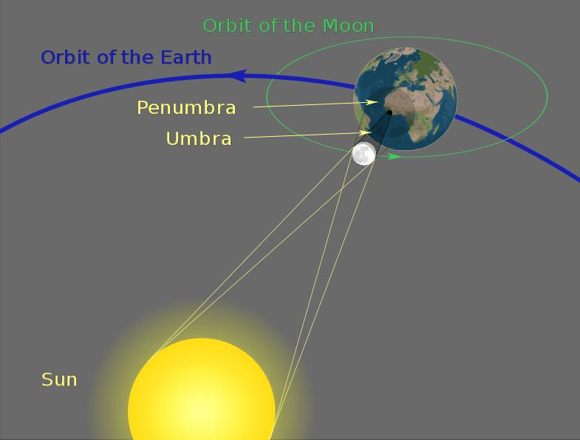
The solar eclipse refers to a phenomenon where the sun and moon line up, so that the latter obscures the former. And while it won’t be affected by the two other events, it is rare that the three events happen even individually.
Supermoon
Most of the time, there are between three and six Supermoons a year. There is set to be six in 2015, two of which have already happened. The next will take place on March 20, the day of the eclipse, and the others will come in August, September and October.

In pictures: The biggest supermoon of 2014
Eclipses can only happen at new moon, when the moon appears is entirely in shadow. And the spectacular Supermoon images that are often spotted can only happen when the moon is full, since it can only be seen then.
As a result, only the last three Supermoons of this year will be visible — because the moon is new rather than full on March 20, it won’t be seen. But it will be gliding past us closer than ever, and its shadow will be visible as it blocks out the sun on Friday morning.
Spring equinox
The equinox will also happen on March 20. While it won’t have any discernable, direct impact on how the solar eclipse looks, it will contribute to a rare collision of three unusual celestial events.
On March 20, the Earth’s axis will be perpindecular to the sun’s rays — which only happens twice a year, at the two equinoxes. After that, it will start tipping over, making the days longer in the northern hemisphere.
As such, the equinox has long been celebrated as a time of beginning and renewal, by a number of historic cultures, and is linked to Easter and Passover.
The equinox will happen at the same time as a solar eclipse in 2053 and 2072, though it doesn’t always appear as close together as that.
Supermoon total eclipse of equinox sun on March 20
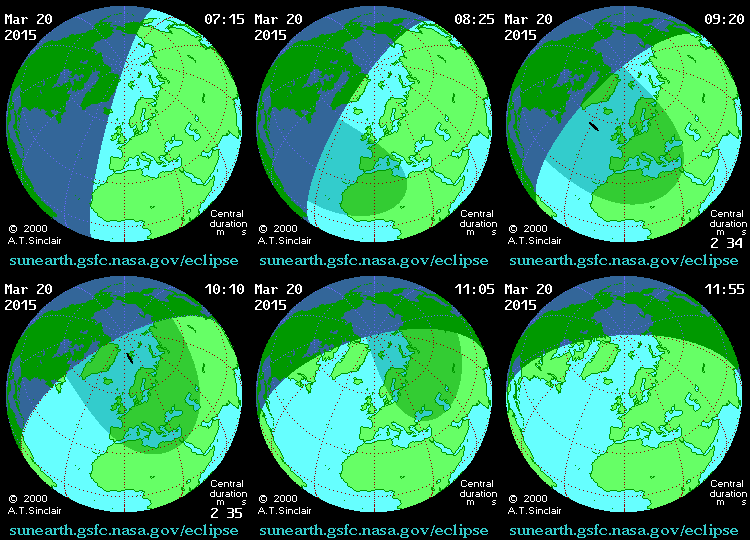
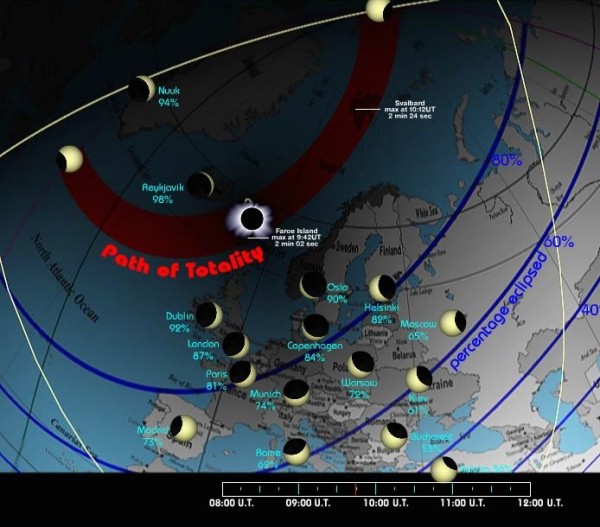


Partial solar eclipse begins: 8:39 a.m. Western European Time (WET)
Total solar eclipse begins: 9:41 a.m. WET
Maximum eclipse: 9:42 a.m. WET
Total solar eclipse ends: 9:43 a.m. WET
Partial solar eclipse ends: 10:48 a.m. WET
Partial solar eclipse begins: 10:12 a.m. Central European Time (CET)
Total solar eclipse begins: 11:11 a.m. CET
Maximum eclipse: 11:12 a.m. CET
Total solar eclipse ends: 11:13 a.m. CET
Partial solar eclipse ends: 12:12 a.m. CET

Solar eclipse begins: 8:38 a.m. Greenwich Mean Time (GMT)
Greatest eclipse: 9:37 a.m. GMT
Solar eclipse ends: 10:39 a.m. GMT
Maximum obscuration of solar disk: 98%
Solar eclipse begins: 8:25 a.m. Greenwich Mean Time (GMT)
Greatest eclipse: 9:31 a.m. GMT
Solar eclipse ends: 10:41 a.m. GMT
Maximum obscuration of solar disk: 84%
Solar eclipse begins: 9:06 a.m. Central European Time (CET)
Greatest eclipse: 10:11 a.m. CET
Solar eclipse ends: 11:20 a.m. CET
Maximum obscuration of solar disk: 53%
Solar eclipse begins: 10:53 a.m. Eastern European Time (EET)
Greatest eclipse: 11:57 a.m. EET
Solar eclipse ends: 1:02 p.m. EET
Maximum obscuration of solar disk: 32%
Solar eclipse begins: 12:13 p.m. Moscow Standard Time (MST)
Greatest eclipse: 1:20 p.m. MST
Solar eclipse ends: 2:27 p.m. MST
Maximum obscuration of solar disk: 58%
Sources:
http://www.independent.co.uk/news/science/solar-eclipse-supermoon-spring-equinox-friday-will-see-three-rare-celestial-events-10111592.html
http://earthsky.org/tonight/supermoon-to-stage-total-eclipse-of-the-sun-on-march-20
Leave a Reply