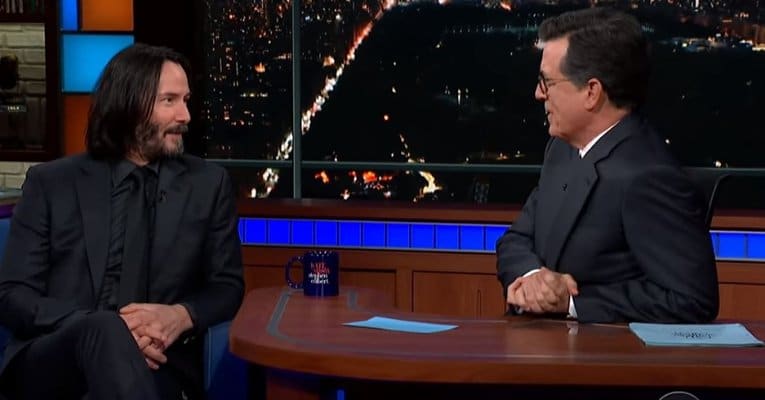
(Elias Marat) Keanu Reeves began his career in Hollywood portraying characters whom few would describe as “profound.”
Related An End of Life Caregiver Has a Message About Death that You Need to Hear Right Now
by Elias Marat, May 14th, 2019
Yet in the years since, Reeves has earned a reputation as a rather down-to-earth, deep and thoughtful person who defies the stereotypes that made him famous. And his latest appearance on Stephen Colbert’s The Late Show on Friday simply reinforces how and why Reeves found his way into our hearts like few, if any, other Hollywood celebrities have.
While making his rounds on late-night talk shows to promote the opening of John Wick: Chapter 3—Parabellum, Reeves dropped by the show to discuss his career and the filming of the blockbuster action film, as well as the plot of the upcoming new Bill & Ted sequel.
While chatting about the long-awaited sci-fi comedy, where the world faces its demise unless Bill S. Preston (Alex Winter) and “Ted” Logan can write one more Wyld Stallyns song, the conversation takes a sudden turn toward philosophy and the fleeting nature of mortality.
Buy Book Journey of Souls: Case Studies of Life Between Lives
The surprisingly reflective discussion takes place near the nine-minute mark:
“It’s the end of the universe” if they can’t write the song, Reeves said. “It’s the end of the time-space continuum.”
Colbert responded:
“So you’re facing your own mortality and the mortality of all existence. Wow.”
At that point, without warning, the deeply Catholic talk show host steers the conversation into very heavy territory, asking:
“What do you think happens when we die, Keanu Reeves?”
At this point, Reeves takes pause to consider the gravity of the question. In typically Keanu fashion, he then delivers a slam-dunk of an answer:
“I know that the ones who love us will miss us.”
For anyone who’s been faced with the death of a loved one, Reeves’ answer is sure to resonate. And so it does for Colbert, who—like Reeves—has had his life shaken by the loss of loved ones. Colbert sits there for a moment, pondering Reeves’ words, before breaking into a broad smile and extending his hand to his guest for a strong handshake.
Suffice it to say, audiences were won over by the exchange.
One online viewer commented:
“That last response was so BEAUTIFUL I had to go back and play it again, and then it made me cry. So beautiful!”
Another noted:
“I didn’t know I could like this man more than I already did.”
And one comment summed up what most of us likely think about Keanu:
“He may not be the best actor there is, but he’s a great dude who makes some great entertainment and, maybe above all, he’s sincere, humble, nice, and generous. There aren’t many in the business who come off as just all around great dudes as much as Keanu does.”
Whether it was his breakout role as an aloof teen headbanger in the 1986 drama River’s Edge, his iconic performance as the airheaded stoner Theodore “Ted” Logan in the Bill & Ted’s films, or his memorable role as a naïve accomplice in the crime thriller Point Break, most of us associate the actor with his iconic line “Whoa,” typically delivered in the gnarly accent of a Southern Californian surfer bro.
Yet Reeves has managed to carve out the reputation of a man who not only isn’t a goofball, but also doesn’t take himself too seriously. He simply hasn’t forgotten what it means to be a human—he hasn’t lost his heart.
Stillness in the Storm Editor: Why did we post this?
Consciousness is one of the most mysterious phenomena of all time. Scientists, philosophers, and mystics have been searching for the answer to the question, What is Consciousness? for most of human history. In modern times, the spiritual origins of consciousness are being replaced with a materialistic view, that awareness emerges as an additive property of electrical impulses in living things. Despite the fact this theory is assumed to be true, any self-respecting psychologist will tell you we have no idea what consciousness really is. The preceding article discusses consciousness, some of its properties, and possible origins. This is helpful to contemplate because, in the act of trying to understand the mysteries of consciousness, you develop critical thinking skills and stimulate your philosophic muscles, both which are immensely important for almost everything we do in life. Additionally, you’ll develop abstract thinking skills, the ability to explore intangible realities that govern material realms. With the power of an active mind capable of navigating the realities of consciousness, great leaps in personal attainment can be made along with preparing you for the Great Work of making this world a better place.
– Justin
Not sure how to make sense of this? Want to learn how to discern like a pro? Read this essential guide to discernment, analysis of claims, and understanding the truth in a world of deception: 4 Key Steps of Discernment – Advanced Truth-Seeking Tools.
Stillness in the Storm Editor’s note: Did you find a spelling error or grammar mistake? Send an email to [email protected], with the error and suggested correction, along with the headline and url. Do you think this article needs an update? Or do you just have some feedback? Send us an email at [email protected]. Thank you for reading.
Source:
https://themindunleashed.com/2019/05/keanu-reeves-stephen-colbert.html
I don’t understand why this was printed. What was the purpose of this? Seems like a waste of time. It’s this kind of banal drivel that undermines the integrity and credibility of any publication.
It was posted for the capacity to catalyzing an awakening mind through the exemplification of a celebrity. That said, celebrity worship isn’t something we endorse, as is made clear by numerous original writings on this site.
Cheers.
Seems to me Reeves’ reply dodges the main question of whether consciousness persists after the death of the physical body. Out of body experiences have led many (myself included) to the answer, especially with so many thousands of cases of recoveries from clinical “death” by emergency procedures of accident victims, etc. The oddity is the efforts of orthodoxy to deny the reality of experiences, clinging to notions of hallucination and some sort of near-chemical euphoria. Seems many are afraid they will be held responsible for their actions. Hint: We all are!