
(Ocean Robbins) The eight-hour workday. Job security. Education and opportunity for advancement for workers. Pensions. Jobsite safety.
Related Healthy Starters and Appetizers for All Occasions
Source – Food Revolution Network
by Ocean Robbins, June 3rd, 2022
That list of conditions most modern workers take for granted hasn’t been around forever. In the UK and the US, in fact, they were all innovations brought about by the cooperative (“co-op”) movement, a revolutionary way of organizing enterprises, developed at a time when most were owned privately — by a wealthy few.
This tradition of pushing the envelope by bringing values into commerce continues today in the co-op movement. Worldwide, thousands of co-ops serve the needs of over a billion members. And included in that number are hundreds of local food co-ops that add health and environmental ethics to their social charters. They exist in industries ranging from food retail to health care to housing to banking to snake handling (hey, someone’s gotta do it).
In addition to your local supermarket or grocery store, you might also shop at farmers markets and CSAs to get your food and other necessities of everyday life. But most people either don’t know about their local food co-ops or may not patronize them due to some common misconceptions.
Misconceptions About Food Co-ops
You might think that co-ops are just places for hippies to get bulk lentils and granola. Or, as the health food market has gone upscale, you might think that co-ops mainly sell bottles of organic patchouli-saffron kombucha to the ultra-wealthy.
The truth is much more mundane. Food co-ops these days mostly just resemble a local grocery store, complete with a produce section, dry goods, refrigerated and frozen shelves, health and wellness products, paper goods, and pet care. Some include small kitchens or juice bars. In most cases, you don’t have to be a member to shop there.
Beyond those similarities, there are also significant differences between food co-ops and regular grocery stores. So what exactly are these differences? How can they benefit you, your community, and the planet? And how can you find a co-op near you, or even start your own?
What Is a Food Co-op?
A food co-op is a store (such as a market or grocery store) that’s democratically owned and controlled by members of the community. Some are owned by their workers and may share decision-making with their customer-members. The shared ownership and decision-making power differentiate co-ops from privately or publicly held corporations or other business entities.
The purpose of a co-op is to meet the goals and aspirations of its members and the community, and not to accumulate profit for owners or investors. So any surplus generated by a co-op is typically reinvested in the business or returned to the members as dividends.
This business model allows co-ops to invest more in paying their employees and suppliers well, and sometimes to pass on lower prices to the consumer, as well.
The First Co-ops
The first co-op was formed in Rochdale, England, a weaving village in northwest England, in 1844. Once a prosperous place, Rochdale’s prospects plummeted in the 19th century as the Napoleonic Wars triggered massive unemployment and widespread famine, and the industrial revolution rendered skilled craftsmen all but redundant.
The founders, known as the Rochdale Pioneers, were fed up with the price gouging and poor quality of goods offered by local grocery merchants. They pooled their meager resources and started a cooperative store to gain control over the costs and quality of products such as oats, butter, flour, sugar, and candles.
From humble beginnings (fewer than 60 members at the start, and burning their own candles to light the shop because the local gas company wouldn’t extend credit), the Rochdale co-op grew to thousands of members by 1900.
Drawing inspiration from the Rochdale success, the co-op movement spread throughout Europe and around the world, following the seven co-operative principles first articulated by the Rochdale Pioneers.
How Do Co-ops Differ from Traditional Grocery Stores?

In addition to being member-owned and operated, food co-ops do a few other things differently from a traditional grocery store.
Co-ops Buy Local
Co-ops prioritize investing in the community and often source as much produce, bulk foods, and packaged goods from local farmers and vendors as possible. On average, co-ops purchase 20% of their products from local sources, compared to just 6% for supermarkets.
Co-ops Diversify
And while the typical supermarket seeks to streamline its supply chain by relying on as few vendors as possible (averaging just 30 per store), co-ops sacrifice that kind of efficiency and purchasing power in favor of variety and resilience; the average co-op orders from around 300 different vendors. So an added bonus of patronizing your local co-op is being able to find items that you won’t see anywhere else.
During the early days of the COVID-19 pandemic, co-ops were able to be flexible and nimble as the industrial supply chain shuddered. They were able to save many farms that had previously relied on restaurant business for their survival, and were able to keep shelves stocked with food and other necessities, while many supermarkets went empty.
Product Standards at a Co-op Grocery
Most food co-ops also establish standards for their products to ensure they meet certain requirements. A typical focus is on healthy, natural, and whole foods, which may include organic, fair trade, and sustainably produced food. Some co-ops may go so far as to only carry products that meet those criteria. Your local co-op may refuse to sell GMO, non-organic, or non-fair trade goods, giving you peace of mind that your dollars are contributing to the world you want — no research or label reading necessarily required.
Co-op Structures
Not all co-ops center their operations in a retail location. Some, like Ozark Natural Foods, run a catalog business and deliver to their members. Instead of an individual buying five pounds of carrots, collectively the Ozark members might purchase 500 pounds or more, — getting the benefit of discount pricing for that large volume and disbursing umpteen bags of carrots among those of their members who want in on the deal.
Employee Benefits at Co-ops
Regardless of a co-op’s structure, employees often feel that they’re better places to work than for-profit grocery stores. They typically enjoy better working conditions and more generous benefits than might be found working for a chain supermarket. These might include higher wages, health insurance, 401K retirement plans, employee discounts, co-op membership, and other perks.
Some co-ops allow or even encourage their owner-members to volunteer in exchange for extra discounts on their own purchases.
Community Participation
Co-ops often serve a valuable function as a community hub. They might offer or sponsor low-cost or free space for community events and classes. For example, during the coming week (as of this writing), Honest Weight Co-op in Albany, New York, offers a knit and stitch gathering, a soups demo with a local chef, and a folk guitar and ukulele workshop.
Co-ops may also support local nonprofits through donations, publicity, and “round-up” programs in which shoppers can choose to round their purchase up to the nearest dollar at the co-op’s point of sale system.
Why Might You Want to Join a Food Co-op?
As noted, you don’t have to be a member to shop at most co-ops. But there can be many benefits to joining a food co-op, beyond the cotton tote bag or bumper sticker you might receive as a membership gift.
Some of those benefits accrue to you directly, like being able to buy foods that you can’t get elsewhere, taking advantage of shopping discounts and deals, and earning patronage refunds and discounts that grow the more you shop. And if your co-op offers educational programs, you can learn a few things, too.
An intangible benefit of membership in a food co-op is the sense of community and belonging that members often feel. Shoppers get to know staff, friendships begin and are nurtured there, and like-minded people can feel safe knowing there’s a place where others appreciate their opinions and share their values. If part of your definition of “the good life” includes living in a vibrant and thriving community, being part of a community-focused co-op can be a way to contribute to that community.
You can also gain a sense of community, connect with like-minded people, and have a say in how the co-op does business and what products it carries. (Try getting your chain supermarket to stock your favorite variety of organic nutritional yeast or hemp milk and you’ll see what a big deal this is.)
Beyond your personal benefit, joining and supporting a co-op can also be a way to promote your values. Specifically, you can vote with your feet and your dollars in favor of fair wages for employees, suppliers, and growers, as well as healthier and more sustainable food systems.
And if your local co-op has a cool name, like “Food Conspiracy Co-op” in Tucson, Arizona, “The People’s Supermarket” in London, England, or “Honest Weight Food Co-op” in Albany, New York, you get to feel cool by association.
Food Co-op Membership
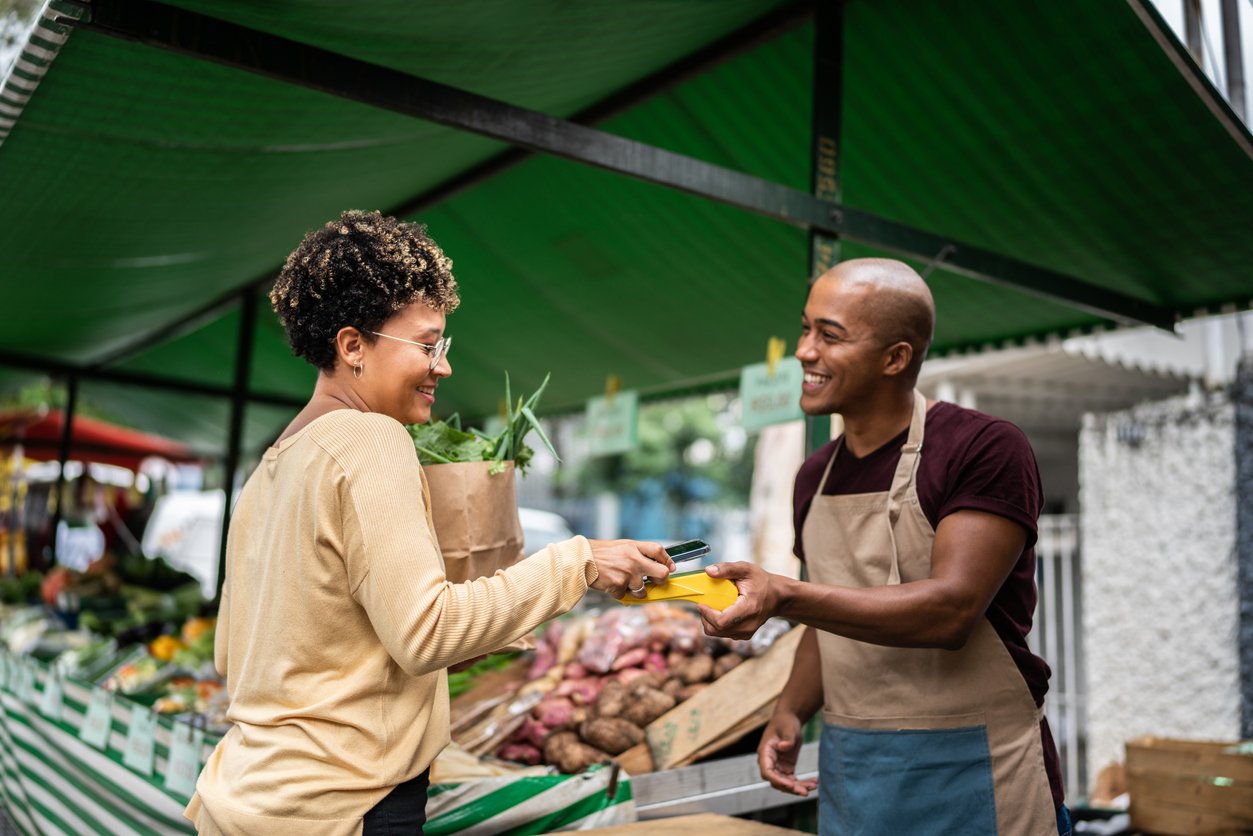
So how do you join a co-op? It may be as simple as visiting your local grocery co-op and asking for a membership application, or clicking the “Getting Involved” link on their website.
Typically, you’ll pay a one-time investment fee to become a member of a grocery co-op, ranging from $75 to $200 depending on the co-op. If that chunk of cash represents a burden on your finances, many co-ops allow you to pay in installments or pay toward your fee only in months when you actually shop at the co-op, or they may waive it entirely. If you ever want to leave the co-op, you can get this money back. Some co-ops also require annual dues to maintain your membership.
How to Find a Co-op Food Market Near You
If you live in the US and aren’t aware of a food co-op in your area, use the National Co-op Grocers (NCG) store finder to search geographically. You’ll see a map with lots of happy green pins indicating the location of the hundreds of co-ops affiliated with the NCG. If you live in a state that doesn’t have a single pin (at the time of this writing, Utah, Wyoming, and Louisiana suffer from this condition), don’t give up.
Use your favorite internet search engine to look for “food co-op [city, state]” or even, if you have geolocation activated on your device, “food co-op near me.” For example, a Startpage search for “food co-op New Orleans” reveals, in the top position, the existence of the New Orleans Food Co-op, which you can join for five monthly payments of $20.
If you’re in the UK, you can search the Co-operatives UK website. Just be aware that their results include many categories of co-op in addition to food, such as distilleries, data services, and graphic design. When I searched the site for “Cotswolds” (a really nice part of the country west of London and south of Birmingham), I was shown a list of co-ops that included music tutors and boat mooring services, but no food co-op. In this case, you might want to use a search engine to find an actual food co-op in your town.
Canadians can search the Co-operation Across Canada database for a wide range of co-ops, including food. It may take a bit of poking around, as it’s not always clear what kind of co-op an individual entry represents. For example, a search for co-ops in Toronto showed a listing for Karma Co-op, which was described as “consumer retail.” Clicking through to their website revealed a very cool-looking food co-op, with the motto “Sustainable Food, Sustaining Community.”
For other countries, your best bet is probably to ask your friends and neighbors, or conduct an internet search. The International Cooperative Alliance website offers lots of resources for those who want to start or grow co-operatives but isn’t really set up for members of the public to search for food co-ops near them.
If all else fails, just look for parking lots full of cars with “Coexist” and “Don’t believe everything you think” bumper stickers. You’ll probably find a nearby food co-op. And if you don’t… Why not start your own?
Resources for How to Start a Food Co-op

If you’re inspired by the Rochdale Pioneers and all the troublemakers who have followed them, you might be the catalyst your community needs to bring to life a food co-op of your own. And unlike those early visionaries, you have the advantage of almost 200 years of trial and learning experience.
Here are a few places to start researching and reaching out for support and guidance if you’re interested. The 2019 book Grocery Story: The Promise of Food Co-ops in the Age of Grocery Giants, by John Steinman, shares the history of the rise of supermarkets and highlights the social and economic gaps caused by their ascendance, as well as laying out a detailed blueprint for creating co-operative alternatives to that sometimes dehumanizing model. The book’s website offers guides and a list of recommended organizations for those who take up the challenge.
If you’re in the US, the Food Co-op Initiative website provides resources and helps people get started setting up a food co-op. And London-based LDN also shares information on starting a UK co-op, including resources for students and schools.
Food Co-ops Are for Everyone!
Co-ops are alternatives to grocery stores that typically put people, health, employee wellness, and local community-building ahead of profits. There are many benefits both to shopping at them as well as becoming a member or even volunteering your time and energy. However you choose to get involved, supporting your local food co-op can be a great way to support “healthy, ethical, and sustainable food for all.”
Now that’s a phrase I’d like to see on a bumper sticker!
Organic Lion’s Mane Mushroom, proven to grow new brain cells and synapses. Guard against Alzheimer’s, dementia, and mental decline. Save 10% and get free shipping with a subscription!“I can feel my mind getting sharper with Lion’s Mane. I put it in my coffee.”
Get your Lion’s Mane from Ascent Nutrition, one of the most pure and potent in the industry.

Stillness in the Storm Editor: Why did we post this?
The news is important to all people because it is where we come to know new things about the world, which leads to the development of more life goals that lead to life wisdom. The news also serves as a social connection tool, as we tend to relate to those who know about and believe the things we do. With the power of an open truth-seeking mind in hand, the individual can grow wise and the collective can prosper.
– Justin
Not sure how to make sense of this? Want to learn how to discern like a pro? Read this essential guide to discernment, analysis of claims, and understanding the truth in a world of deception: 4 Key Steps of Discernment – Advanced Truth-Seeking Tools.
Stillness in the Storm Editor’s note: Did you find a spelling error or grammatical mistake? Send an email to [email protected], with the error and suggested correction, along with the headline and url. Do you think this article needs an update? Or do you just have some feedback? Send us an email at [email protected]. Thank you for reading.
Source:
https://foodrevolution.org/blog/what-is-a-food-coop/
Support our work! (Avoid Big Tech PayPal and Patreon)DIRECT DONATION
Leave a Reply