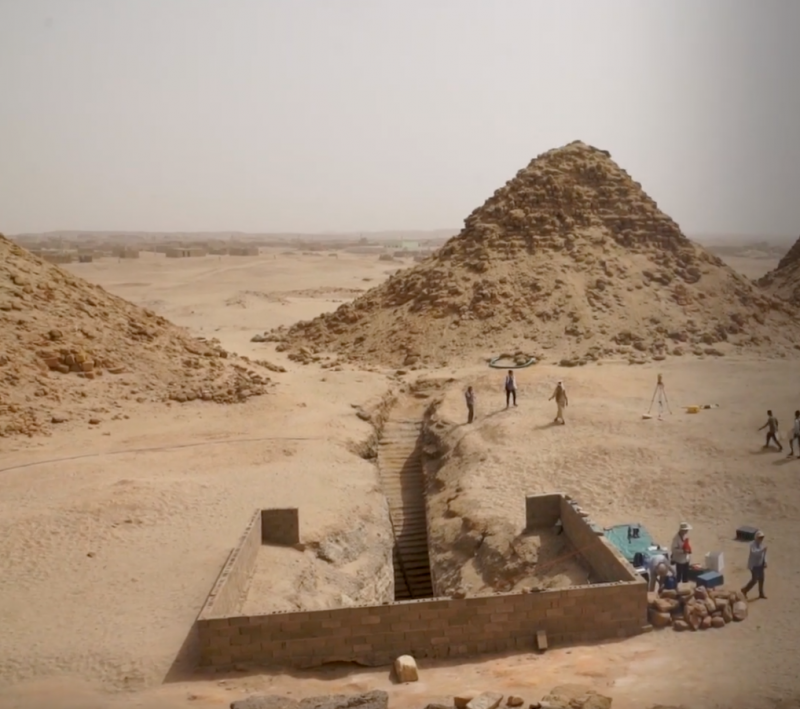
(Janice Friedman) When we think of pyramids, we naturally think of Egypt. But did you know that Sudan has more pyramids?
Related Atlantis and the Lost Tribes
by Janice Friedman, June 16th, 2020
It does, and underwater archaeologists just discovered treasure beneath them buried with Egypt’s black pharaohs.
Situated in a sandy desert of Sudan not far from the Nile, 20 such pyramids rise from the landscape in Nuri, an ancient burial site where the tombs of Egypt’s black pharaohs are located.
For a brief period of just over 100 years from 760 B.C. to 650 B.C., the black pharaohs ruled Egypt.
Unlike other Egyptian rulers, the Nuri kings were buried underneath pyramids instead of inside them. Think of them as giant headstones rather than tombs.
The tomb is beneath the sand.
Now, what does this have to do with underwater archaeology?
Well, after excavating a staircase down to the first chamber of the tomb belonging to Nastasen, the last king of Nuri, the team hit the underground water table, which means if they want to see what’s inside the tomb they would need to take a swim.
Led by underwater archaeologist Pearce Paul Creasman, who is specially trained for such expeditions, the team brought in air pumps with long hoses attached to provide oxygen so they would not have to carry cumbersome air tanks on their backs.
Creasman installed a steel chute they could swim through without having to worry about rocks falling on top of them in case of collapse.
And once he got inside, he got a good look at a tomb not seen for nearly a century since Harvard archaeologist George Reisner first briefly excavated the site before abandoning it because of the water, which had only been knee deep at the time.
One of Reisner’s team members even dug a pit and extracted artifacts in the third chamber.
“There are three chambers, with these beautiful arched ceilings, about the size of a small bus, you go in one chamber into the next, it’s pitch black, you know you’re in a tomb if your flashlights aren’t on,” Creasman told BBC News.
“And it starts revealing the secrets that are held within.”
Fellow underwater archaeologist Kristin Romey joined Creasman and wrote about their exploration of the tomb for National Geographic.
“Creasman and I both trained as underwater archaeologists, so when I heard that he had a grant to explore submerged ancient tombs, I gave him a call and asked to tag along,” she wrote.
“Just a few weeks before I arrived, he entered Nastasen’s tomb for the first time, swimming through the first chamber, then a second, then into a third and final room, where, beneath several feet of water, he saw what looked like a royal sarcophagus. The stone coffin appeared to be unopened and undisturbed.”
The water was much deeper now, what Romey writes is the result of “rising groundwater caused by natural and human-induced climate change, intensive agriculture near the site, and the construction of modern dams along the Nile.”
The mission is mostly to test the equipment and lay the groundwork for future excavations, but they do explore the chambers and even find Reisner’s pit that may still contain treasures.
“Swimming through a low, rounded, rock-cut doorway, we enter the third chamber,” Romey wrote.
“The stone sarcophagus is dimly visible below us—a thrilling sight—and we spot the pit that was hastily dug by Reisner’s nervous worker a century ago.”

As it turns out, Reisner and his team definitely missed out on finding more.
“As we excavate Reisner’s pit—filling plastic buckets with sediment, swimming them out into the air-filled second chamber, dumping the sediment onto a screen and sifting for artifacts — we discover paper-thin foils of pure gold that likely once covered precious figurines that long ago dissolved in the water,” Romey described.
“The gold offerings were still sitting there – these small glass-type statues had been leafed in gold,” Creasman said. “And while the water destroyed the glass underneath, the little gold flake was still there.”
The findings prove that there is still much for archaeologists to discover and learn at Nuri. They also demonstrate that these tombs may be untouched by looters.
“Those gilded figurines would have been easy pickings for looters, and their remains are a sure sign that Nastasen’s tomb has been essentially untouched,” Romey wrote.
That’s a good thing for an archaeological team to know because it means future excavations could produce more priceless treasures and reveal more secrets of Egypt’s black pharaohs.
And unlike archaeologists of the past, modern archaeologists have the technology to go where they could not.
“I think we finally have the technology to be able to tell the story of Nuri, to fill in the blanks of what happened here,” Creasman said.
Book Pyramid Power: The Science of the Cosmos (The Flanagan Revelations) (Volume 1)
“It’s a remarkable point in history that so few know about. It’s a story that deserves to be told.”
Indeed, it certainly does. Reisner wrote off the black pharaohs as racially inferior and ignored their accomplishments.
Now archaeologists can tell their story properly and restore their rightful place in history as powerful rulers of the Egyptian empire.
See the underwater archaeology from National Geographic below:
Stillness in the Storm Editor: Why did we post this?
The news is important to all people because it is where we come to know new things about the world, which leads to the development of more life goals that lead to life wisdom. The news also serves as a social connection tool, as we tend to relate to those who know about and believe the things we do. With the power of an open truth-seeking mind in hand, the individual can grow wise and the collective can prosper.
– Justin
Not sure how to make sense of this? Want to learn how to discern like a pro? Read this essential guide to discernment, analysis of claims, and understanding the truth in a world of deception: 4 Key Steps of Discernment – Advanced Truth-Seeking Tools.
Stillness in the Storm Editor’s note: Did you find a spelling error or grammatical mistake? Send an email to [email protected], with the error and suggested correction, along with the headline and url. Do you think this article needs an update? Or do you just have some feedback? Send us an email at [email protected]. Thank you for reading.
Source:
Have Creasman and Romey gone back down into Nuri’s tomb since 2020 and were they able to open the Sarcophagus? If so, was it filmed?