(Alexander Danvers Ph.D.) The Credibility Revolution in psychology is in part a product of the discipline’s own success, according to a recent philosophy paper. The author Ivan Flis, argues that at the heart of our desire to improve methods for making scientific claims is applying a phenomenon psychologists established observing others to ourselves: Confirmation Bias.
Related SMEAR Factory Southern Poverty Law Center has “Lost all Credibility,” Admits Leftist Washington Post
by Alexander Danvers Ph.D., June 15th, 2019
Confirmation bias is the tendency to focus on information in line with your expectations or supporting the position you want to take. For example, if you are asked to judge whether the position of a political party is good or bad you are likely to look for reasons why the party you already like is right. You are unlikely to look for reasons why your party is wrong.
This type of limited information search is good for justifying yourself to others by presenting arguments for what you already believe, but it’s not good for figuring out how things really work, because alternative possibilities—like your preferred idea or explanation being wrong—aren’t considered.
Confirmation bias came out of a revolution in psychological research described as “The Rationality Wars.” Flis argues that, based on the success of algorithms for decision-making in computer science, the “correct” way to think and reason was to use formal, logical systems. When people deviated from the answers given by formal logic, their decisions should be categorized as irrational or biased. This position was exemplified by the work of Daniel Kahneman and Amos Tversky (work that eventually won Kahneman a Nobel Prize).
Buy Book A Rulebook for Arguments [Learn to Discern Bad Arguments and Be More Effective in Sharing]
Flis demonstrates how reformers describe other scientists as irrational or biased—often specifically invoking confirmation bias—when discussing reform. For example, one set of research papers examines how often psychologists publish results that confirm as opposed to contradict their theory, finding that psychology as a field almost exclusively publishes evidence that confirms theories (91.5% of studies). Further, more “developed” or “harder” sciences tend to be more willing to publish evidence that contradicts a theory.
This tendency to only publish findings that support the ideas we already believe is seen as evidence that scientists are just like other people: naturally irrational. Just because a person is a scientist, it doesn’t mean they don’t fall prey to the same biases as everyone else. According to this argument, we need the reforms of the Credibility Revolution precisely because scientists acting individually use biased logic.
The idea that scientists prefer evidence that supports their own theories pairs nicely with Karl Popper’s idea of falsification. Popper argued that science proceeded not by confirming theories, but by putting them in danger of being falsified by looking for evidence that would contradict them. The more times people try and fail to contradict a theory, the better the theory looks.
This is where Flis takes issue. Popper’s original position is seen as almost irrelevant in modern philosophy of science because his argument for how science should progress isn’t totally consistent logically—and in part because historians of science found that scientists almost never really try to contradict their own theories.
Issues with Popper could probably take up a whole book, but the argument that is most intuitive to me is one described by Paul Meehl (and originally made by Quine): all scientific claims rely on auxiliary assumptions, and so any failure to find an effect can be the result of a bad assumption—not a failure of the theory. A simple example: if a microbiologist is trying to understand the structure of a cell, their microscope needs to be working properly. If there is a smudge or distortion in the lens, then the observations that could disconfirm a theory might just be the result of a problem with the instrument. That the microscope gives accurate information about the cell is an auxiliary assumption of the theoretical test.
These kinds of auxiliary assumptions can be about the way we measure things; in fact, Meehl called for psychologists to develop “A Theory of the Instrument” that tests all the assumptions about our measurement tools. For example, if I want to see if personality is related to likelihood of developing depression, I have to assume that the personality questionnaire I gave people really does measure personality accurately.
Buy Carbon 60 (c60) Super Antioxidant, Anti-Aging, Youth Restoring Supplements and Products
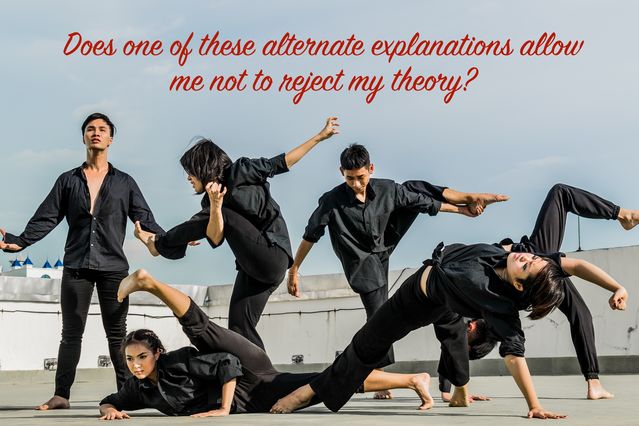
But auxiliary assumptions can also be about more abstract or philosophical issues. For example, I need to assume that depression really is a single thing—as opposed to believing that there are lots of different ways to be depressed and what we call depression is actually a mish-mash that combines them. If I test the relationship of personality to depression, I am making the assumption that there is one thing called depression and that there are not lots of different types of depressions. If I find no relationship, I could refuse to accept that depression isn’t related to personality. Instead, I could question the auxiliary assumption that all depression is the same and start to believe that the problem with my experiment is that I didn’t account for the different types of depressions. Ultimately, I could do something like this for any result, meaning that if I am clever enough I can always find an explanation for my results that doesn’t contradict my theory.
If falsification isn’t so simple in practice, what should we do? One solution is discussed in another recent philosophy paper referenced by Fils. In “Putting Poper to Work,” Maarten Derksen discusses some of Popper’s later work, published in 2002, that argues scientific objectivity is the product not of individuals but of a community of scientists working on problems together. What we need to get good science is what Popper calls “friendly-hostile co-operation.” My tendency to want to believe in my own theory can be worked around if other scientists who don’t believe my theory are also engaging constructively in the scientific process. It is the back and forth between scientists that keeps us honest.
For example, if I don’t find a link between depression and personality and interpret that as a problem with the way we have been thinking about depression, other researchers studying depression can weigh in. They might have done research looking at something like the “many depressions” idea, and be able to tell me if I’m on the right track. Or they might say that my idea seems implausible for other reasons. Our argument helps make the call about whether my interpretation is legit or just a cop out to save my pet theory.
This kind of discussion doesn’t just spring up out of nowhere, though. Popper believed that scientists needed to set up the right kinds of norms and institutions to have these debates. We need a set of ground rules—and enforcement mechanisms when people step out of line—that can link the lofty goal of falsification to the gritty details of making sense of science.
Derksen argues that the current Credibility Revolution is creating these vital norms and institutions. For example, “friendly-hostile” discussion is much more common in psychology now that so many researchers talk about their work on social media. It’s also becoming a common policy for psychology journals to ask authors of research papers to post their data and full analysis results openly, so that they can be replicated. Opening your research up to debate from other scientists online, and your data to reanalysis are ways of making sure that other people have a chance to check your work—and to potentially check your biased interpretations.
Ultimately, this interpretation means that the task of the Credibility Revolution is not to change ingrained biases in reasoning. The task instead is to create habits and incentives that naturally catch us and redirect us when we fall into patterns of biased thinking. The answer to my confirmation bias is having to respond to other people’s ideas.
Stillness in the Storm Editor: Why did we post this?
Psychology is the study of the nature of mind. Philosophy is the use of that mind in life. Both are critically important to gain an understanding of as they are aspects of the self. All you do and experience will pass through these gateways of being. The preceding information provides an overview of this self-knowledge, offering points to consider that people often don’t take the time to contemplate. With the choice to gain self-awareness, one can begin to see how their being works. With the wisdom of self-awareness, one has the tools to master their being and life in general, bringing order to chaos through navigating the challenges with the capacity for right action.
– Justin
Not sure how to make sense of this? Want to learn how to discern like a pro? Read this essential guide to discernment, analysis of claims, and understanding the truth in a world of deception: 4 Key Steps of Discernment – Advanced Truth-Seeking Tools.
Stillness in the Storm Editor’s note: Did you find a spelling error or grammar mistake? Send an email to [email protected], with the error and suggested correction, along with the headline and url. Do you think this article needs an update? Or do you just have some feedback? Send us an email at [email protected]. Thank you for reading.
Source:
Leave a Reply