This is a fascinating piece by a well renowned professor of Cosmology. Main Stream Media would have us believe that modern science has it all figured out, yet if we dismiss the guru’s and start to honestly look at the Data ourselves, it is glaringly obvious some of the facts do not add up, and some are not ‘facts’ at all.
Dewey Larson, is a prime example of someone in mainstream science who earlier in their career saw the bias and corruption of honest truth seeking and took a different approach, the development of Reciprocal Systems Theory is the result, and it stands as one of the most honest works of the 20th century.

The creationist theory of the Big Bang was proposed by a Catholic Priest and implies the existence of a creator. Why the Universe should have had a beginning, or why it would have been created, cannot be explained by classical or quantum physics. To support the myth of the Big Bang, estimates of the age and size of the cosmos, including claims of an accelerating universe, are based on an Earth-centered universe with the Earth as the measure of all things, exactly as dictated by religious theology.
However, distance from Earth is not a measure of the age of far away galaxies. The myth of the Big Bang cannot explain why there are galaxies older than the Big Bang, why fully formed galaxies continue to be discovered at distances of over 13 billion light years from Earth, when according to Big Bang theory, no galaxies should exist at these distances.
To support the Big Bang Myth, red shifts are purposefully misinterpreted based on Pre-Copernican geo-centrism with Earth serving as ground zero. Red shifts are variable, effected by numerous factors, and do not provide measures of time, age or distance. Nor can Big Bang theory explain why galaxies collide, why rivers of galaxies flow in the “wrong” direction, why galaxies clump together creating great walls of galaxies which took from 80 billion to 150 billion years to form.
Big Bang theory requires phantom forces, constantly adjusted parameters, and ad hoc theorizing to explain away and to cover up the numerous holes in this theory. The Big Bang is a myth, major portions of which have been repeatedly falsified. The preponderance of evidence supports the reality of an infinite cosmos which consists of multiple “Hubble Length Universes” which constantly recycles itself. An infinite, eternal, cycling universe has no creator, was not created, dispenses with the need for a “creator god” and does not place Earth at the center of the cosmos.
The infinite universe is peppered with infinite gravity-holes ranging in size from those smaller than a Planck length to universe-in-mass holes (Joseph 2010). Super-massive holes in the center of galaxies, galaxy-in-mass holes in galactic clusters, and a universe-in-mass black hole on the outskirts of this Hubble length universe, explains why galaxies cluster together, why galaxies are moving in every conceivable direction and at variable speeds, and why the velocity of distant galaxies are accelerating.
The universe is not expanding or accelerating. Distant galaxies are accelerating to their doom, their velocities and red shifts increasing and their illumination dimming as they orbit toward the event horizon of a universe-in-mass black hole on the outskirts of the observable Hubble length universe. Black holes, including those smaller than a Plank length, continually destroy and reassemble matter beginning with hydrogen atoms, thereby giving rise to molecules, planets, stars, new galaxies, and Hubble Length Universes which are also recycled. If there was a big bang, it was not the beginning, but a continuation, emerging from the quantum electro-dynamic continuum and eventually collapsing, and then repeating the “big bang” cycle, which also maintains the cycle of life. Through stellar nuclear-synthesis hydrogen becomes carbon, and stars provide the ingredients for life. In an infinite cosmos consisting of infinite universes, life has had infinite time to arise from energized aggregates of complex chemical compounds produced by stars created from hydrogen atoms produced by black holes which consist of gravity. There was no Big Bang beginning. The Big Bang is religion masquerading as science. The cosmos is infinite and eternal, continually recycles itself, and has no beginning, and, no end.

The cosmos is infinite, eternal, and has no beginning and no end. What we call the “known” universe is not just a big piece of a greater whole, or one universe among a multiverse, but an insignificant micro-macro-molecular micro-universe among an infinity of similar micro-universes.
If, from an infinite perspective, or a metaphorical “god’s-eye-view”, we could gaze upon the infinite cosmos as a whole we would discover that our known, observable “Hubble length” universe is an atom-sized fragment of an infinite ensemble of molecular building blocks which make up and create cosmic-super-structures, much like elementary particles, atoms, and molecules comprise tables and chairs. Further, the infinite universe continually recycles matter, breaking down photons and protons by stripping away energy and gravity, and reassembling liberated elementary particles to create hydrogen atoms (Joseph 2010), thereby giving rise to molecules including planets, stars, galaxies, and the chemicals, gasses and metals necessary for life. An infinite universe has no creator and dispenses with the need for a creation event, or a creator god.
By contrast, Big Bang theology is predicated upon the Biblical belief in creation, which implies a creator, and thus a creator god. In fact, the Big Bang was proposed by a Catholic priest who wanted to make the Bible scientific (Lemaître 1927, 1931a,b). In Big Bang theology the universe was created through unknown mechanisms for unknown reasons which cannot be explained by science. Nor can the advocates of the Big Bang explain why the universe had a beginning, and, they are forced to ignore the obvious: what existed before the beginning? How did the beginning begin? What caused the Big Bang creation event? Quantum physics, classical physics, particle physics, general relativity, and so on are completely unable to even address these questions. No facts, no evidence, no theories, not even a reasonable scientific hypothesis has been put forward to explain why the universe should have had a beginning or what caused the so called “Big Bang.”
Because the very foundations of this theory cannot be explained by or are contrary to physics, the acolytes of Big Bang theology claim the laws of physics did not yet apply, before and at the moment of the Big Bang, and this is because these laws had not yet been created. Therefore, the standard Big Bang explanation is the “Universe was self-creating.” However, this is not science, but theology. Belief in the absence of evidence and in the face of disconfirming evidence, is not science, but the domain of faith which belongs to the realm of religion. In fact, the Judeo-Christian religion employs identical terminology when describing “god” as the creator; that is, “god the creator became god the creator at the moment of creation, and thus god is self-creating.”

Not only are the acolytes of the Big Bang religion unable to scientifically explain the beginning but data marshaled in support of a Big Bang universe are predicated upon phantom energies and invisible undetectable substances (Bhattacharjee, 2010; Caldwell and Kamionkowski, 2009; Huan et al., 2010; Jamil. 2010; Perlmutter, 2003; Santos et al., 2010) which can’t be explained by a coherent all-inclusive scientific theory. Rather than coherent mutually supportive data which can be tested and falsified, advocates instead change their parameters to nullify falsification, and rely upon simulations, interpretations based on questionable assumptions, ad hoctheorizing, constantly adjusted theoretical appendages, and estimated distances and ages relative to an Earth-centered geo-centric universe as dictated by the Jewish-Christian Bible and Catholic religion which for almost two thousand years placed Earth at the center of the universes. Therefore, data marshaled in support of the Big Bang place Earth at the center of the universe, with claims of age, distance, expansion, acceleration all relative to where the Earth is now (Perlmutter et al., 1998; Schmidt et al., 1998).
.jpg)

Thus, in the religion of the Big Bang, Earth serves as ground zero and the measure of all things. Thus according to Big Bang theology, a star is “13 billion years old” because it is “13 billion light years from Earth.” A star, and thus the universe, is “accelerating” compared to stars closest to Earth (Perlmutter et al., 1998; Schmidt et al., 1998). Stars display red-shift or blue-shift in relation to movement toward or away from Earth (Perlmutter et al., 1998; Schmidt et al., 1998). Although most cosmologists will deny it, their Big Bang interpretations of data require it: a geo-centric universe with Earth as the center and measure of all things–exactly as demanded by the Judeo-Christian religion.


The “Big Bang” model and the concept of an expanding universe was in fact first proposed by Monsignor Georges Lemaître (1927, 1931a,b), a high ranking Catholic Priest and a member of the Pope’s Council of Scientists. Lemaître (1931a,b) called his theory the ‘hypothesis of the primeval atom” and described it as “the Cosmic Egg exploding at the moment of the creation.” In 1949, Fred Hoyle who championed the “steady state” theory of an infinite universe (Hoyle, 1948; Bondi and Gold 1948) ridiculed Lemaître’s theory, calling it the “big bang.” Hoyle was not alone. Einstein rejected Lemaître to his face at the 1927 Solvay conference, saying “your physics is abominable” (Deprit, 1984).
If there was an explosive creation event, the universe should expand and then collapse. The universe did not collapse. As there is so much data which contradicts uniform expansion as predicted by the Big Bang, such as the superstructures consisting of hundreds of millions of galaxies clumped together in a series of giant walls, proponents instead propose that after the creation the universe slowed down, then it speeded up, then it slowed down, then it speeded up, then it accelerated but not all regions of the universe accelerate at the same speed, and so on. And to explain this speeding up and down, phantom invisible forces are invented. A major requirement of the Big Bang is faith, and a rejection of the scientific method which requires that theories be testable and then abandoned if falsified. Instead, the acolytes of this religion simply adjust their parameters, invent more invisible constructs, engage in moread hoc theorizing, and embrace supernatural phantom forces to explain away the failures of this theory.
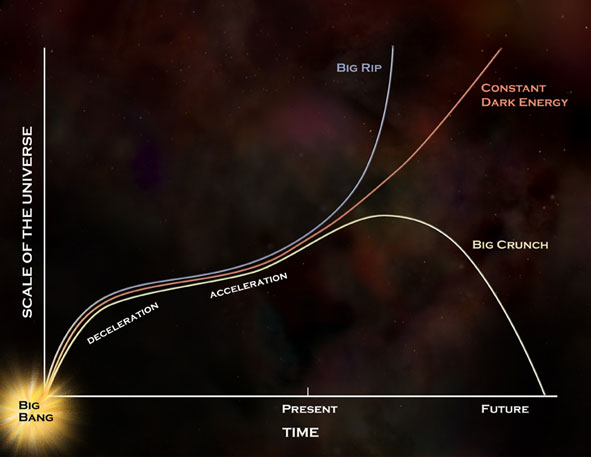
According to Big Bang theology, since the universe was created, it has a birth date. Initially, based on data provided by Hubble (Hubble 1929a,b, 1936a,b,c; 1937a,b; Hubble and Humason, 1931, 1934), it was determined that the creation was just 2 billion years ago. However, once it was discovered that Earth was 4.6 billion years in age, and that there are galaxies which are also older than the Big Bang, this birth date was moved to 8 billion, then 15 billion then 22 billion years (Abell et al., 1988; Freeman 1992; Gott et al., 1976 Peebles 1992; Jayawardhana, 1993); which should tell us that no one knows the age of the universe. Current estimates, which are accepted by NASA and consensus, is the Universe was created 13.75 billion years ago (Benett et al. 2003).
However, since arriving at a 13.75 billion year birth date, new problems have surfaced and old problems have again reared their galactic head. For example, our Milky Way galaxy is believed to be 13.6 billion years in age (Pasquini et al., 2005); meaning it was established within one million years of the Big Bang, which is not consistent with theory. The Milky Way is also orbited by the ancient metal poor Sagittarius Dwarf Elliptical Galaxy (SDG), which is believed to have contributed stars which were captured by the Milky Way billions of years ago (Chou, et al., 2009; Ibata et al., 1997; Majewski et al., 2003). The Canis Major Dwarf Galaxy (CDG) is yet another older, metal poor satellite of the Milky Way and may have contributed stars to this galaxy (Martin et al., 2004). SDG and CDG are probably billions of years older than the Milk Way, and thus older than the hypothetical Big Bang. A number of very ancient globular clusters have also been discovered, and which may be over 16 billion years in age (Van Flandern 2002).

According to current Big Bang theology, the universe should come to an end 13.75 billion light years from Earth, and that with extended viewing times with the Hubble and other telescopes, it should be possible to observe the point where the universe begins. And just prior to the beginning, there should be nothing but light and nebulous balls of gas. In 2004, this prediction was put to the test and the Hubble telescope was pointed at what was believed to be empty space for an extended period of time. However, contrary to prediction, prolonged observation of ultra deep space using the Hubble Wide Field Camera 3 did not reveal the beginning, but instead revealed fully formed galaxies, at distances, from Earth of approximately 13.1 billion light years (American Astronomical Society 2010).
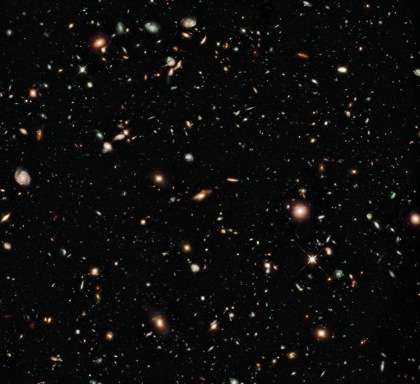
The 13.1 billion light year distance of these fully formed galaxies, of course, is an estimate based on an Earth-centric conception of the universe. The defenders of Big Bang theology like to pretend the age of various galaxies can be determined based on how far they are from our planet, as if Earth is ground zero for the Big Bang, and the measure of all things. In fact, distance is not related to age. Distance is relative. Further, distance from Earth can only provide a minimum age estimate. In fact, these ancient fully formed galaxies must have already been billions of years in age, over 13 billion years ago which again makes them older than the Big Bang.
NASA and the Big Bang theologians have sought to explain away these unexpected discoveries, by claiming these distant fully formed galaxies are probably metal poor, and therefore “primitive” (American Astronomical Society 2010). However, these claims are not based on data, but are interpretations and hypothesis based on belief in the Big Bang. If there was a Big Bang, then the discovery of galaxies where no galaxies should exist, must mean these are primitive galaxies which are metal poor. Given the distance and faint light, the exact nature of these galaxies could not, in fact, be determined. Rather, based on estimates of red shift values (between z=7 and z=8.5) it can only be deduced they are at least 13.1 billion light years distant relative to the Earth. Therefore, it is not known if these distant fully formed galaxies are metal poor. In fact, metal poor is not an indication of “primitiveness” or youthfulness as SDG and CDG and other fully formed ancient galaxies near our Milky Way are also metal poor. In fact, distant quasars and galaxies have been determined to be metal rich (Van Flandern 2002); and these discoveries also defy the Big Bang.
The clumpy distribution of matter also defies Big Bang predictions as all galaxies should be evenly distributed on the outer rims of the expanding explosive force. And yet, ancient galaxies orbit the Milky Way, there are nearby galaxies over 13 billion years in age (Pace and Pasquini 2004) and ancient fully formed galaxies are located over 13.1 billion light years distant from the Milky Way. Moreover, galaxies move in the wrongdirections and at different speeds, with galaxies crashing into one another from every conceivable direction. In fact, the Andromeda and Milky Way galaxies will collide in just a few billion years (Cox and Loeb 2008).


Millions of galaxies over one hundred million light years across, all moving in the same direction, have pierced the center of the local super cluster of galaxies located in the vicinity of the Centaurus and Hydra and constellations. However, adding to this anomaly is the very fact that throughout the known, Hubble length universe, hundreds of millions of galaxies have clumped together, forming super clusters and a series of great walls of galaxies (Geller and Hurcha, 1990; Gott et al. 2005; Tully 1986) which are separated by vast voids of empty space. Some of these elongated super clusters have formed a series of walls, one after another, spaced from 500 million to 800 million light years apart, such that in one direction alone, 13 Great Walls have formed with the inner and outer walls separated by less than 7 billion light years. It has been estimated that some of these galactic walls may have taken from 80 billion (Tully 1986) to 100 billion (Van Mitchell 1997; Flandern 2002), to 150 billion years (Lal 2010; Lerner 1990) to form.

.jpg)


To explain away this overwhelming pattern of disconfirming evidence, Big Bang theologians have invented “dark energy” and “great attractors” so as to explain why a created universe did not spread out uniformly at the same speed and in the same spoke-like directions as predicted by theory. Therefore, because of these invisible, undetectable, phantom forces, the Big Bang universe slows down, then suddenly speeds up, then slows down, then accelerates. with different regions all moving at different velocities and different directions. This isn’t science. Its nonsense.
Moreover, predications based on the Big Bang can account for less than 20% of the mass and density of the known, observable Hubble length universe (Lerner 1991; Mitchell 1997; Van Flandern 2002). Nor can this theory explain gravity, the discordant data on red shifts, galaxy distribution, colliding galaxies, the abundance of hydrogen and helium, the existence of elementary particles, and why the movement of distant galaxies appears to be speeding up, and so on (Arp et al., 2004; Eastman, 2010; Lal 2010; Lerner 1991; Mitchell 1997; Hoyle et al., 2000; Ratcliffe, 2010; Sidharth and Joseph 2010; Van Flandern 2002).
Inflation, for example, requires a density at least 20 times larger than that predicted by big bang nucleosynthesis (Hoyle et al., 2000; Lerner 1991; Mitchell 1997; Van Flandern 2002), the theory’s explanation of the origin of the lightest elements. That density, like the missing matter, excessive gravity, expansion, the clumping of galaxies, distant stars, etc., can be accounted for not by a Big Bang, but an infinite universe peppered with infinite holes in space time which continually breaks down, recreates, and recycles matter (Joseph 2010). Only the addition of ad hoc hypothetical appendages and parameters which are constantly adjusted have prevented the Big Bang theory from complete collapse.
The fact is, the Big Bang has been repeatedly falsified. The Big Bang is a myth. There was no “big bang” or creation event. The Big Bang is religion masquerading as science.
The overall pattern of data is easily explained not by a “Big Bang” beginning, but a universe which is eternal, infinite, and whose structure and properties continually destroys, recycles, and recreates matter beginning with hydrogen atoms. Thus the recycling/recreating model (Joseph 2010), differs from the “steady state” model of Hoyle and colleagues (Hoyle, 1948; Hoyle et al., 2000; Bondi and Gold 1948) which envisioned a universe which continually creates new matter ex nihilo. As detailed in this article and elsewhere (Joseph 2010; Joseph and Schild 2010a), galaxies, stars, planets, moons, molecules, atoms, and so on, are continually recycled and destroyed, and matter and energy, including hydrogen atoms, are continually recycled and recreated via gravity holes also known as “black holes”, “Planck Particles” and “Gravitons” depending on their size and mass (Joseph 2010). These holes and the energies and particles they liberate, radiate and expell, not only explains the existence of matter and the abundance of hydrogen, but contributes to what appears to be an expanding, accelerating universe and what has been called “gravity”, “gravity waves”, “dark matter” and “dark energy.”
Thus, the universe is not expanding, but is constantly being recycled by molecular and macro-molecular universe-in-mass black holes which strips matter of all constituent elements leaving only points of singularity, around which matter is reassembled; and the cycle continues for all eternity. If there was a big bang, it was not the beginning, but a continuation, which means the universe is eternal, and this precludes a creation event and a creator; a position which is anathema to the scientific establishment and those who believe in god, creationism, or the supernatural.
The infinite, eternal universe has no creator, dispenses with the need for a “creator god,” does not rely on phantom, invisible forces, and does not place Earth at the center of the universe as does Big Bang theology. Further, an infinite universe explains not just the fabric of the cosmos, but the cosmic origins, distribution, and evolution of life; which the religious fanatics, the Darwinists, and subscribers to magic wish us to believe is restricted to and was created only on Earth.
There was no Big Bang. There was no creation event. There is no creator god. Earth is not the center of the universe. The Universe is infinite, eternal, and has no beginning, and, no end.
Lemaître’s relativistic cosmology was based on the belief that the universe was created from a “primeval atom” and the radius of the universe increases over time because of the explosion from the creation event. Lemaître (1927, 1931a,b) proposed, therefore, that the expansion of the universe explains the redshift of galaxies following the “creation.” Lemaître derivation antedated Hubble’s formulation by two years. Even so, it became known as Hubble’s law and provided the numerical value of the Hubble constant which in turn has been employed to describe the hypothetical expansion rate and age and size of the universe (Hubble 1936a, 1937a,b, 1953).
There is however, nothing constant about the “Hubble Constant” which initially predicted the universe was expanding at a rate of about 160 km/sec per million-light-years (Lerner 1991; Mitchell 1997). This expansion rate meant the universe had been created 2 billion years ago. When it was subsequently determined that Earth was over 4 billion years old, and thus 2 billion years older than the Big Bang (BB), the Hubble Constant was adjusted and then adjusted again, and adjusted yet again as yet more discomfirming evidence began to pour in (Lerner 1991; Mitchell 1997; Van Flandern 2004). The “Hubble Constant” therefore, has been repeatedly and continually falsified. And yet, the proponents of BB theology continue to cling to this measure which essentially means whatever they want it to mean.
Hubble’s Law/Constant, and thus estimates as to the age and supposed expansion rate of the universe are also predicated on a complete and purposeful misinterpretation of a phenomenon referred to as “standard candles” (distant galaxies whose absolute luminosity supposedly does not vary with distance) and “red shifts” i.e. the changes in the wavelengths of light as an object moves toward or away from an observer (Hubble 1929, 1930, 1936a,b; Hubble and Humason, 1931, 1934; Hubble and Tolman 1935). The concept of “red shift” is based on the Doppler effect; i.e. wave lengths of light contract or expand as they approach and then speed toward or away from Earth. Thus, for red shifts to have any meaning, the Earth becomes the center of the universe; which, of course, is absurd.

The Big Bang theory continues to crumble under the cruel light of objective scrutiny. For example, Hubble’s original standard candles turned out not to be single stars, but clusters of galaxies of various ages and distances. Further, Lemaître and Hubble theorized that red shifts and blue shifts were indications of distance and “apparent velocity” and therefore could be considered proof the universe is expanding in all directions (Lemaître (1927, 1931a,b; Hubble 1936a, 1937a; Hubble and Tolman 1935) with Earth located in the center, which is absurd. Hubble also erroneously assumed all stars emitted the same amount of light and illumination (Hubble, 1929, 1936a, 1937a; Hubble and Humason, 1934). All stars are identical in a Hubble universe. Therefore, stars which are more faint must be further away than those more luminous (Hubble 1929) and as based on their red shift, they must be speeding away; that is speeding away from Earth.
Velocity is not a property of the Doppler effect. Velocity is also unrelated to distance. Hubble’s concepts of red shifts, velocity, and illumination are so preposterous that even ardent BB supporters have been left “perplexed how he (Hubble) could reach such a conclusion—galactic velocities seem almost uncorrelated with their distance, with only a mild tendency for velocity to increase with distance” (Weinberg 1977).
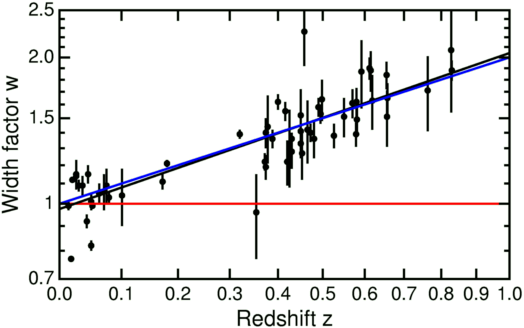

In fact, even Hubble was forced to admit: red shifts give only a gross approximation of a star’s distance. Nevertheless, although Hubble’s laws and constants have been repeatedly falsified and shown to have no validity, belief in “red shifts”, “standard candles” and the dimness of stars, as determinants of the age, velocity, and expansion of the universe (and thus “proof” of the BB) are de rigueur by consensus in the cosmological community. To even question this dogma is considered heresy and is the equivalent of standing up in a fundamentalist church and shouting that Jesus is not god.
For thousands of years it has also been the Christian-religious view that Earth is the center of the universe. Despite the Copernican revolution, an Earth-centered universe remains the standard. All measures of time, distance, acceleration and age, place Earth at the center of the universe, at ground zero (e.g., Perlmutter et al., 1998; Schmidt et al., 1998). In modern cosmology, Earth is still the measure of all things. The consensus view among astronomers is that red shifts, and the Hubble constant can be used to calculate the age, velocity, and distances for stars that are assumed to be extremely far away as based on how faint or bright they appear relative to other stars and from the vantage point of Earth (American Astronomical Society 2010; Hubble 1953; Perlmutter et al., 1998; Schmidt et al., 1998). Therefore, the general view is the universe was created around 13.8 billion years ago because of red shifts, the cosmic microwave background, and as some stars appear to be over 13 billion light years distant.
But 13 billion light years distant from what? Relative to what? To where Earth is now.
When the Hubble Law was formulated it was based on Vesto Slipher’s (1915) measurements of the speed at which stars recede from the Earth! The Earth is placed smack dab in the center of the Universe.


The preCopernican geocentric view of Earth as the center of the galaxy, and thus,ground zero is in fact the basis for claims that the universe is not just expanding, but accelerating (Perlmutter et al., 1998; Schmidt et al., 1998). As succinctly stated by Saul Perlmutter (2003) one of the discoverers of acceleration:
“In principle, the expansion history of the cosmos can be determined quite easily, using as a “standard candle” any distinguishable class of astronomical objects of known intrinsic brightness that can be identified over a wide distance range. As the light from such beacons travels to Earth through an expanding universe, the cosmic expansion stretches not only the distances between galaxy clusters, but also the very wavelengths of the photons en route. By the time the light reaches us, the spectral wavelength has thus been redshifted… That time interval is the speed of light times the object’s distance from Earth, which can be determined by comparing its apparent brightness to a nearby standard of the same class of astrophysical objects… A collection of such measurements, over a sufficient range of distances, would yield an entire historical record of the universe’s expansion.”
Time and distance are relative (Einstein 1905a,b), and all observations of far away galaxies and the so called expanding, accelerating universe are relative to Earth (Perlmutter et al., 1998; Schmidt et al., 1998), which becomes “ground zero” and is placed smack dab in the center of the known universe; exactly where the Catholic Church put it over a thousand years ago (Randles, 1999).
Granted, almost all cosmologists, astronomers and astrophysicists will claim to disavow the geo-centric view of the cosmos. But the fact is, their disavowals are just not true. Even though our solar system has been consigned to an outer arm of the Milky Way galaxy, all models and maps of the known universe, the accelerating universe, and the so called Cosmic Microwave Background, are from the perspective of Earth, and all place Earth, our solar system, and the Milky Way Galaxy, in the middle.

Thus, although Copernicus is credited with launching a cosmological revolution by placing the sun instead of Earth at the center of the solar system, much of modern astronomy and various aspects of astrophysics and quantum mechanics, are still based on an Earth/human/observer geo-ego-centricism which is mired in religion and Biblical-thinking. BB theology is religion dressed up in the language of science, with Earth and man, as the measure of all things.
Distance from Earth has nothing to do with time or the age of the universe. Red shifts and blue shifts are relative to the movements of Earth and our own Milky-way galaxy and may reflect expansions and contractions of space, not time. Moreover, they are effected by numerous variables (Arp 1998, 2003; Ratcliffe 2010), including cosmic dust (Hoyle et al., 2000; Mitchel 1997) and their orbital direction as related to our planet. Thus, as a star or galaxy orbits away from Earth, we see a “red shift” and when it circles round the red shift will change, eventually becoming blue as it now heads in the direction of Earth (Joseph 2000a). Of course, these changes may occur over 100s of millions or even billions of years. Red shifts, in fact, are incredibly variable, and can change drastically in magnitude in just a few years.
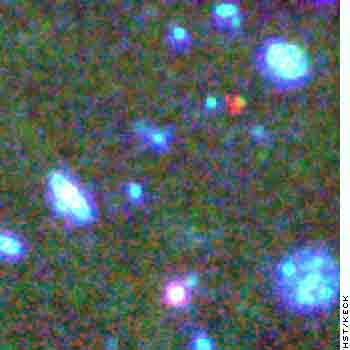
Consider, for example, galaxy STIS 123627, also referred to as “Sharon”. In 1999 it was reported that Sharon is the most distant galaxy every discovered, over 12.5 billion light years away with a suggested spectroscopic redshift of z = 6.68 (Chen et al., 1999). The redshift value z is a measure of the stretching of the wavelength or “reddening” of starlight due to the expansion of space relative to the position of Earth. However, Sharon no longer exhibits the same red shift previously observed. Further, it was subsequently estimated to be not 12.5 but maybe 9 billion light years away (Stern et al., 2000). An error of over 3 billion years!


Cosmology, January 3, 2010 – much more via
Leave a Reply