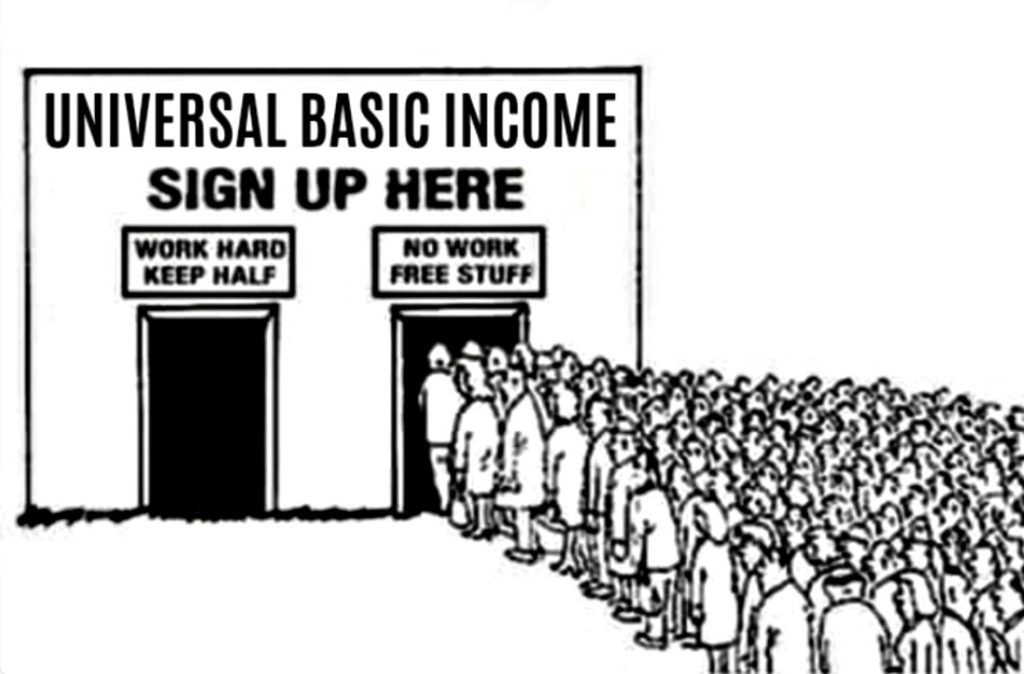
(Arkadiusz Sieroń) The universal basic income (UBI) is gaining popularity as the alternative to the current welfare system. The idea is to give each citizen the same amount of money, no matter if he or she works or not. Therefore, unlike traditional welfare systems, the UBI has no means test, nor willingness-to-work test. Nobody would be then left without a livelihood even if there is no work for him. Doesn’t that sound great?
Related Billionaire Who Promised To Pay Off College Students’ Debt Is Tackling Their Parents’ Debt, Too
by Arkadiusz Sieroń, October 10th, 2019
The problem is that the program must be financed somehow. Let us assume for simplicity that there are 250 million adult Americans and that each of them would receive $1,000 monthly (as presidential candidate Andrew Yang proposes). So we get a total cost of $250 billion monthly and $3 trillion annually. It would amount to about 14 percent of US GDP, or 42 percent of total government spending, or 73 percent of the federal outlays. For comparison, this is more than the total expenditure on health care, defense, and education. And yet we are talking about “just” $12,000 annually (or 19 percent of the median household salary, or 36 percent of the median personal income). Good luck with such an expensive program!
This is why the UBI is a utopian idea. Its introduction would require either a departure from universality (e.g., providing benefits only for young people), or a departure from unconditionality (e.g., the introduction of an income criterion), or reducing payment to small symbolic amounts. Other options include a radical increase in taxes, or implementing “modern monetary theory” and launching the printing press.
Buy Book The FEMA Camps Exposed: American debtors prisons exposed
The first two options would distort the idea of the program, transforming it into another traditional welfare program. The third scenario would not fulfill the program goals, as it would neither eradicate poverty nor significantly increase social security. And the last two options would have negative overall economic consequences that could lead to the results contrary to the intentions of the program, (e.g., an increase in the unemployment rate as a result of additional tax burden on wages), or a reduction in the amount of real benefits as a result of increased inflation. It means that the implementation of the UBI at a substantial level without incurring significant economic costs is a myth.
This is confirmed by a recent article “Basic income or a single tapering rule? Incentives, inclusiveness and affordability compared for the case of Finland” published by OECD economists on the occasion of an experiment with UBI in Finland (which was not a government program). They estimated that the replacement of the current social benefits system by the UBI in Finland would either be too expensive or would mean insufficient benefits for the most deprived and, consequently, an increase in the share of people below the poverty line from 11.5 to 14.3 percent!
The second economic problem with UBI is the negative impact on the labor supply. Economic analysis clearly suggests that an increase in non-wage income shifts the budget constraint line up and increases the reservation wage, which leads to a reduction in working time. And this is what the previous experiments with negative income tax, a concept similar to the UBI, showed — especially in case of women and youth, which were less attached to the labor market. The results are not surprising given the fact that giving people money for nothing reduces the opportunity cost of not working.
Buy Book The Money Deception – What Banks & Governments Don’t Want You to Know
There are ethical issues as well. Supporters of the UBI criticize the welfare state because it allegedly is not good for beneficiaries — this is because one has to sacrifice time and mental resources to receive the benefit. Such an approach turns the matter upside down, or it reflects the ingratitude Thomas Woods talked about in 2018. Helping people temporarily or permanently unable to work is characterized by the UBI supporters as something negative — as something that stigmatizes and constitutes a psychological burden. Yet welfare payments are, in fact, a privilege that the government (through society’s money) provides to needy individuals. (To be clear, I do not praise the government and I’m not a supporter of the welfare state, I’m just pointing out that welfare beneficiaries, well, benefit from welfare.)
Such a perverse perspective is, however, a consequence of the view that UBI should be a right, not a privilege. That is, supporters believe that everyone should have the right to taxpayer-provided income, regardless of their contribution and the possibility of earning on the market. The problem is that someone would have to finance this program, so UBI would still be the privilege of some people at the expense of others. One person’s right to a basic income means that someone else has to pay for it.
The idea of the UBI boils down to breaking the link between income and work, i.e., freeing people from the unpleasant necessity to earn. And here we come across several problems. First thing: who will do the needed, albeit low-paid jobs, since everyone will be emancipated from the yoke of work? Is it possible to eliminate the unpleasantness of work at all or is it just the reality of the temporal world? Will robots take care of our grandmothers? A likely outcome is a significant decline in the overall output of the economy — meaning impoverishment across the board.
Buy Book Bailout: An Inside Account of How Washington Abandoned Main Street While Rescuing Wall Street
Finally, supporters of the UBI claim it increases individual independence. We are told the UBI promises socioeconomic independence by freeing individuals from the tyranny of bureaucrats, bosses, husbands, and the capricious markets (one can see here an echo of utopian socialists). With money in your pocket, work becomes an option.
But there is a paradox that comes with the promise of socioeconomic independence: someone still must pay the UBI. So the dependence would not disappear — only people would become more dependent on Leviathan. Robert Nisbet writes in The Quest for Community that the desire for a sense of belonging does not disappear — if it cannot be realized within the family, neighborhoods, and regional communities, then the gap will be filled by the nation and centralized state. Are you sure this is what we want? Maybe the UBI is thus not merely a utopia we can’t afford, but it’s actually a dystopia?
About The Author
found on Zero Hedge
Stillness in the Storm Editor: Why did we post this?
The economy is a general term describing various exchanges of money, goods, and services between individuals, groups, and nations. The Deep State employ elaborate methods to manipulate the economy for the purpose of controlling human life, specifically by making it difficult to access goods and services that improve quality of life. The preceding information reveals news or research related to the economy at some level. This information is important to understand because it is one facet of the global control system. Truly free people have the ability to exchange their creative works (goods and services), which allows them to gain increased abundance over time due to innovation, technological advancement, and frugality. Thus, but understanding the economy and how money works, which is something most people do not understand, social systems of freedom can be developed. An individual’s freedom is only as effective as the environment within which they express their rights. As such, the individual is encouraged to gain deep knowledge of the law, and the expression of rights, which in a grand sense, is the economy at all levels—the exchange of ideas, energy, and resources. Once a group of individuals learns how to unite to protect their rights and resources (e.g. a nation or country) they can defend themselves from Deep State manipulation if they can guard against divide and conquer tactics and forme a truly lawful body politic.
– Justin
Not sure how to make sense of this? Want to learn how to discern like a pro? Read this essential guide to discernment, analysis of claims, and understanding the truth in a world of deception: 4 Key Steps of Discernment – Advanced Truth-Seeking Tools.
Stillness in the Storm Editor’s note: Did you find a spelling error or grammar mistake? Send an email to [email protected], with the error and suggested correction, along with the headline and url. Do you think this article needs an update? Or do you just have some feedback? Send us an email at [email protected]. Thank you for reading.
Source:
https://mises.org/wire/hidden-costs-universal-basic-income

UBI+ for those who want to earn some more. Called “Fit the Chip” for mark of the beast fans.
Hidden costs of a UBI? How about the hidden benefits? All hidden by your article.
First of all, you make the most basic error that suggests wilful political bias – which is that you only talk about the cost of implementing a UBI without mentioning the fact that it will replace existing benefits and simplify welfare, thereby making cost savings in terms of administration.
You also neglect to mention the savings that are likely to occur from reducing the costs of poverty. As with so many ‘ills’, prevention is better than the cure. If you give people the money up-front, it actually costs less than dealing with the fallout of poverty afterwards – in terms of health, policing and justice costs, to name a few obvious things that would benefit from reducing poverty by way of prevention, or at least up-front mitigation.
In the UK, The Green Party of England and Wales costed a form of UBI (Citizens Income) as to be cost neutral (in 2015). That in itself demonstrates that your conclusions are wrong.
There are so many ways to fund a UBI that it is almost a matter of choice as to how you go about it. Tax the rich, as they can afford it – and it won’t be by as much as you indicate because a) you never included any savings whatsoever and b) the rich will be getting a basic income, too.
A Land value tax is another way to fund the cost. Go look it up.
And let’s not forget that giving millions of people money when they are in receipt of less than that (or nothing at all), means that they make more contributions to society as consumers. Sales tax/VAT goes up, simply because you have more people with the ability to pay their own way. Or does Bill gates, Jeff Bezos, Elon Musk, etc all spend a million each a year on new socks, new shoes, new underwear to make up for all the people who can’t afford it and have to be thrifty?
Even if they could, why would they? They’d be paying out for longer-lasting, better quality clothing, that doesn’t need to be replaced as much as the cheaper stuff the majority of us buy. You make up for the extra cost paid up-front in the long-run, by reducing the need to replace.
You mention economists poring over the Finnish Basic Income trial – but the data and final report isn’t fully available yet – and won’t be until 2020. So that’s obvious BS.
What information has been put out about the Finnish trial – and this is backed-up by similar results elsewhere – is that people’s well-being is much better. And even if they are out of work and are still out of work now, their well-being has improved.
As for labour shortages due to people ‘dropping-out’, this is a demonstrable nonsense. It is what some describe as a logical fallacy – that it might be what you think will happen, but there is no anecdotal, let alone actual evidence to support such a view or conclusion.
Again, trials show – including the Finnish trial – that people are not disengaging from work. For any that do, to reduce stress, spend time with their family, or do other meaningful things with their lives other than working for someone else, others take their place because they have the money to be able to take afford part-time work, when they didn’t before, for reasons of e.g. family care, that kept them at home, or having the time to get qualifications/training, because they weren’t forced to look for work they can do immediately, which didn’t exist or suit, without the training/qualifications that the cost, or other job searching requirements made it impossible for them to take up before.
In short, the difference in the number of people seeking work turns out to be small or negligible. This, as other trials and surveys have shown, is because of the perception that many of us have of other people being lazy, when they are not.
When asked what they would do if they had enough money to live on for a year, people generally say that they would not stop working. But they believe others might or would. Yet almost everyone responds the same way – so who is it that will stop working? I could offer a theory as to why people think this way, but I think it would be wasted on you, here – because your article demonstrates that you have either been lazy and presumptuous, or more likely, wilfully off-putting.
But on that last point of worker engagement, so what if people drop out in any kind of numbers (which I would again emphasise, is not happening)? There isn’t enough work for people now, so if people take their basic income and do other things that are not work, and they don’t do anything active in society and they merely spend the money on maintaining their existence, that in itself is contributing to society – because their spending goes to businesses that provide, and the taxes they pay in the process cycles back as their source of basic income.
So you haven’t got this right at all. You’ve got this all wrong, and so wrong, I question your motivation for writing this garbage.
It is likely the author is projecting his own point of view on the masses. Perhaps the author is lazy. Likely. What a dismal view of a free humanity. This comes from years of self loathing filters from parents and institutions. The future was always going to bring us the promise of technology, in which through mass production & technology and an ever increasing population growth there would not even be enough jobs for all the people. Truly the authors concerns are that of a 19th century dinosaur mindset. Thank god young indigos are coming in without all that baggage and will lead the way without the self hate. What pessimism. My view is that people will have more time to do the projects that they have passion for, to spend time with family and nature and to expand their consciousness ending war and famine, homelessness and artificial poverty. Currently the Entitled corporate Welfare folk (Stock market) are flourishing and yet you don’t mention their laziness in which they wear suits that are so tight, they could not do any real work if they wanted to, but expect others to for much less pay. These people call checking their wallets every five minutes (Looking at their 5 computer screens) to see how much money they are making off other people passion sweat and work. Then there are the banks who expect every ONE else to pay Usury interest from their hard work on money they made out of thin air? Where is that in your article?
World wide needed :
Clean water, food, shelter and free energy.
Offered :
4 hours work a week..
What nonsense. This article is entitled “The Hidden Costs of a Universal Basic System.” But it’s ignoring the huge burdens and hidden costs that we accept daily from an unfair system that favors the rich, the military and corporations. There’s plenty of money from taxes to pay for this program and more if we cut down the grotesquely inflated military budget, for example. How about making the Pentagon accountable for the trillions of dollars that regularly disappear without explanation, to start. It’s so funny to me that people who talk about the burden of taxes on the Middle Class never touch the sacred elephant in the room that is the military budget. If even 10 Percent of the military budget was reallocated towards the people in this country, 98.9 billion dollars in 2020, UBI would be handily funded.
People don’t want a welfare state, we should pull ourselves up by our bootlaces and all that, but somehow living in a corporate welfare state is ok for them. That is, the people bear the burden of taxes and most corporations pay nothing. Even a small amount of corporate taxation would cover UBI handily.
Anyway, $1000/month isn’t going to make anyone lazy, because nobody can live on that. If anything, employees at Walmarts coast to coast (the biggest employer in America) might be able to go off of welfare. That’s right, Walmart forces taxpayers to pay for their employees because they are too cheap to give them full-time with benefits and adequate pay. And regarding the author’s concerns that no one will want to do the shit jobs, for many people, an extra 1K a month will allow them to quit one of their three jobs that they slave away at to make ends meet, so no worries there, your fast food and doughnuts will still be readily available.