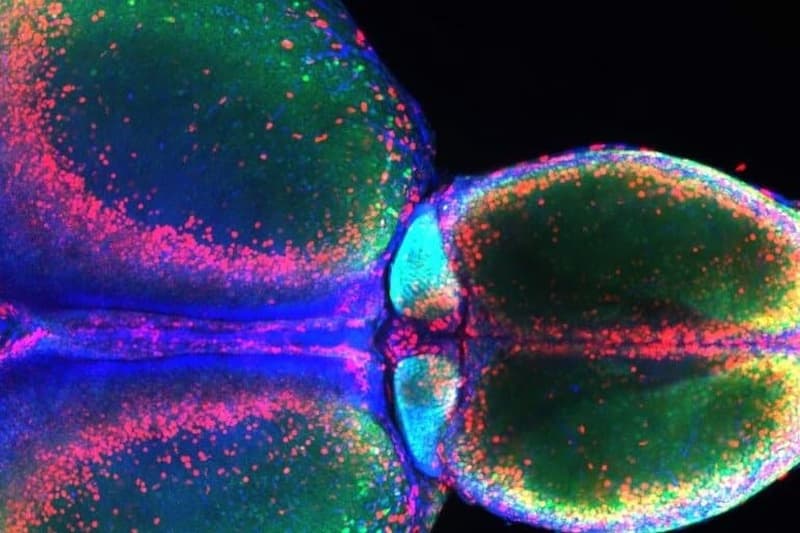
(Neuroscience News) A tiny region in the middle of the brain plays a far more important role than previously known in helping it respond to changes in the environment, a new study shows.
Related Do the People Who Rushed to Get the COVID Shot Have Buyer’s Remorse?
by Staff Writer, August 20th, 2021
This region is called the habenula, a name that reflects its directional role. Habenula means “little rein” in Latin, and a rein, of course, is the leather strap on a horse’s bridle used to direct it.
The study, conducted by researchers at the Norwegian University of Science and Technology’s Kavli Institute for Systems Neuroscience, was published Friday in the scientific journal Current Biology.
The researchers, with first author Ewelina Bartoszek, did their experiments in zebrafish, but the habenula is so important that evolution has ensured it is found in all vertebrates, from fish to mammals to humans. In fact, earlier studies in humans have found links between dysfunctions in the habenula to neurological conditions such as mood disorders and addiction.
Kavli Institute researchers showed that the habenula relays information from the outside world, such as smell and sight, along with internal states associated with emotions and learning, to the brain regions that control adaptive behaviors.
“It turns out that the habenula is an information hub,” said Emre Yaksi, a professor at NTNU’s Kavli Institute for Systems Neuroscience and head of the research group that did the study. “It integrates information about odors from the environment with the information from the limbic system, which is involved in emotional behaviors and learning.”
Translating signals from the outside into alerts
In other words, the brain may be in one state when the smell of a predator—or food, or a mate —wafts into the nose and reaches the habenula. The habenula translates that smell into a kind of alert or saliency signal to shift the brain into a different state, Yaksi said.
“We argue that the habenula helps the brain to stop certain actions and communications across brain regions, in order to shift it to another mode that is better suited to the situation that the scent warns of,” he said. “The brain’s different modes involve different dynamic networks that best enable the animal to solve the challenges that it is about to experience.”
The study highlights how important our sense of smell—or in more scientific terms, the olfactory system—is in regulating what happens in the habenula and the limbic system, during these sensory-induced state changes in the brain.
Finding ‘ancestral’ structures
Another important aspect of the study, Yaksi said, is that the experiments allowed the researchers to identify parts of the zebrafish brain that are “ancestral” to the hippocampus and amygdala in mammals.

In humans, the hippocampus is known to play a key role in our sense of where we are and our memory, while the amygdala is the area that helps process memories and emotional responses, such as fear.
“We also showed that these are the major cortico-limbic systems that drive the habenula,” Yaksi said. The researchers were actually able to observe this connection in zebrafish by stimulating the structures and seeing activity in the habenula, he said. This finding is particularly important as researchers continue to unravel the different roles that different parts of the brain play in cognition.
The researchers suggest that given the role of the habenula in regulating moods and brain states, sensory experiences might provide a non-invasive pathway to modify habenular activity, perhaps even in humans.
10 times more effective than ribavirin against Herpes (HSV1, HSV2), Swine flu (H1N1), Bird flu (H1N4), Pox (cowpox). Studied by the DoD for the Bioshield program. Get your Agarikon biodefense from Ascent Nutrition, one of the most pure and potent in the industry. Save 10% and get free shipping with a subscription!“I felt like I was getting a cold, but Agarikon stopped it in its tracks.”
Organic AGARIKON fights Viruses & Bio-warfare, and much more!

Stillness in the Storm Editor: Why did we post this?
The news is important to all people because it is where we come to know new things about the world, which leads to the development of more life goals that lead to life wisdom. The news also serves as a social connection tool, as we tend to relate to those who know about and believe the things we do. With the power of an open truth-seeking mind in hand, the individual can grow wise and the collective can prosper.
– Justin
Not sure how to make sense of this? Want to learn how to discern like a pro? Read this essential guide to discernment, analysis of claims, and understanding the truth in a world of deception: 4 Key Steps of Discernment – Advanced Truth-Seeking Tools.
Stillness in the Storm Editor’s note: Did you find a spelling error or grammatical mistake? Send an email to [email protected], with the error and suggested correction, along with the headline and url. Do you think this article needs an update? Or do you just have some feedback? Send us an email at [email protected]. Thank you for reading.
Source:
https://neurosciencenews.com/habenula-smell-emotion-19165/
Support our work! (Avoid Big Tech PayPal and Patreon)DIRECT DONATION
Leave a Reply