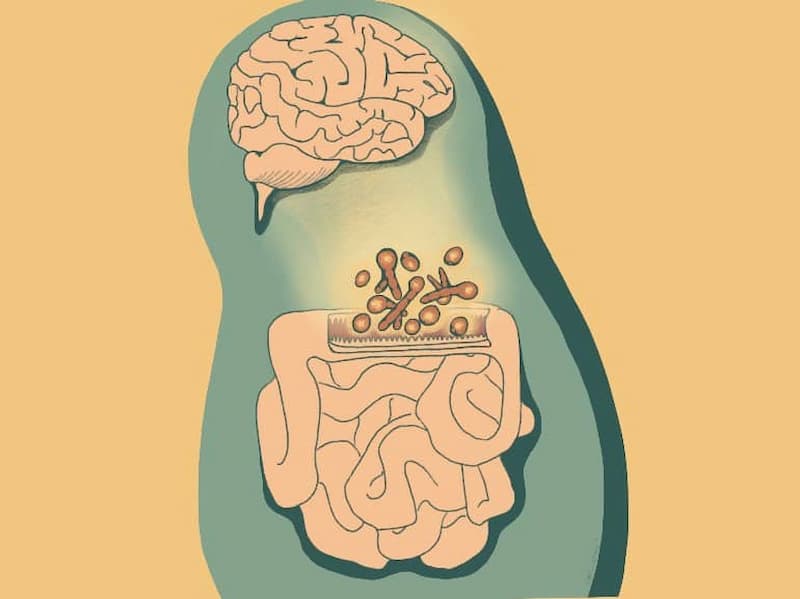
(Weill Cornell Medicine) A specific group of fungi residing in the intestines can protect against intestinal injury and influence social behavior, according to new preclinical research by scientists at Weill Cornell Medicine.
Related The Gut Trains the Immune System to Protect the Brain
by Weill Cornell Medicine, February 16th, 2022
The findings extend a growing body of work identifying a “gut-immunity-brain axis,” a signaling system that may have a wide range of effects on physiology in both health and disease, influenced not only by the body’s own cells but also the resident microbes.
The study, published Feb. 16 in Cell, reveals a novel set of molecular signals connecting fungi in the gut to their host’s cells throughout the body, including immune cells and neurons.
“We have made a direct link between a major immune pathway induced by fungi in the lining of the intestine and signals in the nervous system that impact animal behavior,” said senior author Dr. Iliyan Iliev, associate professor of immunology in medicine in the Division of Gastroenterology and Hepatology and a member of the Jill Roberts Institute for Research in Inflammatory Bowel Disease at Weill Cornell Medicine.
Drs. Dilek Colak, Melanie Johncilla and Megan Allen from Weill Cornell Medicine and Dr. Rhonda K. Yantiss from Weill Cornell Medicine and NewYork-Presbyterian also contributed to this study.
The lining of the intestine must balance conflicting needs, absorbing water and nutrients from food while acting as a barrier to prevent the vast population of microbes in the gut from invading the bloodstream.
Examining this system in a mouse model, the scientists mapped the locations of different fungi within the intestine and found that a unique consortium of fungi tends to accumulate at specific sites near the gut epithelium, or lining, suggesting that these species have colonized the gut and interact closely with the nearby epithelial cells.
Mice carrying some of these fungi enjoyed better protection against events that can disrupt the intestinal barrier, such as intestinal injury and bacterial infection. “There was fortification of those barrier functions when we added that specific fungal community to mice,” Dr. Iliev said.
Improving intestinal barrier integrity wasn’t the only effect of the fungi. In separate experiments, the team found that mice carrying the fungal community in their gut displayed more social behavior than animals without these fungi.
Both effects appear to stem from the animals’ own T cells, a type of immune cell. The fungi cause T cells to secrete two immune signaling proteins, cytokines IL-22 and IL-17. Fungi-induced IL-22 acts locally in the epithelium, strengthening its barrier function, while IL-17 enters the bloodstream and eventually reaches neurons, which have receptors for it. Mice lacking the IL-17 receptor in their neurons don’t exhibit the social effects of fungal colonization.
“There is this harmony—a kind of communication between or across different types of organisms,” Dr. Iliev said.
Now the investigators hope to explore that communication network further. “We are trying to go deeper into the mechanisms of this interaction, looking at the signals that are involved at the neuronal level in different brain regions,” said lead author Dr. Irina Leonardi, an instructor of immunology in medicine in Dr. Iliev’s laboratory at the Jill Roberts Institute for Research in IBD.
One tantalizing possibility is that different microbial communities in the gut could stimulate different regions of the brain and the immune system, exerting distinct effects on their hosts’ biology.
“This opens a whole new area to explore,” Dr. Iliev said.
10 times more effective than ribavirin against Herpes (HSV1, HSV2), Swine flu (H1N1), Bird flu (H1N4), Pox (cowpox). Studied by the DoD for the Bioshield program. Get your Agarikon biodefense from Ascent Nutrition, one of the most pure and potent in the industry. Save 10% and get free shipping with a subscription!“I felt like I was getting a cold, but Agarikon stopped it in its tracks.”
Organic AGARIKON fights Viruses & Bio-warfare, and much more!
Stillness in the Storm Editor: Why did we post this?
The news is important to all people because it is where we come to know new things about the world, which leads to the development of more life goals that lead to life wisdom. The news also serves as a social connection tool, as we tend to relate to those who know about and believe the things we do. With the power of an open truth-seeking mind in hand, the individual can grow wise and the collective can prosper.
– Justin
Not sure how to make sense of this? Want to learn how to discern like a pro? Read this essential guide to discernment, analysis of claims, and understanding the truth in a world of deception: 4 Key Steps of Discernment – Advanced Truth-Seeking Tools.
Stillness in the Storm Editor’s note: Did you find a spelling error or grammatical mistake? Send an email to [email protected], with the error and suggested correction, along with the headline and url. Do you think this article needs an update? Or do you just have some feedback? Send us an email at [email protected]. Thank you for reading.
Source:
https://neurosciencenews.com/gut-fungi-social-behavior-20082/
Support our work! (Avoid Big Tech PayPal and Patreon)DIRECT DONATION
Leave a Reply