
Related First Time Ever: The Baltic Dry Index Plunges To 394 As Global Trade Grinds To A Standstill
Source – The Economic Collapse Blog
We haven’t seen numbers like these since the last global recession. I recently wrote about how global trade is imploding all over the planet, and the same thing is true when it comes to manufacturing. We just learned that manufacturing in China has now been contracting for seven months in a row, and as you will see below, U.S. manufacturing is facing “its toughest period since the global financial crisis”. Yes, global stocks have bounced back a bit after experiencing dramatic declines during January and the first part of February, and this is something that investors are very happy about. But that does not mean that the crisis is over. All bear markets have their ups and downs, and this one will not be any different. Meanwhile, the cold, hard economic numbers that keep coming in are absolutely screaming that a new global recession is here.
Just consider what is happening in China. Manufacturing activity continues to implode, and factories are shedding jobs at the fastest pace since the last financial crisis…
Chinese manufacturing suffered a seventh straight month of contraction in February.China’s official Purchasing Managers’ Index (PMI) stood at 49.0 in February, down from the previous month’s reading of 49.4 and below the 50-point mark that separates growth from contraction on a monthly basis.A private survey also showed China’s factories shed jobs at the fastest rate in seven years in February, raising doubts about the government’s ability to reduce industry overcapacity this year without triggering a sharp jump in unemployment.
China’s premier told visiting U.S. Treasury Secretary Jacob Lew on Monday his government is pressing ahead with painful reforms to shrink bloated coal and steel industries that are a drag on its slowing economy and ruled out devaluing its currency as a short-cut to boosting exports.Premier Li Keqiang’s comments to Lew on Monday were in line with a joint declaration by financial officials from the Group of 20 biggest rich and developing economies who met over the weekend in Shanghai. They pledged to avoid devaluations to boost sagging trade and urged governments to speed up reforms to boost slowing global growth.Across all state-controlled industries, as many as six million workers could be out of a job, with almost two million in the coal industry alone.
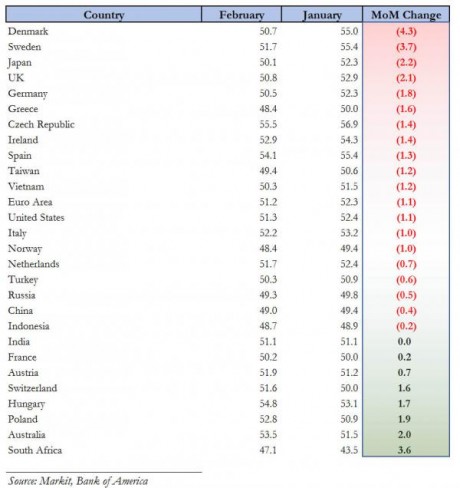
As the below table shows, 28 regions have reported so far. Seven saw improvements in their manufacturing sectors in February, twenty recorded a weakening, and India was unchanged. This means that over 70% of the world saw manufacturing sentiment deteriorate in February compared to January.In terms of actual expansion, there were 21 countries in positive territory and 7 in negative. In particular, Greece moved from neutral to contraction territory, while Taiwan dropped below breakeven from expansion.
“The February data add to signs of distress in the US manufacturing economy. Production and order book growth continues to worsen, led by falling exports. Jobs are being added at a slower pace and output prices are dropping at a rate not seen since mid-2012.“The deterioration in the manufacturing sector’s performance since mid-2014 has broadly tracked the dollar’s rise, which makes US goods more expensive in overseas markets and leads US consumers to favour cheaper imported goods.“With other headwinds including the downturn in the oil sector, heightened uncertainty due to financial market volatility, global growth worries and growing concerns about the presidential election, it’s no surprise that the manufacturing sector is facing its toughest period since the global financial crisis.“
_________
Source:
Leave a Reply