
| Image Source. |
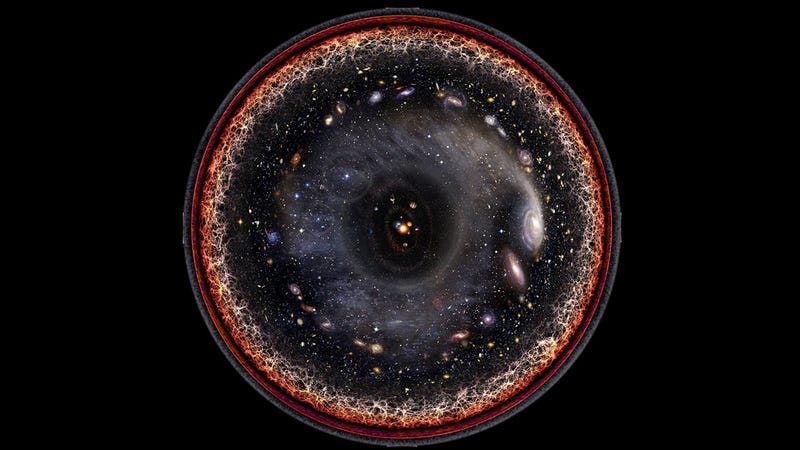
(Stillness in the Storm Editor) The expansion of the universe at an ever-increasing rate was a theory first proposed in the 1990s and is currently pushed through the media as accepted fact. But like many of the scientific theories floating around in our world today—as promulgated by propaganda networks like The Science Channel—there is no observed evidence to support this conjecture.
The article below details a study recently conducted by Oxford University that observed Type Ia supernovae suggesting that the universe is actually expanding at a constant rate. Data gathered deflates the theory that “dark energy” exists in the universe. Since the universe isn’t expanding at an accelerated rate there is no need to suppose that some mysterious source of energy exists.
Dark energy, like dark matter, has never been observed and is an invention to account for misperception—at least this is what many non-conforming cosmologists believe. Electric Universe proponents are especially keen on debunking many of the fallacies rife within cosmology today, dark energy and matter being among them.
Speaking as someone who has a background in science and has studied physics, I can personally say that there is an unacknowledged problem insofar as confusing model with reality that touches nearly every aspect of scientific study. Modeling is the process by which mathematics is used to illustrate a theory and should always be guided by observation. But in the late 19th century, science began to confuse representations with reality, and since then whole schools of thought have emerged based purely on conjecture, brandished as fact to the public and students alike.
This recent study is yet another example showing that as outsiders—those of us who lack the time or personal skills to understand these things individually—we must not place our faith blindly in the priesthood of science, sometimes called scientism.
Related Peer Review Hoax Exposed-60 Faked Papers Discovered In Accepted Science
– Justin
by Dom Galeon, October 23rd 2016
A new study out of Oxford University is questioning the accelerated expansion theory that says dark energy is driving the expansion of the universe. According to the study, accelerated expansion theories are based on an unobserved model, opening up the possibilities to new theories on our expanding universe.
The theory the universe has been expanding at an increasing rate, first proposed in the late 1990s, is now facing a new round of criticism by a team of scientists from Oxford University’s Department of Physics.
The theory of an accelerated expansion was developed by analyzing Type Ia supernovae (thermonuclear explosion of dying stars) via the Hubble Space Telescope. It put a strange substance called dark energy — the alleged driver of this accelerated expansion — into the limelight.
Now, the Oxford team led by Professor Subir Sarkar, a fellow at the Neils Bohr Institute, is challenging this Nobel-winning idea. After analyzing a catalog of 740 Type Ia supernovae, ten times more than the original 1990s sample size, the researchers said the accelerated expansion theory falls short of scientific accuracy, according to the study published in Scientific Reports.
“The evidence for accelerated expansion is, at most, what physicists call ‘3 sigma’,” Sukar said, according to Phys.org. “This is far short of the ‘5 sigma’ standard required to claim a discovery of fundamental significance.”
Sarkar said other evidence suggesting an accelerating universe, like the cosmic microwave background, were all made under the framework of an assumed and unobserved model.
CHALLENGING PREVIOUS ASSUMPTIONS
The research shows data more consistent with the theory of expansion at a constant rate. It’s a bold claim, one that questions many of the theories we currently hold about the nature of the universe, including what we know about dark energy (which is already so little, to begin with).
 Expansion simulation. Credits: Heitmann et. al.
“A more sophisticated theoretical framework accounting for the observation that the universe is not exactly homogeneous and that its matter content may not behave as an ideal gas — two key assumptions of standard cosmology — may well be able to account for all observations without requiring dark energy,” Sarkar said, according to Phys.org.
Such is the way of science: Theories are created and new theories are formed as a result of better technology and fresher data.
_________________________
Stillness in the Storm Editor’s note: Did you find a spelling error or grammar mistake? Do you think this article needs a correction or update? Or do you just have some feedback? Send us an email at [email protected]. Thank you for reading.
Source:
http://futurism.com/no-the-universe-is-not-expanding-at-an-accelerated-rate-physicists-say/
Leave a Reply