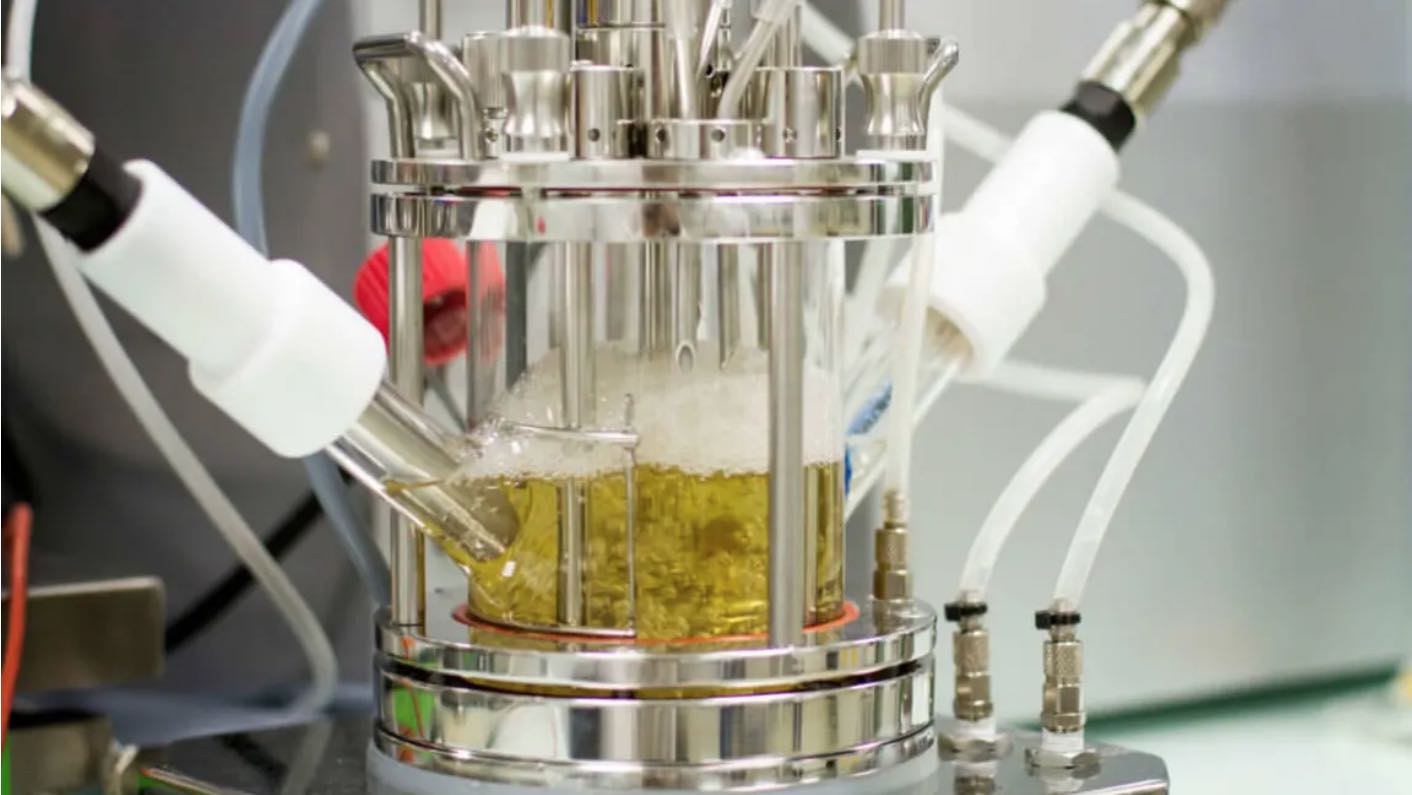
(Andy Corbley) Utilizing an enzyme found within composted leaves, scientists are now breaking down plastic all the way into a recyclable form in a matter of hours. Carbios, the French company responsible for the breakthrough, is already collaborating with Pepsi and L’Oréal to unleash industrial market-scale production of the new substance within five years.
Related Photographer Captures Once-in-a-Lifetime Shot of a ‘Horizontal Rainbow’ That Filled the Entire Sky
by Andy Corbley, April 12th, 2020
“We are the first company to bring this technology on the market,” the deputy chief executive at Carbios, Martin Stephan, told The Guardian. “Our goal is to be up and running by 2024–2025, at large industrial scale.”
Their discovery, which sources described as a major advance, joins an arsenal of solutions for plastic pollution control that have appeared over the last decade.
Just like Boyan Slat who took on the Great Pacific Garbage Patch, or the bracelet folks at 4Ocean who took on the problem of ocean pollution in rivers, the scientists from the University of Toulouse are applying their breakthrough to another part of the problem—the recycling of plastic.
Plastic isn’t straightforward to recycle. There are common varieties of plastic made from multiple layers of different esters, each one requiring different equipment or temperature to breakdown. And, there are a lot of plastic esters that could be recycled but aren’t because the market value for the recycled material is so low it can’t financially sustain the operation.
In the scientist’s paper published in Nature, they detail how poly(ethylene terephthalate) PET, the most common polyester plastic, loses much of its mechanical utility when heated for recycling. Therefore, creating new material is preferred, and PET waste continues to accumulate.
Book Mycelium Running: How Mushrooms Can Help Save the World
Their new enzyme achieves a minimum of 90% de-polymerization in just 10 hours, meaning that the polymers—large complex particles, become monomers—small single particles in less than a day, and perhaps even more amazing, end up as biologically depolymerized plastic that can actually be reused to create things like plastic bottles.
While manufacturing plastic bottles from recycled PET made by this enzyme would cost about 4% of the amount needed to make new bottles from fresh petroleum, the recycling infrastructure, including the grounding up and heating of the plastic bottles before the enzyme is added would still make it more expensive in the end.
Nevertheless, the future is bright for this technology. Co-enzymes could be synthesized, companies could produce more inexpensive recycling infrastructure—both of which could finally bring down the cost of producing recycled plastic goods.
Carbios has also begun tackling the normally unrecyclable plastic film problem. In an alliance with several other European companies under the name Carbiolice, they demonstrated a plastic film last year that can be compostable in home or municipal compost piles. Their objective will be to address the markets of plastic films and single-use bags—and later on, rigid packaging and disposable tableware.
“These milestones reinforce our ambition to offer the market circular economy solutions that are both competitive and eco-friendly, and which will revolutionize the end of life for plastics and textiles.”
Stillness in the Storm Editor: Why did we post this?
The preceding information is an update from one of the many alternative media persons driven to help humanity by providing important information. Updates of this sort, as cursory as they are, help individuals feel connected to the greater works taking place at this time as well as providing a personal glimpse into the mind of a content creator. It also serves to humanize such individuals and reveal to the public that alternative media is largely populated by people that work long hours providing information usually for free or for little financial compensation.
– Justin
Not sure how to make sense of this? Want to learn how to discern like a pro? Read this essential guide to discernment, analysis of claims, and understanding the truth in a world of deception: 4 Key Steps of Discernment – Advanced Truth-Seeking Tools.
Stillness in the Storm Editor’s note: Did you find a spelling error or grammatical mistake? Send an email to [email protected], with the error and suggested correction, along with the headline and url. Do you think this article needs an update? Or do you just have some feedback? Send us an email at [email protected]. Thank you for reading.
Source:
https://www.goodnewsnetwork.org/newly-developed-enzyme-breaks-down-plastic-bottles-in-hours/
Leave a Reply