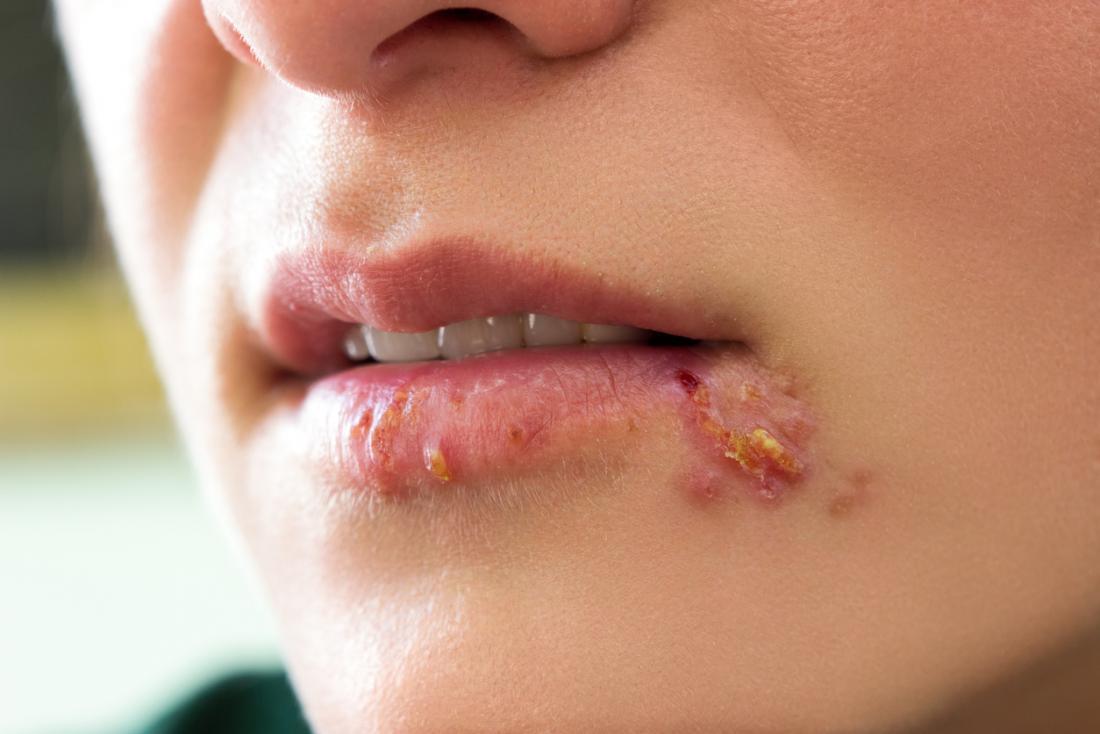
(Collective Evolution) Let’s be honest: There’s a huge stigma surrounding herpes. It ends up being a make or break for tons of relationships and is something that’s feared and looked down upon in the dating world. For those with herpes, it can be a confidence crusher and a reason to remain disconnected from others, ultimately creating further division amongst us all.
Related Cuddling up With Your Partner Can Lead to Better Sleep
by Staff Writer, May 14th, 2020
Ask yourself: If you found out your current (or potential future) partner had herpes, would you stay with him or her? If you feel like you can answer that question without any hesitations, then I challenge you to question whether you even know what herpes really is and what its symptoms look like. Can you be positive you don’t have herpes? You could be a part of the 87.4% of infected individuals who don’t even know they have herpes, according to the U.S. Centers for Disease Control and Prevention (CDC).
The truth of the matter is, according to the World Health Organization (WHO), approximately 3.7 billion people below the age of 50 have HSV-1, more commonly referred to as cold sores. Another 417 million people between the ages of 15 and 49 are infected with HSV-2, which is typically considered to be a sexually transmitted disease (STD). However, 140 million people get genital infections from HSV-1, those pesky cold sores you may have had in or around your mouth, meaning that half a billion people could sexually transmit either virus.
To gain a better understanding of herpes, let’s debunk some of the more commonly heard myths:
Myth #1: Cold sores and herpes are very different
The CDC defines genital herpes as, “a sexually transmitted disease (STD) caused by the herpes simplex viruses type 1 (HSV-1) or type 2 (HSV-2).” So, very clearly, you can become infected with herpes from cold sores or susception to the STD itself.
Raquel Dardik, MD, Clinical Associate Professor at NYU Langone’s Joan H. Tisch Center for Women’s Health, states, “Many people wrongfully believe that cold sores don’t count as ‘real’ herpes.” It’s important to note that although their symptoms typically manifest differently, HSV-1 in the mouth and HSV-2 around the genitals, all it takes to transfer the infection is skin-to-skin contact. In other words, the sores from both viruses can form anywhere on your body.
[the_ad id=”77758″]
Even if there’s no genital to genital interaction, you can still get HSV-2. For example, if you are performing oral sex on your partner, you can contract HSV-2 and develop sores in your mouth. Yes, it’s more common for HSV-1 to form around the mouth and HSV-2 on the genitals, but that doesn’t mean it’s the only place you can get a breakout.
Myth #2: If you’ve never had an outbreak, you don’t have herpes
Wrong. You could have herpes for your entire life and never have an outbreak, or at least the type of outbreak so many people are terrified of experiencing. Now that you know that, the fact that 87.4% of infected individuals have no clue they have herpes doesn’t seem so unimaginable.
As Fred Wyand, Director of Communications for the American Sexual Health Association, explains, “Outbreaks can be very mild and even confused with things like heat rash, jock itch, yeast infections, allergic reactions… So while some cases do involve pronounced symptoms, most never do.”
Book An Epidemic of Absence: A New Way of Understanding Allergies and Autoimmune Diseases
Myth #3: I get tested for STDs regularly, so I can’t have herpes
Like many other STDs, when it comes to herpes, it’s all about the timing of your test. Herpes takes at least two weeks to be detected, but can sometimes take months to appear. If you have a routine checkup for STDs, herpes often isn’t included, as the CDC doesn’t recommend frequent testing for it.
Myth #4: Herpes isn’t contagious if there’s no visible outbreak
Since we’ve already established that outbreaks aren’t always obvious or can be mistaken for other issues, this isn’t 100% true. This is due to viral shedding, which Wyand explains: “There are a few days a year when herpes is active, and possibly transmitted without any symptoms present…. This doesn’t happen on most days, but it’s tricky, because there’s no real way to know.”
Myth #5: I have herpes, so I can’t have kids
If you hope to have children one day, don’t worry — herpes won’t ruin that dream for you. Herpes in no way affects your fertility, so you’re just as likely to become pregnant with herpes as you are without the infection. You don’t need to be overly concerned about passing the virus to your children either, as there are numerous safe options for delivering your baby to avoid this.
However, there are still some added risks associated with having herpes while carrying a child. Unfortunately, genital herpes can increase the risk of miscarriage and premature birth, and in rare cases, herpes can be a dangerous infection in newborns, although this is only an issue if the mother has an outbreak at the time of birth.
Myth #6: My partner suddenly got herpes, so he/she clearly cheated on me
One of my former partners suddenly got genital warts from an unknown source after we’d been dating for quite some time. If a similar situation occurred with your partner, don’t automatically assume that he/she cheated on you.
In fact, even if you and your partner have been together for 20 years, this could still be a possibility. This is because you can have herpes without experiencing any symptoms or your partner could have mistaken previous symptoms as being a result of another health issue.
Of course, your partner may have cheated on you, but that’s not the only explanation. If you find yourself in this situation, you can either trust your partner’s explanation, or you could meditate on it and trust your own intuition.
Book Fake Science: Exposing the Left’s Skewed Statistics, Fuzzy Facts, and Dodgy Data
Stillness in the Storm Editor: Why did we post this?
The news is important to all people because it is where we come to know new things about the world, which leads to the development of more life goals that lead to life wisdom. The news also serves as a social connection tool, as we tend to relate to those who know about and believe the things we do. With the power of an open truth-seeking mind in hand, the individual can grow wise and the collective can prosper.
– Justin
Not sure how to make sense of this? Want to learn how to discern like a pro? Read this essential guide to discernment, analysis of claims, and understanding the truth in a world of deception: 4 Key Steps of Discernment – Advanced Truth-Seeking Tools.
Stillness in the Storm Editor’s note: Did you find a spelling error or grammatical mistake? Send an email to [email protected], with the error and suggested correction, along with the headline and url. Do you think this article needs an update? Or do you just have some feedback? Send us an email at [email protected]. Thank you for reading.
Source:
https://www.collective-evolution.com/2020/05/14/is-everything-we-know-about-herpes-completely-wrong/
Leave a Reply