
(Stillness in the Storm Editor) An intimacy crisis is at our doorstep. Life, in a sense, is all about finding better ways to meet our fundamental needs. These needs are personal, social, and universal, a blend of animal instincts and biological urges energizing an evolving psyche, even an emerging spiritual nature—the soul. Since time immemorial, humanity has had to contend with these needs, yet we continue to struggle with them in our advancing world—especially the grandest of needs, the desire for intimacy, fellowship, and union with others.
Related Admitting Your Grievances Against Your Partner: Your Best Hope For Healing Your Relationship
The article at the bottom of this introduction presents statistical studies that demonstrate intimacy problems are on the rise.
In the following introduction, I’ll lay out some reasons why this might be the case, leaning on an eclectic body of research that ties psychology, neurology, energy medicine, the mind-body connection, and spirituality together in one comprehensive body of understanding.
Love and Intimacy’s Transforming Power
There are multitudes of reasons why individuals experience intimacy problems—specific to the individual. But in the main, the same principles or mechanics are at work in everyone. In short, healthy intimacy is all about recognizing your needs and finding better and better ways to realize them, with a trusted partner.
Sexual intimacy, which is only one of the many types of intimacy human beings crave, is arguably the most all-consuming because sexual desires incorporate nearly everything we experience within the universe that makes up who we are. This can be easily recognized by how powerfully “falling in love” acts as a catalyzing agent for personal growth and change. Of course, some people change themselves for the worse when they fall in love, while others realize undreamed of states of personal growth, development, and self-mastery.
“The power of love doesn’t know the word “impossible.” Action combined with love can transform dreams into reality”
― Debasish Mridha MD
Buy Shared Heart: Relationship Initiations and Celebrations
The psychological mechanic at work here is admiration, what religions called worship in the past. “That which you love the most you seek to become like”—hence, loving a “bad person” slowly turns you into one, to put it simply. Conversely, love placed in the right hands is one of the greatest tools for healing, growth, and empowerment.
Almost everyone agrees that love is one of the most powerful creative forces in the universe. But this raw creative energy needs to be directed properly, by you, the one who is the repository of such soul catalyzing energy.
Sexual desires—wrapped up with the urge to love and be loved—is more than just getting your rocks off, it’s about sharing the fullness of who you are with another person, in one of the most naked, vulnerable, and revealing ways possible.
The simple act of revealing yourself opens you up to change. If the experience is positive, it will reinforce certain aspects of your personality. if it is negative, it will dissolve or harden certain aspects. Thus, intimacy is simultaneously one of the most powerful tools for personal development, in a social setting, while also a potential agent of destruction and chaos.
When we find the courage to reveal ourselves fully to another, resulting in a truly satisfying experience, we often call this “being in love.” Love, in this self-acceptance and other-acceptance way, acts as a stabilizing and expanding agent for those attributes within us that were active during the experience. If we took a risk, let ourselves “go wild” in the heat of the moment, and it was received well and satisfactorily, we’ll feel more confident to do the same later. The inverse causes the reverse effect, we’ll withdraw in ourselves and reduce our vulnerability.
Biological Sexual Instincts Distorted Through Culture
According to Wilhelm Reich, a psychologist who studied sex in relation to the psyche in the early 20th century, sexual energy builds up in the body, using pranic energy channels recognized by Eastern Medicine.
This sexual energy charge is a tension that seeks to be relieved through sexual expression, ideally with a person we love or feel affection for. Inhibited or suppressed sexual urges, usually formed as a result of cultural influence, hinder sexual expression and true orgasmic release, as Reich termed it. The inability to release built up sexual energy results in psychic disturbances, or in modern terminology, psychological problems and conditions. Interestingly enough, this also causes physical health problems as well, like cancer and autoimmune diseases. If Reich were alive today, he would likely assert that the vast host of psychological problems diagnosed by modern-psychologists are in fact sexual disturbance issues—and his evidence-based work seems to prove this point quite well.
Reich’s research is far too vast to quickly list present here. But it might be summed up as follows.
Our biology and psyche yearn for intimacy. We need it as infants (the need to be touched), we need at as young people (cuddling, hugging, and rough and tumble play), and we need it as adolescents and adults (sexual play and union). Biology merely provides the basic instincts. Culture is the lens through which this biological sexual energy finds expression in our desires.
Thus, if a culture hasn’t incorporated the realities of biology and human nature, it will limit or inhibit an individual in their capacity to sexually express themselves.
Reich determined that the vast majority of mental disturbances, including physical health problems, resulted from an inability to properly release sexual energy charge; and that the primary reason why this happens is that the individual is oppressed by the culture in which they were reared.
Enculturation refers to the slow process of personally internalizing cultural norms, mores, beliefs, and taboos.
For example, if your culture considers burping at the dinner table to be distasteful, that biological urge will initially be suppressed by an external force—punishment—usually through your parents. They will shame you, punish you, and embarrass you—a behavioral modification technique—causing you to develop personal reasons for not burping at the table, namely avoiding punishment and loss of social status. Eventually, the social inhibition is internalized—you choose not to burp at the table, not so much to avoid punishment but to retain social standing and acceptance within your family or ingroup. Thus, the primary psychological motivator of an enculturated personal inhibition is an internalized extrinsic taboo—the desire to avoid loss of social standing by self-censorship or choosing to do the will of the culture that you inhabit.
Here, the problem is that a natural urge is there for a reason and a culture’s duty to the individual is to incorporate reality into cultural norms and values.
Using the example above, burping facilitates healthy digestion, through the removal of excess gas from the gastrointestinal tract. If the culture was healthy, it would find a way to allow the individual to express their innate biological urges without fear of loss of social status.
Why do intimacy problems arise?
Likely because of internalized cultural influences. But culture isn’t only the grand social aggregate of a nation or religion. Culture, insofar as influencing the individual, could be as small as two people, most notably, a couple, or family unit. There’s the culture of your romance, the culture of your family, the culture of your friend network, the culture of your workplace, the culture of your township or city, and the perceived culture of your social media networks, nation, and the planet. All these, and more not listed here, influence your personal behavioral choices within various settings.
In general, part of you evaluates your behavior in terms of the social groups you’re apart of. You decide if your personal choice should be acted on by thinking about what it might do for your social status—this appears to be an innate human drive. Sexually, a lot of people filter their expression through this cultural influence. Thus, comprehending how your culture influences you is vitally important to address any intimacy issues you might be dealing with. And arguably the most influential cultural force is the micro-culture of the family unit, the husband-wife, boyfriend-girlfriend, domain of social interaction.
In the past, the prevalence of social mores and religious traditions made it easier to understand the relationship between culture and sexual expression. Clearly, if your religious institution considers sexual release, like masturbation, an evil sin, this would create psychological blocks that limit expression. Most will agree that this taboo creates a serious double-bind situation—you feel strong passions and desires for sexual expression, yet your culture tells you to do so is evil, and if you do, you’ll be socially ostracized. We dealt with this in the past by doing things in private, by acting one the way in public while doing something different behind closed doors.
Reich, and many more—both within mainstream psychology, and alternative psychology—cite many cases wherein people who grapple with moral stigmas related to sexual expression experience major and sometimes catastrophic mental disturbances, such as, catatonia, mania, bipolar disorder, borderline personality disorder, pedophilia, rap, murder, and many more.
What all this suggests is that how you, personally, make sense of sex and your desire for it directly corresponds with the nature of your mental health. By extension, the health of your relationships is also tied to how you define these urges and the way you allow yourself to express them.
Psychologically, sex, as we know it in everyday life, is a blend of biological instincts and cultural influences.
In effect, you are the maestro or author of your sexual tastes and desires, through the choices you make in relation to how you express your desires within your culture. If sexuality is truly embraced by your culture, mechanisms to encourage healthy expression will be present. This was apparently the case in the Trobrianders tribes of Papua New Guinea, who, according to Reich and James DeMayo, realized a culture that was so in harmony with nature, anti-social behavior of all types never manifested. Rape, murder, theft, infidelity, and sexual perversion, in general, was non-existent for this tribal people. Reich concluded that the reason this was the case was due to the fact culture embraced human nature, as opposed to attempting to suppress it.
Causally, you’re born with undefined desires for intimacy. The way you choose to realize these desires comes from culture. You look to adults, stories of romance, and anecdotes to understand “acceptable” ways of expressing yourself. A reciprocal relationship slowly biases these desires over time. Then, as you act on these culturally conditioned methods of expression, they embed themselves in your psyche after the fact as value acquired behaviors. Eventually, culturally influenced behaviors become entrenched, feeling like they were always there, when in fact, they emerged through a slow process, often beginning in a primordial fashion during childhood.
As a proof of the influence of culture on sexual expression, and just how plastic or prone to change our sexual desires are, consider the psychological effects of pornography. Many of the sexual tastes of modern-day people emerged directly through their observation of the things people do in porn. When you watch porn, you tend to assume that, more or less, what you’re seeing is acceptable, even desired by potential sexual partners. This creates the social feedback loop that entrenches a sexual proclivity into a cultural population.
Online porn users, whether a mild “healthy” or borderline addictive usage, appears to cause alterations of sexual choices and proclivities. High-speed online video porn, in particular, seems to have the strongest neuroplasticity effects. Research shows, the more you watch online porn, the more distorted your innate sexual desires become, due to diminishing return effects that cause you to seek more wild and new sexual scenes for exciting your desire.
Here’s how we think porn affects the psyche.
When you’re watching porn, a part of the brain normally stimulated during normal sexual experiences comes online but without a person to anchor it to. The video images are not dynamic, they are static in that there is no possibility of engaging novelty—interactive play. You’re a spectator, not a player. But sexuality is a full-contact sport, so to speak. This means that while porn can entice you through visual imagery and fantasy, there’s no hope of intimate contact with a real person. As a result, the responses you feel from specific porn images diminishes over time.
A video you watched the first time might have triggered an extremely intense sexual sensation. A week later, the same video might not even register a response. As a result, you’ll naturally seek for something new, something edgier, more daring, more exciting, even fringe or kinky. This step into an unknown zone of sexual fantasy, especially if it feels abnormal for you, triggers the adrenal system, causing a blend of both sexual excitation and thrill-seeking responses. This rewires the brain to seek for adrenaline pumping experiences during sex. As a result, a porn user will need to chase progressively more intense and divergent sexual scenes in porn to feel the same excitement they felt in the beginning. Eventually, in as little as a few weeks, your sexual tastes can change radically. Thankfully, cessation of porn watching quickly reorients the psyche back to healthy practices, especially if combined with a consciously applied methodology of restoring healthy sexual function.
Buy Book Your Brain on Porn: Internet Pornography and the Emerging Science of Addiction
What’s the effect?
Case studies reveal that online porn habits can distort innate sexual desires as quickly as within a few weeks. In many cases reported, men, who considered themselves heterosexual and rather normal—vanilla, as it is called online—quickly develop desires for transgender porn or homosexual porn—but it can go much further than this. Many men report questioning their sexuality because they feel themselves getting excited about things they never considered before. But it’s not just men, women can experience the same distorting effects. But women, tend to read porn, instead of watching it, which appears to have different effects on the psyche.
While this writing isn’t meant to offer a value analysis of pornography usage, enough data is herein presented to make the case that porn unquestionably changes the psyche and sexual behaviors.
The porn point is raised herein as evidence for the incredible power that culture has on sexual desire and how we define and express it in our lives. As a side note, online porn usage, as little as an hour a day, has been associated with a host of psychological problems, such as social anxiety, self-worth issues, sexual dysfunction, and low-self esteem, to name a few.
Sex and Acceptance
Sexual expression is one of the most powerful ways to feel personally accepted by another, and as such, it is often wrapped up in our need for acceptance of self at the grandest level. When we fail to find a way to express our sexual desires the way we want, this makes us feel unaccepted in general. This is cited as a possible reason why porn addicts can experience such profound social anxiety—because their isolated sexual experiences don’t impart true fellowship.
The situation becomes even more complex when we’re in a romantic relationship, especially traditional arrangements like monogamy.
Most people engage in monogamous style romantic partnerships. Even if people don’t on the surface, the psychological character of many relationships employs monologue ways of thinking. By this I mean, our brain seems to be designed for monogamous relationship arrangements, and even in polyamorous settings, monogamous urges still assert themselves.
Monogamous urges, psychologically, create a situation wherein you expect and need your partner to embody certain characteristics in order to create, for you, a peek sexual experience. It appears, that once you enter into a union with someone, even if it isn’t defined as monogamous, we tend to define that relationship in terms of trusting association—one-on-one. That is, if you had the best sexual experience of your life with a one-night-stand, most people will naturally nest that experience within a monogamous narrative structure—they’ll start placing the agency of peek sexual experience in the hand of this glorified partner, who “haunts them for all their days,” becoming the yardstick of what should happen in a relationship with another.”
This point in and of itself is fascinating, but not the focus of this writing. It is presented here to assert that sexual union, in any respect, creates social bonds with people, which seem to rest on ancient psychological mechanisms associated with pair-bonding instincts. These mechanisms play a factor in determining how we express ourselves sexually.
There are many factors that play a role in peek sexual experiences, such as ancient biological instincts, cultural influences, and personal tastes and proclivities. Generally speaking biological instincts and cultural influences play the biggest role in shaping how we form our personal desires.
In a relationship, which could be a recurrent non-monogamous scenario (friends with benefits) or a marriage, acceptance of self is one of the things we’re seeking to gain. We also want to be seen by our partner as an ideal version of ourselves. Thus, we simultaneously crave totally acceptance, while also craving the acceptance of who we want to be. Managing this with your partner can be challenging for many reasons. In short, a healthy relationship walks the line between total acceptance of who we are while also incorporating the way we want to be seen.
What does any of this have to do with intimacy issues?
As was stated earlier, sexuality is complex in application, for the individual, while being fairly simple in principle for humanity at large.
Generally speaking, intimacy issues arise because:
1. Culture failed to provide a realistic method for encouraging the development of healthy sexual release and exploration.
2. Individuals internalized sexual blocks that limit their ability to express the full complement of their sexual desires.
3. The partner’s we’ve chosen influences us at a microcultural level, hindering our willingness to be vulnerable insofar as being “naked” with our desires in front of another.
A sexual trauma, for sake of argument in this writing, we’ll define as a sexual experience that causes inhibition or blockage of desire and expression. For example, if you tried something new with your partner, and it went horribly wrong, this trauma could stifle sexual expression with your partner in the future.
If you felt a sexual urge, and you chose not to act on it due to fear of cultural reaction (social embarrassment and loss of social status), you’ll create a block in your psyche that leads to sexual frustration.
Sexual frustration is the desire for something, often specific, which you consider unattainable. Thus, you question the agency of sex in general, when feeling sexually frustrated.
In relationships, sexual frustration could be due to many reasons, such as one partner’s inability to properly employ foreplay or romance—as mind and imagination are the best aphrodisiacs. Or it could be due to a sexual performance issue, such as premature ejaculation. Regardless of the specific problem, due to the seemingly inductive power of monogamous contextualization, you “outsource” peek sexual experience to your partner. That is, we tend to place the burden of responsibility for our sexual needs on our significant other. If you can’t get that experience, no matter how reasonable or unreasonable, this leads to sexual frustration. If the situation isn’t corrected, a pattern of unsatisfactory sexual experiences results in a loss of overall sexual desire.
This is the ill-fated plight of many long-term couples in the modern world. Sexless marriages, according to several studies, make up as much as 20% of all marriages. However, these studies don’t determine the potency of sexual contact. Clearly, a “sneeze in the pants” sexual act isn’t nearly as satisfying as an hour of deep intimate contact and lovemaking.
Thus, the question for determining overall sexual health in a population isn’t “How often are you having sex?” it’s “How often do you have fully satisfying sex?”
In this latter respect, we don’t really have good data to work with. But in a personal survey of sexual satisfaction, I have determined that the vast majority of people experience some degree of sexual frustration, whether single, coupled, or married.
Unchecked sexual frustration causes disillusionment with the agency of sex in general. Many suffering long term sexual dysfunction turns away from the pursuit of maximum sexual satisfaction entirely, accepting less than ideal sex as the norm. However, according to Reich and many other sexual researchers, the ideal is a peek sexual experiences—and a part of us seems to know this at a deep level. Thus, we might convince ourselves that a fast-food meal is all we need, but deep down, we know that only a fancy feast can truly satisfy our soul.
Thus, there’s a serious and glaring problem in our world.
Biologically, we crave real and totally satisfying sexual experiences. Psychologically, these urges can be distorted through culture, whether at the macrocosmic societal level or at the microscosmic couple/familial level. But due to culture’s failure to properly attune itself to biological realities, alongside arguably unhealthy modes of discharging sexual energy (porn), a growing problem of intimacy is sweeping the planet.
Final Thoughts
The research seems to confirm over and over again how important healthy sexual function is. Yet these essential and primal human needs remain largely misunderstood and ill satisfied.
Despite the so-called “sexual revolution and liberation” scores of people feel dissatisfied, and many of those dissatisfied people eventually turn away from sex entirely.
What’s worse, more and more young people appear to have had their sexuality stifled at a young age, likely due to the influences of modern-day media. Japan is potentially the worst country affected, as nearly a third of people under 30 never engaged in sex at all.
The solution seems rather simple. We need to get back to nature, understand the truth about what being human is, and work to make culture reflective of reality.
We need healthy examples of true sexual expression. We need social mechanisms to teach people, at all ages, what healthy sexuality is. We need researchers to fill in the gaps in our understanding. And finally, and arguably most importantly, we need to carefully invalidate bad ideas about sex, through honest and valid research, so as to install new cultural mores that properly teach people how to express their sexual urges in a healthy way.
On this score, I have made the restoration of the human family a primary focus of my work. Of which, healthy sexual expression and pair-bonding is a key pillar.
In the final analysis, sex is a tough subject to discuss honestly and openly for many reasons. It can be uncomfortable, it can trigger self-defensive responses and even social taboos. But if we want to make our world a better place, I would say, we must dare to question the dogma of the past, and respectfully introduce better cultural mechanisms for the future.
We’ve made many great advances in the past. And we must continue to evolve through honest inquiry and respectful discourse.
Culture can change, indeed it does by and through our personal actions. But radically changing a culture without an ethical and respectful process of doing so often leads to disaster.
In this sense, the ultimate solution to this problem may take generations to effect. But it can be done if, as individuals, we seek to understand our nature more fully, tactfully sharing that with the world and our fellows in the domain of social interaction. In this way, each individual’s choice adds to the tapestry of our civilization’s culture.
The wolf we feed is the one that wins in the end.
– Justin
Read more articles by Justin Deschamps.
Like our work? Support this site with a contribution via Paypal, cryptocurrencies, or P
(Christopher Ingraham) The share of US adults reporting no sex in the past year reached an all-time high in 2018, underscoring a three-decade trend line marked by an aging population and higher numbers of unattached people.
Related How Blaming Can Destroy Intimacy
by Christopher Ingraham, April 1st, 2019
But among the 23 percent of adults – or nearly 1 in 4 – who spent the year in a celibate state, a much larger than expected number of them were 20-something men, according to the latest data from the General Social Survey.
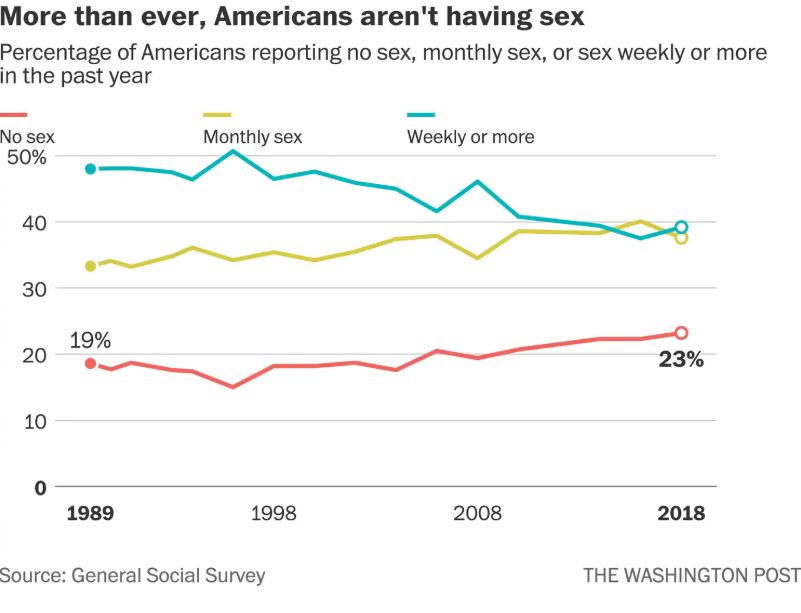
Experts who study Americans’ bedroom habits say there are a number of factors driving the Great American Sex Drought.
[the_ad id=”69933″]
Age is one of them: The 60-and-older demographic climbed from 18 percent of the population in 1996 to 26 percent in 2018, according to the survey.
The share reporting no sex has consistently hovered around 50 percent, and because that age group is growing relative to everyone else, it has the net effect of reducing the overall population’s likelihood of having sex.
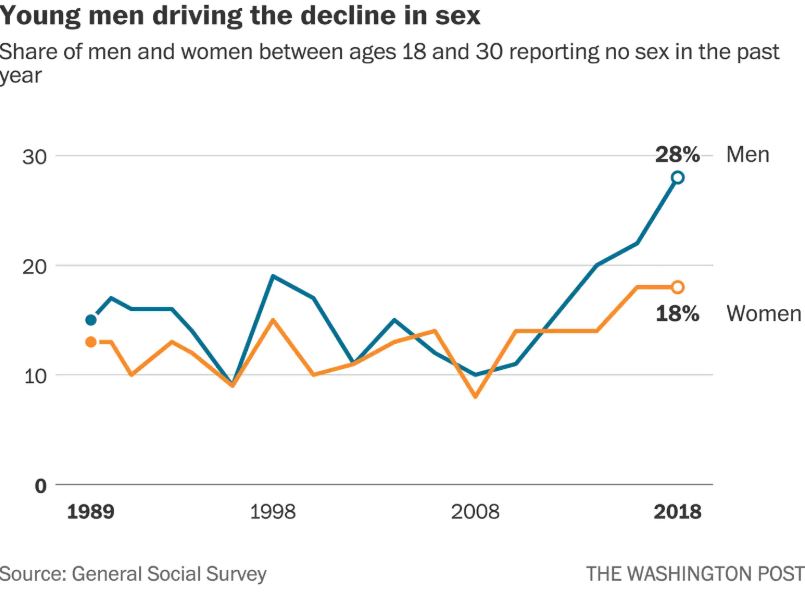
But changes at the other end of the age spectrum may be playing an even bigger role. The portion of Americans 18 to 29 reporting no sex in the past year more than doubled between 2008 and 2018, to 23 percent.
Jean Twenge, professor of psychology at San Diego State University and author of iGen: Why Today’s Super-Connected Kids Are Growing Up Less Rebellious, More Tolerant, Less Happy – and Completely Unprepared for Adulthood, said in an interview that growing sexlessness among America’s 20-somethings is primarily attributable to partnering up later in life.
“There are more people in their twenties who don’t have a live-in partner,” she said. “So under those circumstances I think less sex is going to happen.”
Americans in their 30s, 40s and beyond, meanwhile, are much more likely to be married than those in their 20s. These age groups are now more likely to have sex in a given year than their younger peers.
The data also show a significant gender divide among 20-somethings.
For most of the past three decades, 20-something men and women reported similar rates of sexlessness. But that has changed in recent years. Since 2008, the share of men younger than 30 reporting no sex has nearly tripled, to 28 percent.
That’s a much steeper increase than the 8 percentage point increase reported among their female peers.
Buy Book What Went Right: Reframe Your Thinking for a Happier Now
[the_ad id=”72703″]
There are several potential explanations for this, Twenge said. Labor force participation among young men has fallen, particularly in the aftermath of the last recession. Researchers also see a “connection between labor force participation and stable relationships,” she said.
The survey showed, for instance, that 54 percent of unemployed Americans didn’t have a steady romantic partner, compared with 32 percent among the employed.
Young men also are more likely to be living with their parents than young women: In 2014, for instance, 35 percent of men age 18 to 34 were living in their parents’ home, compared with 29 percent of women in that age group.
At the risk of stating the obvious, “when you’re living at home it’s probably harder to bring sexual partners into your bedroom,” Twenge said.
One final factor that may be affecting Americans’ sexual habits at all ages is technology. “There are a lot more things to do at 10 o’clock at night now than there were 20 years ago,” Twenge said. “Streaming video, social media, console games, everything else.”
That may speak to the drop-off among the sexually active: The share of people who are having relations once a week or more now sits at 39 percent, compared with 51 percent in 1996.
Buy Book A Small Treatise on the Great Virtues: The Uses of Philosophy in Everyday Life
[the_ad id=”69044″]
Stillness in the Storm Editor: Why did we post this?
Psychology is the study of the nature of mind. Philosophy is the use of that mind in life. Both are critically important to gain an understanding of as they are aspects of the self. All you do and experience will pass through these gateways of being. The preceding information provides an overview of this self-knowledge, offering points to consider that people often don’t take the time to contemplate. With the choice to gain self-awareness, one can begin to see how their being works. With the wisdom of self-awareness, one has the tools to master their being and life in general, bringing order to chaos through navigating the challenges with the capacity for right action.
– Justin
Not sure how to make sense of this? Want to learn how to discern like a pro? Read this essential guide to discernment, analysis of claims, and understanding the truth in a world of deception: 4 Key Steps of Discernment – Advanced Truth-Seeking Tools.
Stillness in the Storm Editor’s note: Did you find a spelling error or grammar mistake? Send an email to [email protected], with the error and suggested correction, along with the headline and url. Do you think this article needs an update? Or do you just have some feedback? Send us an email at [email protected]. Thank you for reading.
Source:
https://www.sciencealert.com/the-percentage-of-americans-not-having-sex-has-reached-a-record-high
Leave a Reply