
Sol Invictus (Sol Novus) was known as the second Sun, the Invincible Sun and the Unconquered Sun God. In Latin he was often called: Jovi Soli inviBo Sarapidi, meaning To Jupiter the Sun, and also the Invincible Sarapis, and the great God JupiterSol Serapis. Later in the early Roman Empire he became known simply as Sol Invictus as the patron of priests and soldiers.(1)
Sol Invictus is the esoteric name for the God of Light, King of the Heavens and the Soul of the World known in science as the planet Jupiter. For thousands of years, Jupiter was always held as the Lord of the Earth and Heavens by many cultures all throughout the world.
The fourth century Greek Neoplatonist philosopher Proclus had written about Jupiter in one of the verses of Orpheus:
“Jupiter is the king. Jupiter himself is the original source of all things; there is one power, one god, and one great ruler over all. But we have seen that Jupiter and all the other Gods were but names for the Sun; therefore it follows that the Sun, either as emblem or as God himself, was the object of universal adoration.”
The ancient Israelites in their treaty between the Egyptian Ramses II and Hattusili III of Hatti, the Hittite chief, they refer to Jupiter as “the lord of the heaven.” Their descendants who I believe to be the Phoenician Hebrews of Crete, and Hellenistic Greeks (Jews) who had called Jupiter by the names of Baal, Vulcan, and later in the scriptures as Yahweh, Jehovah, and now by the name of Adonai.
Jupiter was often depicted as a God in human form in places such as in ancient Greece where Jupiter was known as the God Zeus, or in Egypt he was the Green God Osiris and later in Greco-Egypt as the bearded God Jupiter-Amon. In Rome, he was later morphed into Jove, Jovi Soli inviBo Sarapidi and Sol Invictus. The Anglo Saxons and Norse had called him by the names Odin or Woden.
There have been many Egyptian Pharaohs, Cretan Kings, Greek Archons, Roman Emperors and European royalty who had proclaimed themselves sons of Jupiter with the divine right to rule. Famous rulers such as Alexander the Great, Julius Caesar and his son Augustus. Never do they claim they are sons of the sun, but always as sons of Jupiter.

During the time of the Caesars in Rome, Jupiter was served by the patrician Flamen Dialis, the highest-ranking member of the flamines. Marc Antony was said to be the first Flamen voted by Julius Caesar. From this point on, every Pope of Sol was a member of the Roman Imperial cult, indicating that the priesthood of Sol was now one of the most prestigious and powerful in the world.
This cult would later morph into the formation of the Catholic Church under Constantine. The Brotherhood of Jupiter from approximately this point forward would often represent their imperial cult with as symbolic sunburst, and the initials, I.H.S. which represent the Latin Iesus Hominum Salvator, meaning in English Jesus (Iesus), Saviour of men” in Latin. or the Latin phrase “Invictus Hoc Signo,” meaning in English“ In this sign (we are) unconquerable or we will conquer.” In the etymology of the name sol invictus, we find that sol represents Jupiter, and in the word victus meaning in, vic for victory and us for we or simply us.
Here is the personal coat of arms for the first Jesuit Pope Francis with the insignia I.H.S.

Manly P. Hall had written in the Secret Teachings of All Ages; “In Masonry the sun has many symbols. One expression of the solar energy is Solomon, whose name SOL-OM-ON is the name for the Supreme Light in three different languages. Hiram Abiff, the CHiram (Hiram) of the Chaldees, is also a solar deity, and the story of his attack and murder by the Ruffians, with its solar interpretation, will be found in the chapter The Hiramic Legend. A striking example of the important part which the sun plays in the symbols and rituals of Freemasonry is given by George Oliver, D.D., in his Dictionary of Symbolical Masonry, as follows:
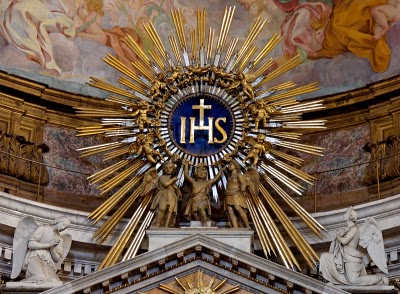
“The sun rises in the east, and in the east is the place for the Worshipful Master. As the sun is the source of all light and warmth, so should the Worshipful Master enliven and warm the brethren to their work. Among the ancient Egyptians the sun was the symbol of divine providence.” The hierophants of the Mysteries were adorned with many. insignia emblematic of solar power.
The sunbursts of gilt embroidery on the back of the vestments of the Catholic priesthood signify that the priest is also an emissary and representative of Sol Invictus.”
SOURCES:
1. The supplement to Antiquity explained, and represented in sculptures By Bernard de Montfaucon
RESEARCH EXCERPT:
THE next is one of the most curious and instructive Images we have X feen in this Theatre of Antiquity. It doth not seem to be in the Egyptian Style, tho’ it hath something os that whimsical Manner of the Egypttan Figures. The Head hath a Basket on it, and darts Rays. The Beard and Hair are such as we fee in the Images of Jupiter. The Body is clothed from the Head to the Feet, and folded about with a Serpent, whose Head appears above the Man’s Feet, the Serpent’s Body being twisted round the Man’s in several Folds, and ending at his Shoulders j and the Man holds the Serpent’s Tail in his left Hand, which seems only to be free for the other is hid under the Folds of the Serpent and his own Garments. All the Arm is covered except *he Elbow, perhaps this intimates some Mystery.
Between the Foldings of the Serpent there are four void Spaces, in which the twelve Signs of the Zodiack are pictured, three in each Space. This is undoubtedly the great God Jupiter Sol Serapis, so often mentioned in Greek and Latin Inscriptions. A Greek one in Gruter is to this effect: To the great Jupiter Sol Serapis, and the other Gods worshipped m this Temple, Another Greek Inscription repeats the four first Words of this Inscription. A Latin one is thus: Jovi Soli inviBo Sarapidi. “To Jupiter the Sun “the invincible Sarapis.” Where, by the way, the Reader may note, that both Greek and Latin Monuments call him more frequently Sarapis than Serapis, nay even Writers in both Languages. Here he is styled the invincible Sarapis-, the Title of Invincible is proper for him as being the Sun -, and for the fame Reason Mithras, who was taken for the Sun, was honoured with the (ame Epithet; as thus in an Inscription, DEO SOLI INVICTO MITHRAE.
To the God Sun the invincible Mithras. The Sunis styled invincible, because nothing can stop its Course, proceeding always at an equal Rate, nothing being able either to hasten or retard his diurnal Journies. Another remarkable Inscription informs us, that the sacred Order os Paanists at Rome, of Great Jupiter Sol Serapis, had honoured the Prophet Embes, Father of the same Order of Paanifts, with a Marble Bust, which was placed in the House of that Order. This was done on the eleventh Day of the Month Pacon, according to the Alexandrians, which is the Day before the Nones of May, or on the eighth Day of that Month, under the Consulate of Sextus Erucius Clarus, and of Cneius Claudius Severus, which fell in the Year of our Lord 146′. About this Time the Worship of Jupiter Sol Serapis seems to have been most in vogue, under the good Emperor Antoninus Pius.
A whole Order at Rome being consecrated to the great Jupiter Sol Serapis, is a Proof of this, and perhaps this Order invented the mysterious Image now under Consideration. This new Order must have set it self to invent some new Method to make his Worship famous, and that these Images, by their Singularity and mysterious Figures, might engage the Attention of the Devotees. Or perhaps the Pæanifis, or other interested Persons, invented this manner of representing him.
Leave a Reply