
() Bad intel is being used as a tool to cause rot within our country. We see this time and time again, and I have grown sick of it.
Related Will Prominent Banned Public Figures Return if Elon Musk Buys Twitter?
On April 6, U.S. Intelligence officials publicly admitted they have been using weak intelligence to fight an information war with Russia. “It doesn’t have to be solid intelligence,” one U.S. official said. “It’s more important to get out ahead of them [the Russians], Putin specifically, before they do something.”
So, U.S. government officials admit that they are saying whatever they think will get the desired reaction from the Russians. Any relation to the truth is purely coincidental. All’s fair in love and war, but the issue here is that the average American is the recipient of these psychological operations just as much as the Russians are. We need to be aware of how much “news” is propaganda in order to be situationally aware and to make the best plans for ourselves and our families.
A lot of people have begun to understand this intuitively. Trust in media is close to an all-time low.
Let’s look at some examples of why average Americans have lost faith in our once-trusted government and media institutions.
On March 9, a U.S. Defense official said of the Russian claims about the U.S. hosting biological weapons research facilities in Ukraine, “It is absurd. It is laughable. It is untrue.”
The day before this, March 8, before the Senate Foreign Relations Committee, Senator Marco Rubio asked Under Secretary of State Victoria Nuland whether or not Ukraine had chemical or biological weapons. She admitted that not only do biological research facilities exist (this link has since been removed), but some of them contain research materials dangerous enough that the U.S. fears the Russians getting hold of them.
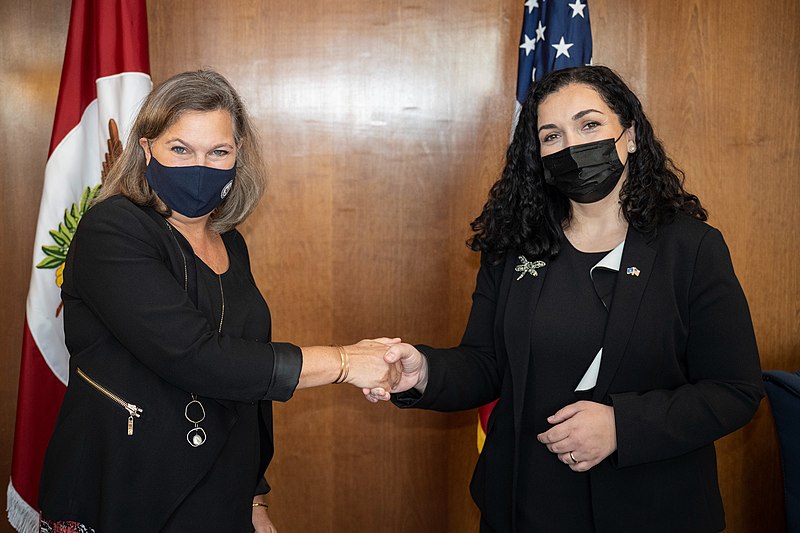
Under Secretary Nuland immediately followed this up by saying that if a chemical or biological attack occurred, she’s absolutely sure it would be the Russians releasing the weapons, but as far as I’m concerned, that’s beside the point. Our leaders are lying, and they are not even trying that hard to conceal it.
And it’s not only about Ukraine. On April 10, 2022, Dr. Fauci said that people were just going to have to start making individual risk calculations regarding Covid. “We’re going to have to live with some degree of virus in the community.”
Sounds like common sense.
It would have been nice to hear that before hundreds of thousands of small businesses closed and millions of children had their educational and social lives irreparably damaged. Instead, for the past two years, we’ve been hearing Dr. Fauci say such things as:
- August 19, 2020: “You don’t want to mandate and try to force anyone to take a vaccine.”
- July 11, 2021: “. . . I do believe, at the local level, there should be more mandates.”
- September 10, 2021: He asked state officials to support OSHA’s regulations requiring employers with more than 100 workers to enforce a vaccine mandate for their employees
But now, as of April 2022, we should all just be responsible for our own health. I would have been happy to hear that back in December 2020.
And I understand that evidence evolves, but the goalposts have moved a lot in a short period of time.
We have been told to “trust the science,” but that phrase is a contradiction in terms. Saying “trust the science” is asking someone to take a leap of faith.
Science isn’t about trust.
It’s about looking at hard facts and drawing reasonable, defensible conclusions. It’s about airing your conclusions and arguing with other educated people. Without the process of review, criticism, and defense before your peers, it’s not science.
It’s just another belief system, a faith with its own sometimes-fanatical adherents.
To make educated decisions, we need the best data available. If we’re supposed to take responsibility for our own health, great.
Give us all the information we need to make the best decisions for ourselves and our families. For starters, let us see the safety profiles of the vaccines we were all supposed to take.
A group of doctors and scientists committed to the health and safety of their patients filed a Freedom of Information Act (FOIA) request to examine the data used by the FDA to license the recent Covid vaccines. Pfizer said it needed 75 years to produce the requested documentation.
Now, a Texas judge ordered them to produce it in less than a year, proving that some federal employees still do their jobs, but the fact that Pfizer even made the request is outrageous. I’ll say it again: how are we supposed to trust government and industry leaders when they do these kinds of things?
Both of the above examples are very recent. But let’s look at an older example of sloppy government work involving faulty intelligence.
The invasion of Iraq.

Before anyone writes me off as being anti-military, allow me to say that, at the time, I absolutely believed what we were being told. I believed, along with many others, that we had rock-solid evidence that Hussein was building chemical and biological weapons. I believed what I heard on the news: that this justified an invasion. Otherwise, it was just too likely that the weapons would fall into the hands of terrorists.
More importantly, my military-age friends and family members believed this, and many of them signed up.
One of my best friends worked in heavy construction in Iraq, which meant that she saw a lot of action. Her unit built roads. They were usually the first people in any given area and encountered a lot of opposition.
I remember asking her what she thought when she got back after her first deployment. She told me it was like nothing on any news station. She said, in a way, they were all right, and they were all wrong. Some villages really did hate and resent the Americans, just like CNN said. Other ones loved and welcomed the Americans, just like Fox said. She said it was messy and confusing.
So bear in mind that anything I write, I write out of a firm conviction that the American military deserves better. They deserve clear-cut, winnable missions. They deserve to have their lives valued enough that the government will not send them overseas, putting their lives at risk unless they have the backing of the majority of the American people.
While Congress overwhelmingly voted to invade Iraq, support among the American people dried up within a few years. When my friend got back from her second tour, she was told at the airport as she returned home that she was a murderer. She signed up to serve her country. She didn’t deserve that.
By 2015, even Colin Powell admitted the war was a big mistake. No weapons of mass destruction were ever found. He blamed bad intelligence for the decisions that were made.
But it’s easy to go on screen and say, “Whoops, my bad.” It’s not so easy to spend years of your life in violence far away from home. It was not easy for the American troops that didn’t come back. It’s not easy for their families. And it’s not easy for the more than 200,000 Iraqi civilians that died.
“Bad intel” has consequences.
I had a close family member that died in combat in Afghanistan, and it upended my life.
The depression afterwards ruined my marriage, changing my financial world. I look at my own circumstances after losing a loved one overseas and then look at the people living in Iraq. Millions of Iraqis have lost family members as well. The thought of multiplying my own pain (and I am still living in relative comfort in a first-world country) by millions makes my head spin.
I still believe that the U.S. military, for the most part, is made of people that just want to serve our country. I grew up implicitly trusting American military leadership. But they have squandered that trust. When Lt. Col. Stuart Scheller, a veteran of both Iraq and Afghanistan, publicly demanded consequences for the disastrous Afghanistan pullout, he was court-martialed. I firmly believe Lt. Col. Scheller’s grievances were legitimate. Soldiers and their families deserve competent leadership, and throwing someone in jail over a workplace disagreement is not supposed to happen in a free country.

Media networks spouting propaganda masquerading as news isn’t supposed to happen in a free country, either. This week, a top U.S. Defense official admitted they had been feeding weak intelligence to the press in order to manipulate people. But the manipulation has been going on for a long time. They’ve just stopped pretending to hide it.
(All the more reason to check out our free QUICKSTART Guide to emergency evacuations.)
None of this will really surprise the prepping community.
But it does beg the question: what do we do? When our main sources of information have admitted that they are releasing propaganda, how do we get good information?
I grew up in a household with parents that read the news religiously. One parent speaks Russian, and the other speaks German, and my German-speaking parent has been listening to radio broadcasts in German lately.
These days, I wish I’d paid attention when my parents tried teaching me their languages as a kid.
But other countries have their own brands of propaganda too. I have friends all over the world, and they have all expressed frustration over the lack of good information. We all look at the news. We all feel like it’s mostly designed to manipulate us. It’s not just the U.S. Do we have other options?
I’ve believed for a while now that looking at a variety of alternative sources is the best bet.
That, combined with securing communications between yourself and your real-world friends, is probably the best we can do.
Speaking about communications…
Regarding securing communications between yourself and your community, The Organic Prepper has been posting a lot of information about ham radio lately.
One of our authors just published a guide to post-disaster communications, and now is the time to learn all you can.
It may be impossible soon to get a good big-picture assessment of world affairs. But that’s something people lived without for a long time.
French peasants of the 1800s didn’t know what was going on in Japan. They didn’t need to. Personally, I’ve enjoyed living in a world where I can learn about other places and other cultures. Having friends all over the world has given me perspective and helped me learn better ways to live in accordance with my values.
But all good things come to an end, and maybe the end of global networks of friends is near. I hope not, but it’s a possibility.
Understanding events on the other side of the globe can give us wisdom and perspective, but we can live without it. We do need, however, ways of communicating within our own trusted communities. We may not be able to trust our leaders and institutions, but we all need to have our small circles of friends and relatives.
The time to make plans for strengthening those bonds is now.
What are your thoughts on bad intel?
Have you noticed an uptick in outright falsehoods and manipulations via the media? What are your thoughts on this? Why do you think it’s happening? Share your opinions in the comments.
Save 10% and get free shipping with a subscription!Fight viruses, remove heavy metals and microplastics, and restore your gut all at once with
Humic and Fulvic Acid from Ascent Nutrition.
MUST HAVE DETOX POWERHOUSE!

About The Author
Marie Hawthorne
A lover of novels and cultivator of superb apple pie recipes, Marie spends her free time writing about the world around her.
Stillness in the Storm Editor: Why did we post this?
The news is important to all people because it is where we come to know new things about the world, which leads to the development of more life goals that lead to life wisdom. The news also serves as a social connection tool, as we tend to relate to those who know about and believe the things we do. With the power of an open truth-seeking mind in hand, the individual can grow wise and the collective can prosper.
– Justin
Not sure how to make sense of this? Want to learn how to discern like a pro? Read this essential guide to discernment, analysis of claims, and understanding the truth in a world of deception: 4 Key Steps of Discernment – Advanced Truth-Seeking Tools.
Stillness in the Storm Editor’s note: Did you find a spelling error or grammatical mistake? Send an email to [email protected], with the error and suggested correction, along with the headline and url. Do you think this article needs an update? Or do you just have some feedback? Send us an email at [email protected]. Thank you for reading.
Source:
https://www.theorganicprepper.com/bad-intel/
Support our work! (Avoid Big Tech PayPal and Patreon)DIRECT DONATION
Leave a Reply