(Neuroscience News) For the first time, researchers have provided physiological evidence that a pervasive neuromodulation system – a group of neurons that regulate the functioning of more specialized neurons – strongly influences sound processing in an important auditory region of the brain. The neuromodulator, acetylcholine, may even help the main auditory brain circuitry distinguish speech from noise.
Related Burger King Depicts Mascot in Gay Kiss with Ronald McDonald
by Staff Writer, December 20th, 2020
“While the phenomenon of these modulators’ influence has been studied at the level of the neocortex, where the brain’s most complex computations occur, it has rarely been studied at the more fundamental levels of the brain,” says R. Michael Burger, professor of neuroscience at Lehigh University.
Burger and Lehigh Ph.D. student Chao Zhang along with collaborators Nichole Beebe and Brett Schofield of Northeast Ohio Medical University and Michael Pecka of Ludwig-Maximilians University Munich conducted the research.
The findings have been described in an article, “Endogenous Cholinergic Signaling Modulates Sound-evoked Responses of the Medial Nucleus of the Trapezoid Body,” published earlier this month in The Journal of Neuroscience. The journal’s editors designated the article as “noteworthy” and it was included in “featured research” for its particular significance to the scientific community.
“This study will likely bring new attention in the field to the ways in which circuits like this, widely considered a ‘simple’ one, are in fact highly complex and subject to modulatory influence like higher regions of the brain,” says Burger.
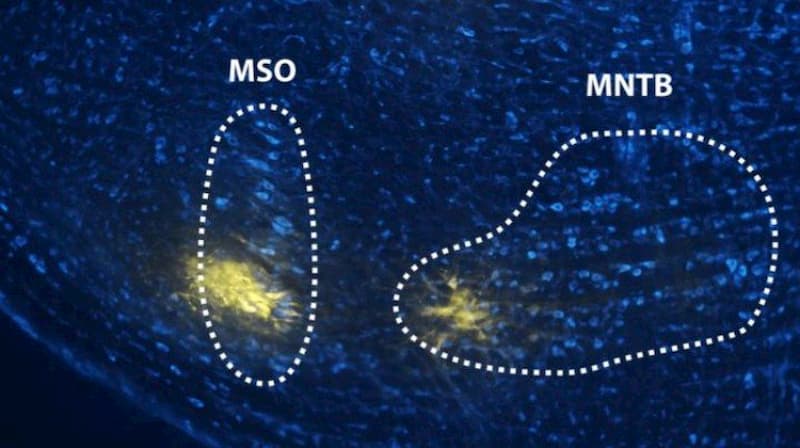
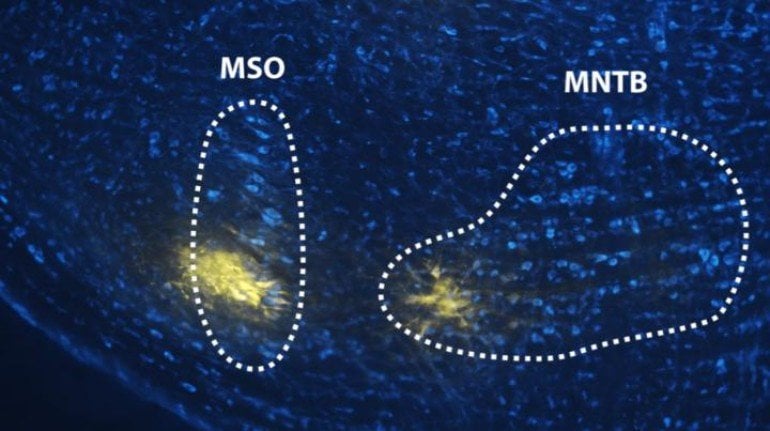
The team conducted electrophysiological experiments and data analysis to demonstrate that the input of the neurotransmitter acetylcholine, a pervasive neuromodulator in the brain, influences the encoding of acoustic information by the medial nucleus of the trapezoid body (MNTB), the most prominent source of inhibition to several key nuclei in the lower auditory system. MNTB neurons have previously been considered computationally simple, driven by a single large excitatory synapse and influenced by local inhibitory inputs.
The team demonstrates that in addition to these inputs, acetylcholine modulation enhances neural discrimination of tones from noise stimuli, which may contribute to processing important acoustic signals such as speech. Additionally, they describe novel anatomical projections that provide acetylcholine input to the MNTB.
Burger studies the circuit of neurons that are “wired together” in order to carry out the specialized function of computing the locations from which sounds emanate in space. He describes neuromodulators as broader, less specific circuits that overlay the more highly-specialized ones.
“This modulation appears to help these neurons detect faint signals in noise,” says Burger. “You can think of this modulation as akin to shifting an antenna’s position to eliminate static for your favorite radio station.”
“In this paper, we show that modulatory circuits have a profound effect on neurons in the sound localization circuitry, at very low foundational level of the auditory system,” adds Zhang.
In addition, during the course of this study, the researchers identified for the first time a set of completely unknown connections in the brain between the modulatory centers and this important area of the auditory system.
Burger and Zhang think these findings could shed new light on the contribution of neuromodulation to fundamental computational processes in auditory brainstem circuitry, and that it also has implications for understanding how other sensory information is processed in the brain.
[the_ad_group id=”25840″]
Stillness in the Storm Editor: Why did we post this?
The news is important to all people because it is where we come to know new things about the world, which leads to the development of more life goals that lead to life wisdom. The news also serves as a social connection tool, as we tend to relate to those who know about and believe the things we do. With the power of an open truth-seeking mind in hand, the individual can grow wise and the collective can prosper.
– Justin
Not sure how to make sense of this? Want to learn how to discern like a pro? Read this essential guide to discernment, analysis of claims, and understanding the truth in a world of deception: 4 Key Steps of Discernment – Advanced Truth-Seeking Tools.
Stillness in the Storm Editor’s note: Did you find a spelling error or grammatical mistake? Send an email to [email protected], with the error and suggested correction, along with the headline and url. Do you think this article needs an update? Or do you just have some feedback? Send us an email at [email protected]. Thank you for reading.
Source:
https://neurosciencenews.com/acetylcholine-speech-hearing-17670/
Leave a Reply