
(Zero Hedge) Last weekend’s mass shootings in El Paso and Dayton (following the devastation in Gilroy the weekend before) prompted the usual evidence-free avalanche of political point-scoring, blaming “the other side” for all the world’s woes.
by Staff Writer, August 7th, 2019
Babylon Bee’s satirical take summed things up perfectly:
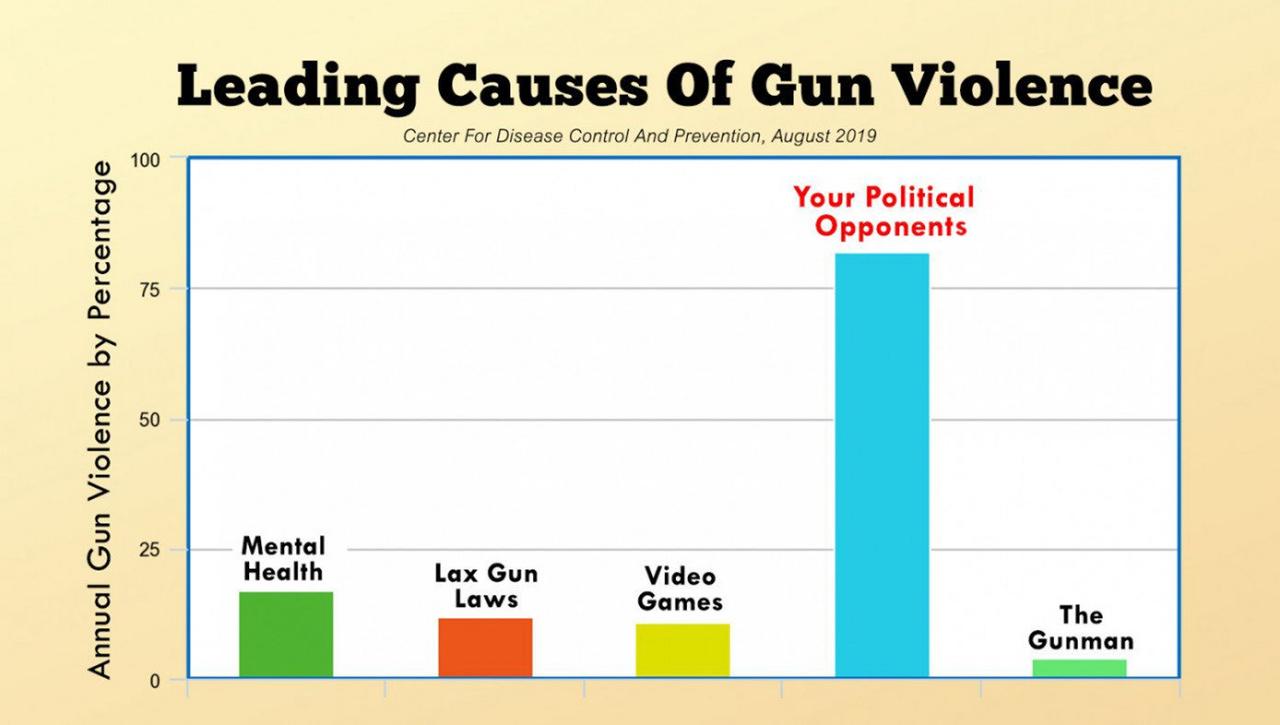
An exhaustive new study from the CDC reveals that the leading cause of gun violence in America is your political opponents. Researchers looked at a number of potential causes of gun violence such as mental health, family situation, cultural shifts, gun laws, rap music, videogames, sugar consumption, and the actual gunman, but by and large, the most prominent cause of gun violence was what most already suspected. The fault lies with those who you disagree with politically.
But, as Jillian Peters and James Densley write in an LA Times op-ed, instead of apportioning blame based on the narrative being pushed, analyzing and understanding data about who commits such massacres can help prevent more lives being lost.
For two years, we’ve been studying the life histories of mass shooters in the United States for a project funded by the National Institute of Justice, the research arm of the U.S. Department of Justice. We’ve built a database dating back to 1966 of every mass shooter who shot and killed four or more people in a public place, and every shooting incident at schools, workplaces, and places of worship since 1999. We’ve interviewed incarcerated perpetrators and their families, shooting survivors and first responders. We’ve read media and social media, manifestos, suicide notes, trial transcripts, and medical records.
Buy Book Mass Shootings: Media, Myths, and Realities (Crime, Media, and Popular Culture)
Our goal has been to find new, data-driven pathways for preventing such shootings. Although we haven’t found that mass shooters are all alike, our data do reveal four commonalities among the perpetrators of nearly all the mass shootings we studied.
First, the vast majority of mass shooters in our study experienced early childhood trauma and exposure to violence at a young age. The nature of their exposure included parental suicide, physical or sexual abuse, neglect, domestic violence, and/or severe bullying. The trauma was often a precursor to mental health concerns, including depression, anxiety, thought disorders or suicidality.
Second, practically every mass shooter we studied had reached an identifiable crisis point in the weeks or months leading up to the shooting. They often had become angry and despondent because of a specific grievance. For workplace shooters, a change in job status was frequently the trigger. For shooters in other contexts, relationship rejection or loss often played a role. Such crises were, in many cases, communicated to others through a marked change in behavior, an expression of suicidal thoughts or plans, or specific threats of violence.
Third, most of the shooters had studied the actions of other shooters and sought validation for their motives. People in crisis have always existed. But in the age of 24-hour rolling news and social media, there are scripts to follow that promise notoriety in death. Societal fear and fascination with mass shootings partly drives the motivation to commit them. Hence, as we have seen in the last week, mass shootings tend to come in clusters. They are socially contagious. Perpetrators study other perpetrators and model their acts after previous shootings. Many are radicalized online in their search for validation from others that their will to murder is justified.
Fourth, the shooters all had the means to carry out their plans. Once someone decides life is no longer worth living and that murdering others would be a proper revenge, only means and opportunity stand in the way of another mass shooting. Is an appropriate shooting site accessible? Can the would-be shooter obtain firearms? In 80% of school shootings, perpetrators got their weapons from family members, according to our data. Workplace shooters tended to use handguns they legally owned. Other public shooters were more likely to acquire them illegally.
Buy Book 9/11 Unmasked: An International Review Panel Investigation
So what do these commonalities tell us about how to prevent future shootings?
One step needs to be depriving potential shooters of the means to carry out their plans. Potential shooting sites can be made less accessible with visible security measures such as metal detectors and police officers. And weapons need to be better controlled, through age restrictions, permit-to-purchase licensing, universal background checks, safe storage campaigns and red-flag laws — measures that help control firearm access for vulnerable individuals or people in crisis.
Another step is to try to make it more difficult for potential perpetrators to find validation for their planned actions. Media campaigns like #nonotoriety are helping starve perpetrators of the oxygen of publicity, and technology companies are increasingly being held accountable for facilitating mass violence. But we all can slow the spread of mass shootings by changing how we consume, produce, and distribute violent content on media and social media. Don’t like or share violent content. Don’t read or share killers’ manifestos and other hate screeds posted on the internet. We also need to study our current approaches. For example, do lockdown and active shooter drills help children prepare for the worst or hand potential shooters the script for mass violence by normalizing or rehearsing it?
We also need to, as a society, be more proactive. Most mass public shooters are suicidal, and their crises are often well known to others before the shooting occurs. The vast majority of mass shooters leak their plans ahead of time. People who see or sense something is wrong, however, may not always say something to someone owing to the absence of clear reporting protocols or fear of overreaction and unduly labeling a person as a potential threat. Proactive violence prevention starts with schools, colleges, churches and employers initiating conversations about mental health and establishing systems for identifying individuals in crisis, reporting concerns and reaching out — not with punitive measures but with resources and long-term intervention. Everyone should be trained to recognize the signs of a crisis.
Proactivity needs to extend also to the traumas in early life that are common to so many mass shooters. Those early exposures to violence need addressing when they happen with ready access to social services and high-quality, affordable mental health treatment in the community. School counselors and social workers, employee wellness programs, projects that teach resilience and social-emotional learning, and policies and practices that decrease the stigma around mental illness will not just help prevent mass shootings, but will also help promote the social and emotional success of all Americans.
Our data show that mass shooters have much in common. Instead of simply rehearsing for the inevitable, we need to use that data to drive effective prevention strategies.
Buy Book Obedience to Authority (Harper Perennial Modern Thought)
* * *
Perhaps wannabe-politicians like Beto O’Rourke should wind their ‘Trump is Hitler and therefore to blame’ soundbites in and focus on the real issues facing Americans.
found on SHTF Plan
Stillness in the Storm Editor: Why did we post this?
Corruption is endemic to our world. Organizations that gain the trust of the people misuse that trust and are rarely brought to justice. The people have a valid right to know of the activities of its public servants so as to dethrone them once malfeasance or wrongdoing has been identified. The preceding article highlights corruption within public service institutions, revealing a breach of trust with respect to their lawful mandate to occupy said office. It is critically important for the evolution of society that individuals become aware of corruption, so as to unite together and declare grievances in an effort to correct the situation. When those grievances aren’t recognized by those in office, the people now have a valid right to remove the lawless individuals in these positions of power so as to restore law and order. All of this can only be possible individuals to gain awareness of the corruption at hand and begin the process of forming actions groups capable of issuing lawful rebukes. If done properly, the forces that oversee the realms of men will rally to support the people.
– Justin
Not sure how to make sense of this? Want to learn how to discern like a pro? Read this essential guide to discernment, analysis of claims, and understanding the truth in a world of deception: 4 Key Steps of Discernment – Advanced Truth-Seeking Tools.
Stillness in the Storm Editor’s note: Did you find a spelling error or grammar mistake? Send an email to [email protected], with the error and suggested correction, along with the headline and url. Do you think this article needs an update? Or do you just have some feedback? Send us an email at [email protected]. Thank you for reading.
Source:
If you’re serious about finding the mass shooters investigate the CIA, FBI and the intelligence apparatus working for the big corporations (Rothchild’s). This article is a waste of time, especially given the fact these
organizations have been setting up people for decades. Any serious journalist would never miss this or would know it might be better to keep their mouth shut.
MK Ultra came to mind at all situations like those…
And this is .gov kind of action.