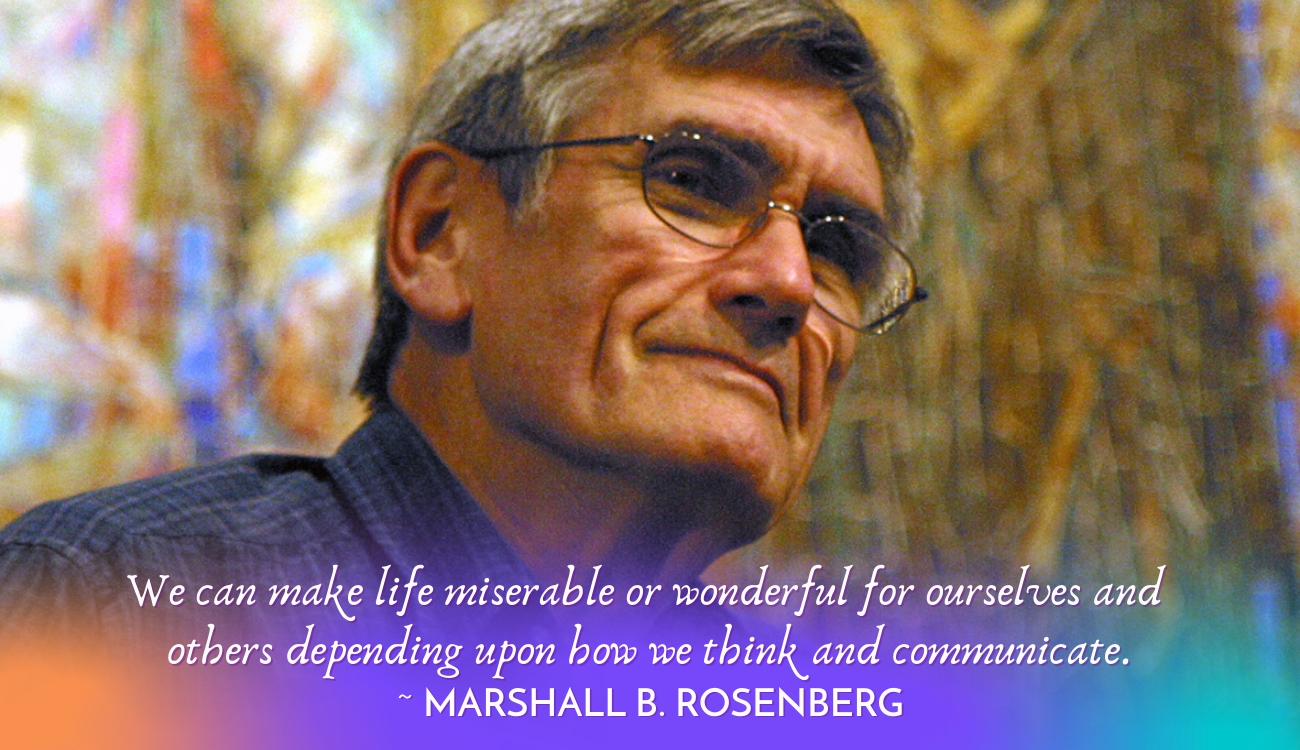
(Chandra Loveguard) Founder of Nonviolent Communication Marshall B. Rosenberg said, “Most of us grew up speaking a language that encourages us to label, compare, demand, and pronounce judgments rather than to be aware of what we are feeling and needing.” Does this cultural training lead to a type of violence in our communication style? And what is the impact of learning how to change our ways so we speak to people’s needs and pain instead of projecting our own hurts onto them?
by Chandra Loveguard, March 6th, 2021
Part 2 of an Original Stillness in the Storm Series on the Power of Thoughts and Words
American psychologist, mediator, author and teacher Marshall B. Rosenberg (October 6, 1934 – February 7, 2015) developed a process for supporting partnership and resolving conflict within people, in relationships, and in society in the 1960s. He called this process Nonviolent Communication. The process has become known familiarly as NVC. Thousands of people around the world are students and practitioners of Nonviolent Communication as a way to heal relationship wounds, gain clarity about the needs and feelings of ourselves and others, and learn how to communicate compassionately.
Here are a few well-known quotes from Marshall that help us comprehend NVC and its reason for being better:
People have been trained to criticize, insult, and otherwise communicate in ways that create distance among people.
Instead of playing the game “Making Life Wonderful”, we often play the game called “Who’s Right”. Do you know that game? It’s a game where everybody loses.
Marshall was well aware of the “everybody loses” game especially when he was working to create peace and resolution in war-torn areas.
A dedicated teacher, peacemaker and visionary leader, Dr. Rosenberg led NVC workshops and international intensive trainings for tens of thousands of people in over 60 countries across the world and provided training and initiated peace programs in a number of war-torn areas including Rwanda, Burundi, Nigeria, Malaysia, Indonesia, Sri Lanka, Sierra Leone, the Middle East, Colombia, Serbia, Croatia, and Northern Ireland. He worked tirelessly with such groups as educators, managers, mental health and health care providers, lawyers, military officers, prisoners, police and prison officials, clergy, government officials, and individual families.
The process of healing cultural, societal and interpersonal relationship issues relies on creating a culture of compassion and empathy where people feel free to express their needs and feelings without giving away their power or cowering in fear. Here are a few more illustrative quotes from Marshall:
NVC suggests behind every action, however ineffective, tragic, violent, or abhorrent to us, is an attempt to meet a need.
The objective of Nonviolent Communication is not to change people and their behavior in order to get our way: it is to establish relationships based on honesty and empathy, which will eventually fulfill everyone’s needs.
Every criticism, judgment, diagnosis, and expression of anger is the tragic expression of an unmet need.
Empathy is a respectful understanding of what others are experiencing. Instead of offering empathy, we often have a strong urge to give advice or reassurance and to explain our own position or feeling. Empathy, however, calls upon us to empty our mind and listen to others with our whole being.
Though Marshall has passed on beyond this world, he still influences us today with his compassion, his humor, and his intention to help us become more human.

Rosenberg dedicated his life to helping humanity find its way. When we learn how to communicate compassionately with one another in our families, our organizations and workplaces and all around our world, we will co-create very differently.
Here are some questions for further reflection:
- Can you imagine a world full of compassionate communicators?
- What does it feel like to live in this world?
- Could our media be using communication violence to divide instead of bringing together?
- How important is our “intent” in our communications?
Below is more about NVC and Conflict Resolution from the Nonviolent Communication Website:
Nonviolent Communication and Conflict Resolution
With Nonviolent Communication skills, you can help strengthen your relationship with your family, friends, coworkers, and even passers by on the street by fostering empathy and compassion for those with unresolved needs manifesting as “conflict mentality.”
~ Marshall B. Rosenberg, PhD.
When we use Nonviolent Communication for conflict resolution, the results are often transformative and long lasting.
Many of us have experienced difficult conversations, or even conflicts in our lives.
Few people have developed the skills to be able to consistently move through conflict all the way to the point of greater mutual understanding and connection between the people involved.
Nonviolent Communication (NVC) for conflict resolution allows for:
- Compassion in difficult interactions
- The de-escalation of conflicts
- Steering the dynamic toward more connection and mutual understanding
- And ultimately, co-creating mutually satisfying outcomes.
By using Nonviolent Communication for conflict resolution, we gain these tools; and with practice, people everywhere can become skilled at both preventing and resolving conflicts.
Grow by Embracing Conflict
Most people don’t think about how they can enhance their capacity to learn and grow by embracing conflict. But it’s true: embracing conflict — rather than avoiding it when it happens — can help you grow as a person!
Most human beings are either nervous around, or afraid of, conflict.
However, conflict will always be with us and is a fact of life. Avoiding it doesn’t make it go away.
If we think of conflict as something bad and then start to fear it, we will tend to avoid it and are more likely to have judgments about it, which often will deepen a conflict!
We also often lack confidence because we are not sure how to effectively employ NVC for conflict resolution.
When we don’t have confidence in our skills for navigating conflict, it’s easier to be conflict-avoidant, which can take us away from connection and toward even more conflict. This means our fear of conflict can actually get in the way of a resolution and mutually satisfying outcomes.
Conversely, when we accept that conflict is a natural part of life, we are more likely to consider embracing conflict. As a result, we are more likely to develop our skills in this critical area. With a higher skill level, and the confidence that comes with it, conflicts are no longer avoided. They become perceived as opportunities for learning, growth, connection, mutual understanding, deepening relationships, and better solutions.
This level of clarity and confidence is an indicator that we are truly empowered within ourselves to work constructively with others with our Nonviolent, or “Compassionate” Communication skills for resolving conflicts!
Compassionate Communication Skills for Resolving Conflicts
You can develop strong compassionate communication skills for resolving conflicts. In fact, we want to encourage you to work on your skills — compassionate, collaborative, respectful, conscious communication — so that you can be a powerful contributor in helping others resolve their conflicts!
There are many schools of conflict resolution, and they each have something valuable to offer.
Many of these schools rely on NVC principles to a substantial extent, or they remain consistent with the tenets of Compassionate Communication in the very least. In fact, a few have even tried directly incorporating NVC principles into their curricular frameworks.
While each modality has its own unique approach, NVC addresses conflict resolution through needs-based mediation. In other words, NVC mediation allows people to more easily connect to each other’s humanity, because the needs are common to all people and therefore mutually relatable.
In NVC, we define needs as Universal Human Needs. Needs can be thought of as core human motivators common to all people; or the conditions necessary for any human to thrive, regardless of culture or geographic location.
Some mediation modalities offer interest-based mediation. We recognize that this can be useful and helpful. However, from an NVC perspective, interests are not universal.
If you take any conflict and distill it to the Universal Human Needs, at that point people can more easily see each other as human beings and relate to each others’ humanity.
When people cease to see each other as enemies, and they see that their own best interest lies in a mutually beneficial outcome, that is the moment when the resolution process will pick up momentum.
Compassionate Communications Mediators
What gets in the way of being a good Compassionate Communication mediator?
When we use Compassionate Communication (NVC) skills for resolving conflicts, we go deeper than interests, to the Universal Human Needs underlying them. NVC can seem foreign to some people because it is so different from the way we have been taught to communicate.
One of the cultural beliefs impairing our ability to navigate conflict skillfully is the conviction that our options are to either win or lose, and that mutually agreeable solutions are not possible.
A skilled mediator can create the conversation container, slow down the conversation, and help people learn to hear each other’s hearts by translating any judgments or criticism into underlying values and universal needs.
Ideally, we all want to think we can handle everything on our own. But when the pain is high, and especially if the trust level is low, a skilled facilitator is absolutely essential.
Please be wary of falling into the trap of thinking I must go it alone!
Also, keep in mind that when we are participants in a conflict it is much more challenging to facilitate NVC for conflict resolution. Even people with a high level of NVC skills for conflict resolution still seek out an NVC mediator, as necessary, to help them resolve their conflicts for everyone’s benefit.
If you are a participant in a conflict, having an outside Compassionate Communication mediator can free you up from running the process in order to fully participate in the resolution.
Practice Nonviolent Communication Skills
You can practice Nonviolent Communication skills for conflict resolution.
In a very basic sense, NVC mediation follows the following format: ABABAB.
Person A speaks.
Person B reflects back their understanding of A’s message.
Person A confirms they were understood (or clarifies, going back to #1).
Person B speaks.
Person A reflects back their understanding of B’s message.
Person B confirms they were understood (or clarifies, going back to #4).
Repeat — go back to #1.
This explanation is oversimplified but provides a sense of the process: We take turns listening to and hearing each other, and confirming understanding as all parties move forward.
As the conversation winds deeper, more significant layers of meaning are surfaced, mutual understanding begins to grow, and slowly the conflict begins to resolve itself.
As you practice Nonviolent Communication skills within this structural format, focus on the connection first. Take your time to make sure the parties understand each other. And keep in mind that understanding is different from agreement.
Once people have arrived at mutual understanding, then the search for solutions or resolution is much more likely to be collaborative!
Dr. Marshall Rosenberg PhD on NVC for Conflict Resolution
We are fortunate to have the writings of Dr. Marshall Rosenberg, PhD. on NVC for conflict resolution!
When Dr. Rosenberg developed NVC, he knew that some level of connection must come before any solution.
Our experience indicates that the #1 mistake people make in the conflict resolution process is moving prematurely to a solution. In the race to solve the problem, many people miss the deeper needs the conflict actually needs to address.
This is why NVC for conflict resolution stresses the fundamental importance of connection to facilitate outcomes that are not met with resistance, foot-dragging, sabotage, and/or resentment from any of the parties involved in the conflict.
In other words: Go slow to go fast!
You want the solutions to meet everyone’s needs — so take your time in making sure the deeper needs are identified. Then look for strategies that contribute to all the needs, or as many as possible.
Because this will help us avoid revisiting conversations or decisions unnecessarily, it usually saves us a lot of time in the long term.
Finally, Dr. Rosenberg understood that patience is the cornerstone of the NVC-based conflict resolution process. He would encourage us to remain mindful that sometimes the resolution we’re looking for may be several conversations (or more) away. Therefore, we must consciously work on beginning, maintaining and perhaps most importantly, ending each conversation in such a way that there is an openness to the next one, and the next one, and the next one, until the conflict is ultimately and successfully resolved.
The Above Portion of this Article is from the Nonviolent Communication Website
On a final note, I leave you with a few further potent thoughts from Marshall Rosenberg. Contemplate well and if you feel called, I invite you to begin to embrace the principles of nonviolent communication.
Your presence is the most precious gift you can give to another human being.
Get very clear about the kind of world we would like and then start living that way.
~ Marshall B. Rosenberg
About the Author
Chandra Loveguard
Chandra Loveguard is a researcher, seasoned writer and Patriot who questions everything, envisions the best for our communities and families, our country, and our world. She also holds The United States of America dear and acknowledges the vision of the Founding Fathers for this country to be a beacon of light and freedom for all the world.
“I felt like I was getting a cold, but Agarikon stopped it in its tracks.”
Organic AGARIKON fights Viruses & Bio-warfare, and much more!
10 times more effective than ribavirin against Herpes (HSV1, HSV2), Swine flu (H1N1), Bird flu (H1N4), Pox (cowpox). Studied by the DoD for the Bioshield program.
Get your Agarikon biodefense from Ascent Nutrition, one of the most pure and potent in the industry.
Save 10% and get free shipping with a subscription!

Stillness in the Storm Editor: Why did we post this?
Inspiration is spiritual nourishment that helps regulate mood and maintain personal integrity. The preceding information offers some words or stories of inspiration. With the power of inspiration in hand, all of life’s hardships can be weathered with greater cheer, without the destruction of a positive and constructive outlook on life. A positive attitude is critically important to avoid trauma, lashing out toward others, and making poor health choices. It is also important for building fellowship, unity, and working toward making the world a better place.
– Justin
Not sure how to make sense of this? Want to learn how to discern like a pro? Read this essential guide to discernment, analysis of claims, and understanding the truth in a world of deception: 4 Key Steps of Discernment – Advanced Truth-Seeking Tools.
Stillness in the Storm Editor’s note: Did you find a spelling error or grammatical mistake? Send an email to [email protected], with the error and suggested correction, along with the headline and url. Do you think this article needs an update? Or do you just have some feedback? Send us an email at [email protected]. Thank you for reading.
Source:
Embedded In Article
Leave a Reply