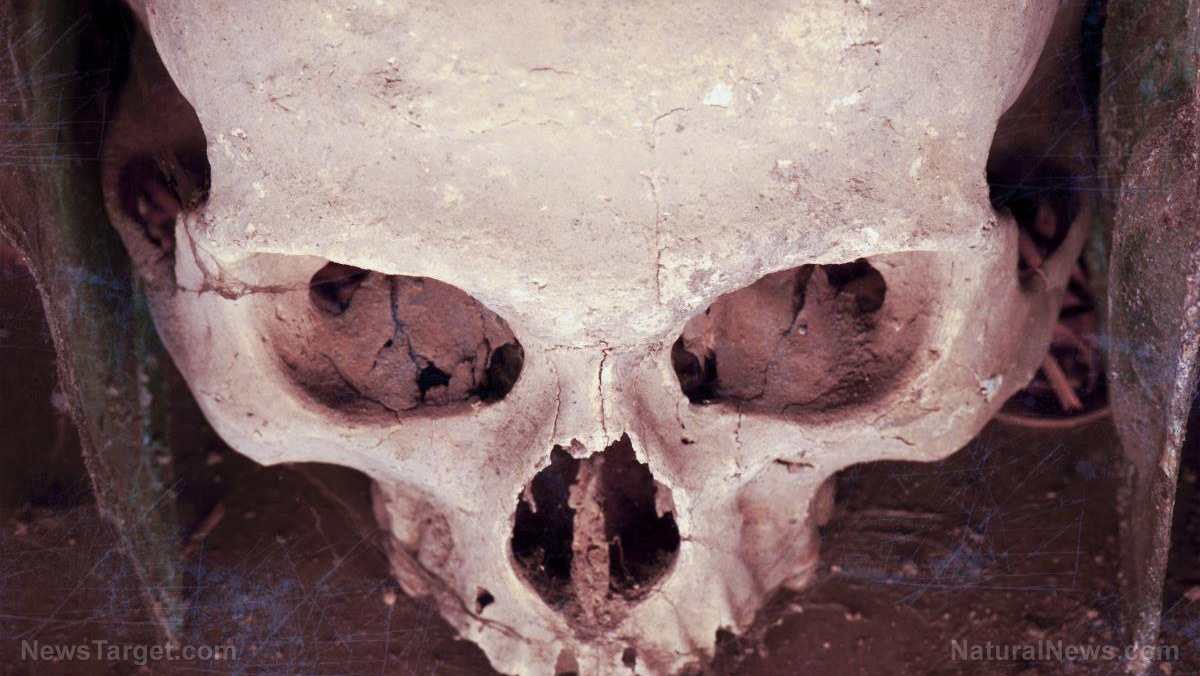
(Michael Alexander) Human skeletons unearthed in northeast China represent some of the earliest evidence of intentional skull reshaping, says a recent study in the American Journal of Physical Anthropology.
Related Elves, Guides, Robots and Aliens: The Therapeutic Potential of Psychedelic Entity Encounters
by Michael Alexander, June 5th, 2020
Between 2011 and 2015, the dig at the Houtaomuga site yielded 11 modified skulls and 14 skeletons with unmodified craniums. The former, in particular, had artificially elongated braincases and flattened bones at both the front and back of the head. Five of the modified skulls were adults – of which four were men – while six belonged to children. The ages of the individuals to whom the skulls belonged ranged from as young as three years old to as old as 40.
Ten of the skulls, the researchers noted, were found in sediment dating between 6,300 and 5,000 years ago. The remaining skull, meanwhile, was found in a layer of sediment from around 12,000 years ago.
“This is the earliest discovery of signs of intentional head modification in the Eurasia continent, perhaps in the world,” said co-author Qian Wang, a biomedical sciences professor at Texas A&M University’s College of Dentistry.
Note: The more curious readers of this article will realize there is an alternate explanation that isn’t embraced by mainstream anthropological science.
Deformed skulls a status symbol?
Artificial cranial deformation is usually done early in life to take advantage of the infant’s soft cranial bones. This deformation or reshaping of the skull can be achieved by compressing an infant’s head with one’s hands, binding the head with hard, flat surfaces such as wooden boards or by tightly wrapping the head in cloth.
The practice of skull reshaping or artificial cranial deformation was usually reserved for high-status individuals and certain families. Proof of this, the researchers said, was found in the items the skulls were buried with. (Related: Prehistoric site described as “real-life Atlantis” – experts in a race against time to retrieve treasures before it disappears again.)
For instance, the three-year-old child with a reshaped skull was buried alongside pottery and other artifacts that suggest he was from a wealthy family. The woman, meanwhile, had shell ornaments placed on her body, which indicated her high-born status.
Book Ancient Egypt: Uncovered by Brian Foerster
“All of this evidence indicates that among the whole population, the practice of intentional cranial modification was a type of cultural practice only implemented on certain individuals,” the researchers said in their study.
The practice of artificial cranial deformation wasn’t limited to East Asia. Evidence of the practice was documented in archaeological finds in Australia, where indigenous tribes practiced it. In Europe, it persisted in several small French towns until the early 19th century, and it was considered a sign of prestige among the elite members of the ancient Egyptian and Mangbetu societies in Africa.
In the Americas, it was practiced by the Mayan and Incan peoples – of which the so-called Paracas Skulls are arguably the most well-known.
Discovered on the desert peninsula of Paracas in Peru by native archaeologist Julio Tello in 1928, the Paracas Skulls are considered to be some of the most extreme examples of artificial cranial deformation ever found. The skulls, known for their extreme elongation, have since fueled theories regarding more fantastical origins, with some proponents even stating that the skulls belonged to visiting aliens, or if not, then at the very least, their alien-human progeny.
Despite the skulls found at the Houtaomuga site now being considered as the oldest evidence of artificial cranial deformation in human history, the researchers urged caution against claims that the practice originated in Asia.
“It is too early to tell whether intentional cranial modification first emerged in East Asia and spread elsewhere, or originated independently in different places,” the researchers noted, adding that if the practice indeed began in East Asia, then it would have most likely spread to the Middle East, Russia and Europe through the steppes and to the Americas via the Bering land bridge.
Stillness in the Storm Editor: Why did we post this?
The news is important to all people because it is where we come to know new things about the world, which leads to the development of more life goals that lead to life wisdom. The news also serves as a social connection tool, as we tend to relate to those who know about and believe the things we do. With the power of an open truth-seeking mind in hand, the individual can grow wise and the collective can prosper.
– Justin
Not sure how to make sense of this? Want to learn how to discern like a pro? Read this essential guide to discernment, analysis of claims, and understanding the truth in a world of deception: 4 Key Steps of Discernment – Advanced Truth-Seeking Tools.
Stillness in the Storm Editor’s note: Did you find a spelling error or grammatical mistake? Send an email to [email protected], with the error and suggested correction, along with the headline and url. Do you think this article needs an update? Or do you just have some feedback? Send us an email at [email protected]. Thank you for reading.
Source:
https://www.naturalnews.com/2020-06-05-long-skulls-indicate-social-status-ancient-china.html
Leave a Reply