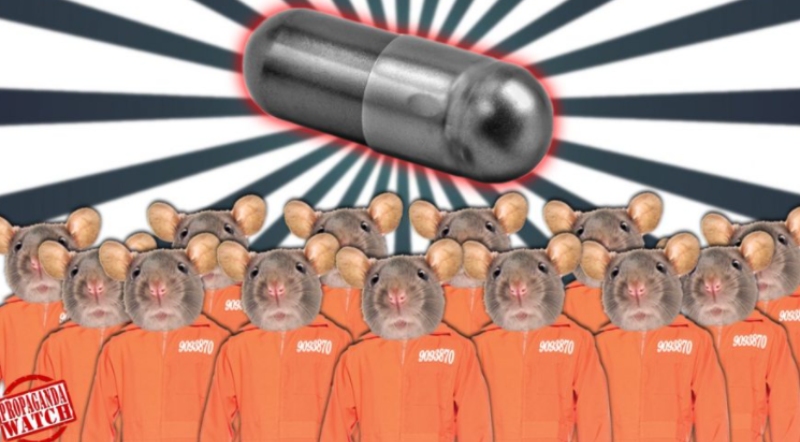
(Kit Knightly) In his latest, “Mouse Utopia and the Blackest Pill”, James Corbett takes aim at perhaps the most insidious propaganda narrative of all, and one that is very close to my heart: Overpopulation.
by Kit Knightly
This has been a personal bugbear of mine since I grew old enough to detect subtext, but long before I could articulate exactly why: The pervasive and destructive idea that there are too many people.
A propaganda construct that seeks to create contempt for masses of ordinary people, whilst excusing hubristic and inhumane practices by institutions and elites.

These destructive belief systems have come to the fore during this “pandemic”, made obvious by the fevered gleeful enthusiasm with which so many took up the narrative. One UN representative claimed the coronavirus was Earth “sending us a message”.
Back in April, the South China Morning Post ran an article headlined: Why Covid-19 is a human overpopulation problem – perhaps humans are the virus?
We’ve been told for nearly two centuries that the planet is overpopulated, it has never been true. The idea there are too many people (or soon will be) has been around since the world’s population was less than 1/10th of what it is now.
The crisis – Paul Ehrlich’s infamous “Population Bomb” – is yet to materialise, but since when did failed predictions deter apocalyptic doomsaying?
It’s not hard to see the appeal of the idea.
On an institutional level, overpopulation is a grand excuse. When Thomas Malthus predicted the overpopulation crisis in the early 19th century, and claimed that mass want was inevitable, he handed the ruling class a “get out of jail free” card.
As inequality spikes and living standards diminish anyone who campaigns for change, or protests outside the seats of power, can be told “it’s not our fault there is suffering! It’s not our fault there is poverty! It’s your fault, you’re reproducing too fast! There are simply too many people!”.
In that sense, it is a lie which protects the ruling class from the anger of those they control. But it serves another purpose too.
On a personal level, “enlightened” members of the elite have always been keen to write-off huge swaths of the population as surplus to requirements.
The idea of overpopulation allows academics, royals and bankers – men and women who hold themselves above the common folk based on their brains, blood and gold – to preach mass-murder whilst hiding their misanthropic god-complexes behind concern for the “common man”, our “future children”, or “the environment”.
From this wellspring flows eugenics and “useless eaters” and all those evil ideas spread by technocrats and billionaires, who would never in a thousand years considers themselves part of this supposed surplus.
People who convince the world they are “good” by camouflaging their insidious means behind supposedly beneficent ends.
Also read: Bill Gates Is The Biggest Depopulationist Alive
It’s possible – and easy – to refute these ideas intellectually.
The complete output of all the farmland we currently use is enough to feed every person on this planet, plus another 3 billion people. There are vast, vast amounts of untapped resources available to us – including people themselves.
Each new person born could be the genius who invents a way to increase crop yields or better harness geothermal energy or some other amazing step forward in societal evolution.
Even supposing we were nearing any kind of purely hypothetical population ceiling, there would be no need to do anything about it. Nature is self-limiting. We’re taught that at 12 years old, with diagrams and big green arrows.

When there are lots of rabbits, you get lots of foxes. The foxes eat the rabbits, the rabbits decrease. Fewer rabbits feed fewer foxes. Fewer foxes means the rabbits grow more numerous. And so the cycle repeats.
This cycle has maintained life on this planet for millions of years before humans, and will do so for millions of years afterward. To seek to corral or control nature has been historically shown to be both impossible and unnecessary.
So yes, it’s important to oppose the pervasive myth on a purely intellectual level.
But it’s equally important – perhaps more important – to oppose it on philosophical, even spiritual level. To hold fast against the idea that human life, any life, can be reduced to a matter of cold arithmetic.
That bankers or royals or scientists have any kind of right to decide exactly which people are necessary, and which are simply taking up space.
Simply put: we need to outright, in full voice, reject the idea that some people don’t matter. Or that people as a whole are an unnatural plague which needs to be cured.
James Corbett puts it well near the end of the above video:
“You are not a cancer on this planet, you are not a useless eater. We do not need drastic strictures of control over the human population, both literal and metaphorical, in order to make the world better…”
But the best-expressed rejection of the Malthusian belief system is from a very appropriate source, given the time of year.
In Dickens’ A Christmas Carol, Ebenezer Scrooge famously says that if the poor are like to die they had “better do it, and decrease the surplus population.” To which The Ghost of Christmas Present offers this stinging rebuke:
“Man, if man you be in heart, not adamant, forbear that wicked cant until you have discovered What the surplus is, and Where it is. Will you decide what men shall live, what men shall die? It may be, that in the sight of Heaven, you are more worthless and less fit to live than millions like this poor man’s child.”
And that, I think, is a fine place to leave you.

Stillness in the Storm Editor: Why did we post this?
The news is important to all people because it is where we come to know new things about the world, which leads to the development of more life goals that lead to life wisdom. The news also serves as a social connection tool, as we tend to relate to those who know about and believe the things we do. With the power of an open truth-seeking mind in hand, the individual can grow wise and the collective can prosper.
– Justin
Not sure how to make sense of this? Want to learn how to discern like a pro? Read this essential guide to discernment, analysis of claims, and understanding the truth in a world of deception: 4 Key Steps of Discernment – Advanced Truth-Seeking Tools.
Stillness in the Storm Editor’s note: Did you find a spelling error or grammatical mistake? Send an email to [email protected], with the error and suggested correction, along with the headline and url. Do you think this article needs an update? Or do you just have some feedback? Send us an email at [email protected]. Thank you for reading.
Source:
https://humansarefree.com/2020/12/debunking-the-myth-of-overpopulation.html
I think that you make some good points. Depopulationists do harbor evil ideas and faulty hypotheses. And they heap scorn on humans. And that is wrong.
However, the concern with overpopulation is legitimate. Yes, the planet in the end deals with those who evade the feedback system too long. There are many tales of animals crashing to zero in the aftermath of an overpopulation incident. I do not wish this path on humans; do you? If not, it makes sense to see if there is a way for humans to self-regulate.
You never mention the fact that we humans are ruining the Earth. Paving over everything is not really a path to an abundant future, no matter how you slice it. That underlies many people’s concern. Not equity.
And Corbett’s argument that our cleverness will help us evade planetary limits is risible. We are dependent on the planet (which is finite), not the planet on us. Our inventiveness is dependent on having a healthy natural world that supports us, keeps us alive, helps us thrive.
Infinite reproduction on a finite planet is an insane idea…. don’t you think?
Indeed infinite material growth on a finite material sphere is irrational. That said, the concept of economic growth increasing overtime is valid. Economies are, at their core, founded on the idea of capital that is the measure of goods and services produced by the citizens of a nation or community. As human intelligence and wisdom increases, people can use their rights more effectively, in trust, to form wealth and abundance. This means the value of the economy increases as time goes on, so long as people are using their rights properly and the skill with which they are used increases. However, eventually, a limit is reached wherein a population’s desires transcend the use of rights merely to produce wealth for survival and selfish abundance only, at which point, the society evolves to the “star trek” epoch, wherein the collective aim of humanity is the betterment of mankind and the further discovery of truth, and by extension, cosmic values—–in other words, God.