
(Exploring Your Mind) Clever Hans is a horse that was considered gifted at the beginning of the 20th century. Apparently, he had a prodigious memory and intelligence. Keep reading to learn more!
Related Mosquitoes Kill Cattle and Horses in Louisiana
by Staff Writer, November 19th, 2020
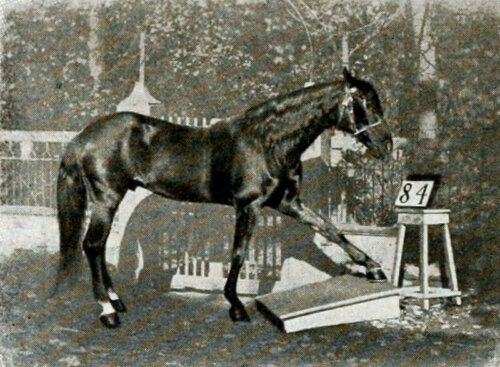
Clever Hans, also known as “Intelligent Hans”, is a famous horse that impressed German society at the beginning of the 20th century. This animal had a large number of public presentations where people would ask it to do mathematical operations, as well as other types of calculations. The most interesting fact about all is that the horse was always right.
Clever Hans’ fame spread outside the borders of Germany. In fact, many people in different parts of the entire planet talked about it nonstop. Everyone felt a deep fascination with this horse, which answered questions by raising its leg and hitting the ground.
Furthermore, the horse became so popular that several musicians wrote songs in its honor. An interesting fact is that Clever Hans became a hero to children. For that reason, toy companies also made toys in his image. Additionally, a liqueur was created with his name. And after deciphering its complex history, today, there’s something called “the Clever Hans effect”.
The origin of the Clever Hans story
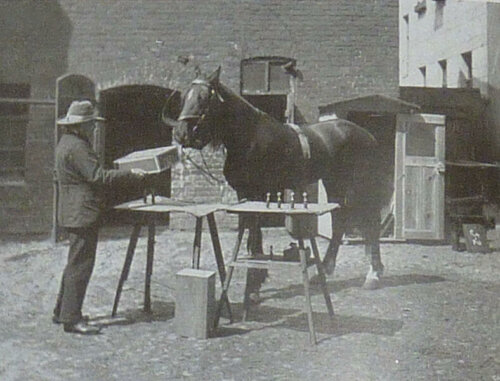
It all started in the summer of 1904, in a small country house located north of Berlin, Germany. In that place, a rumor began to spread. Basically, a retired professor named Wilhelm von Osten had a horse that was more intelligent than many humans. To prove it, he periodically put on a show where the horse, in addition to trotting gracefully, also did sums. It could count people, tell time, and even memorized the annual calendar.
Hundreds of people attested to the skills of Clever Hans. Since it was unable to speak, it answered questions by tapping its paw on the ground or by tilting or shaking its head from side to side.
People would always ask the horse’s owner about the origin of its abilities. He’d always respond by saying that he’d raised it as one of his old students. He’d say that he’d used a blackboard to teach it to count. In this same way, he’d taught it to read. In addition, he was teaching it music with a harmonica.
The suspicion became greater
While some people gave credit to the old master, certain scientists didn’t believe in Clever Hans’ remarkable intelligence. So much interest aroused the animal that some teachers formed “The Hans Commission”, a project at the University of Berlin meant to study the phenomenon.
Experts traveled to the country house and witnessed firsthand how great the animal’s abilities actually were. They then signed a letter, which included 13 rubrics, attesting to the horse’s skills and certifying that the teacher hadn’t given it any special indication that could mean cheating.
Wilhelm von Osten told them that he’d used a teaching method from a small nomadic ethnic group called the Khoekhoe, which lived in Africa. It’s safe to say that everyone was amazed. Actually, an expert pedagogue even said that Clever Hans was as smart as a 13 or 14-year-old boy.
An in-depth investigation
Psychologist Carl Stumpf decided that the phenomenon was worth studying scientifically. For that reason, he asked his student Oskar Pfungst to examine the horse’s abilities in depth. The student personally did the tests and, almost by accident, noticed that, if he looked at the numbers, Clever was correct. But if he didn’t, the horse’s answer would be wrong.
Likewise, when the sum was whispered in his ear, the horse couldn’t do the operation. Pfungst then started getting suspicious and thought that Clever Hans was picking up some signs from the environment and that’s how he arrived at the correct answers in math operations. Later, through other experiments, the student discovered that Hans was able to “read” the attitude of humans, which was how he managed to always be correct.
The interrogators would emit small body signals. First off, they’d look at his paws when they waited for him to start counting, and then they’d tilt their body when it gave the correct answer. Basically, the questioner’s posture and expression would change and the horse knew that that was the signal to stop kicking the ground.
In brief, it was a case of conditioning. Furthermore, this piece of research revealed how the presence of the researcher can condition the responses of the sample. Today, this bias in experimentation is known as the Clever Hans effect, in memory of this beautiful animal.
“I can feel my mind getting sharper with Lion’s Mane. I put it in my coffee.”
Organic Lion’s Mane Mushroom, proven to grow new brain cells and synapses. Guard against Alzheimer’s, dementia, and mental decline.
- Regulates blood sugar.
- Reduces high blood pressure.
- Promotes healthy energy levels and combats fatigue.
- Helps to prevent excess blood lipid accumulation.
- Protects heart health.
- Slows biological aging.
- Protects liver health.
- Protects kidney health.
Get your Lion’s Mane from Ascent Nutrition, one of the most pure and potent in the industry.
Save 10% and get free shipping with a subscription!

Stillness in the Storm Editor: Why did we post this?
The news is important to all people because it is where we come to know new things about the world, which leads to the development of more life goals that lead to life wisdom. The news also serves as a social connection tool, as we tend to relate to those who know about and believe the things we do. With the power of an open truth-seeking mind in hand, the individual can grow wise and the collective can prosper.
– Justin
Not sure how to make sense of this? Want to learn how to discern like a pro? Read this essential guide to discernment, analysis of claims, and understanding the truth in a world of deception: 4 Key Steps of Discernment – Advanced Truth-Seeking Tools.
Stillness in the Storm Editor’s note: Did you find a spelling error or grammatical mistake? Send an email to [email protected], with the error and suggested correction, along with the headline and url. Do you think this article needs an update? Or do you just have some feedback? Send us an email at [email protected]. Thank you for reading.
Source:
https://exploringyourmind.com/clever-hans-the-horse-that-did-math/
Leave a Reply