(Stillness in the Storm Editor) Various actors on the world stage are pushing chemtrails or solar radiation management as a solution to climate change. Governments, philanthropists, Hollywood celebrities and environmentalists have been whipped up into a frenzy over the past decade. The Deep State is now trying to capitalize on this idea that we need to protect the planet by polluting it with chemical spraying. The hypocritical irony is palpable.
Related United Nations Pushes Geoengineering As Last Ditch Effort to Save Humanity
In the following article, which was written by a mainstream physics news outlet, they discuss the atmospheric impact of particulates in the air. These particulates come from a wide range of sources, such as dust, fires, volcanos, and of course, human beings.
The article doesn’t explicitly promote chemical spraying. It doesn’t even mention the United Nations IPCC calling for geoengineering as a solution, which they did as early as 2013.
So what’s the big deal?
I would argue, this is one part of a multipronged propaganda effort to “sell” the public on geoengineering.
To be sure, researchers like Dane Wigington of Geoengineering Watch have amassed volumes of documents, scientific reports, and testimonies confirming that chemtrailing or geoengineering has been taking place for decades.
Some claim, now that the technology has been perfected, and is already in use en masse, now is the time to make it public.
As part of that effort, the redefining of words and ideas needs to occur. This is because subtle programming or propaganda requires recontextualization, taking something most people consider bad and reframing it so it can be seen as good, even natural.
The specific focus of this part of the effort is on the word aerosols.
Buy Book How Propaganda Works
Generally speaking, especially in older generations, people don’t consider aerosols as natural compounds.
For most of natural history, clouds were seeded with particulates from dust storms, volcanic eruptions, micro-meteor impacts, and similar natural phenomena. The idea that pumping pollutants into the air as a way to seed clouds is abhorrent to most people. As evidence of this, several years ago, acid rain—which is formed from clouds seeded by polluted air—was a major environmental activist issue. But now, lines are being blurred. And that’s the point.
Twenty years ago, persistent vapor trails from airplanes (chemtrails) were mostly unheard of. Only in rare instances were they seen. Today, the entire sky is covered by them. Younger generations assume that this has always been the case.
The specific focus of this article appears to be to subtly redefine aerosols as natural. Here’s one example from the article:
“Clouds are ‘seeded’ by tiny particles in the air called aerosols. These particles can include dust, soot, and salt, some of which are particularly important for supplying nutrients to the oceans.”
It seems innocuous at first glance, but that’s the point. The propaganda or mind manipulation isn’t obvious, it’s subtle. Let’s look at the formal definition of aerosols to give us a clue as to what’s happening here.
Aerosols: a substance enclosed under pressure and able to be released as a fine spray, typically by means of a propellant gas. (source)
Now, it should be noted that natural compounds are included in the formal definition. But generally, the word aerosol is used in reference to artificial compounds, used in various industrial applications.
Buy Book No Natural Weather: Introduction to Geoengineering 101
Weather Modification research began in the mid-20th century using aerosol sprays to seed the clouds, particularly, silver iodide. Aerosols were used to deliver the compounds to the clouds.
I argue the goal is to confuse people with respect to aerosols.
Again, most people are smart enough to know the difference between a natural emission of aerosols and artificial ones. Most people assume clouds are formed naturally. By associating the word aerosol with natural compounds the lines between artificial and natural are blurred. As a result of this prior psychological conditioning, people will be subconsciously more willing to accept aerosol spraying as a solution once it is presented to them. They will likely assert that it’s just using a “natural process” already used by nature. Of course, if one studies the compounds in these aerosols they are hardly natural and extremely toxic to life.
This is the way propaganda works.
Subtle messages are carefully sent as commands to the subconscious where they slowly reframe a person’s meta-state. Later, these frames can be used to nudge someone into a decision, like accepting chemtrails as a viable solution.
I expect to see more propaganda like this over the next few months. I also expect they’ll start to be more explicit about the solution, and brand it accordingly, likely using the word aerosol in the branding.
Stay vigilant friends, and share the truth with those you think are ready and capable of hearing it.
– Justin
by Dr Nerissa Hannink, December 17th, 2018
Everyday our atmosphere has to find a way to clean itself of the air, sea and soil pollution we throw at it.
So, in order to study how this cleaning process works, the University of Melbourne’s Dr. Robyn Schofield is sailing through the pristine environment of the Southern Ocean to our most untouched continent, Antarctica—an environment with the least amount of pollution on the planet.
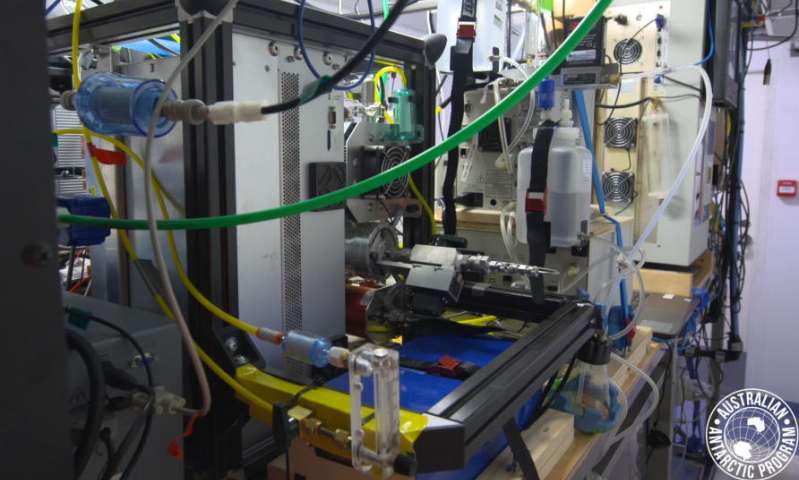
But a detailed study in this part of the world isn’t feasible without a fully functioning laboratory. So, onboard the ship with Dr. Schofield is a unique, mobile, air chemistry, shipping-container laboratory, known as AIRBOX or the Atmospheric Integrated Research Facility for Boundaries and Oxidative Experiments.
This custom-built laboratory is small—only 2.5 by 2.5 by 3 metres. But within that space it has nine instruments designed to carry out comprehensive atmospheric monitoring—taking measurements in the most remote places.
For this trip, the research team have also added another eight guest instruments measuring atmospheric chemistry, gases and aerosols over the Southern Ocean.
AIRBOX, an unsubtle stowaway, will travel on the icebreaker RSV Aurora Australis on four voyages this summer, as part of the Australian Antarctic Program.
With two expeditions on each of the voyages, Dr. Schofield and her colleagues will measure the summer season while all the Antarctic stations are resupplied.
And there’s a roster of expertise heading south throughout the Southern Hemisphere’s summer.
Buy Book Chemtrails, HAARP, and the Full Spectrum Dominance of Planet Earth
Dr. Branka Miljevic, from the Queensland University of Technology (QUT), and Jared Lewis, from the University of Melbourne, have just returned from resupplying Davis Station, one of three permanent bases and research outposts in Antarctica managed by the Australian Antarctic Division.
The University of Woollongong’s Dr. Dagmar Kürbistin and Dr. Schofield left in early December to resupply Casey Station in the Windmill Islands, just outside the Antarctic Circle.
They will be followed by Mr Joel Ahroe, from QUT, and Imogen Wadlow, from the University of Melbourne, who will resupply Davis and Mawson in the Australian Antarctic Territory.
And finally, Dr. Alan Griffiths from the Australian Nuclear Science and Technology Organisation and Associate Professor Helen (Clare) Murphy from the University of Wollongong will resupply Macquarie Island.
One of the areas the research is focusing on is clouds.
A CLOUD’S LIFECYCLE
The generation of clouds, starting from an aerosol and ending with rainfall, is an important part of our atmosphere’s self-cleaning. However, researchers want to know more about the process and understand how best to keep the system working in our warming climate.
“Clouds are very important, as well as beautiful weather phenomena,” Dr. Schofield says.
“By shading and cooling the Earth’s surface, cloud cover plays a direct role in rates of global climate change”, explains Dr. Schofield, based at the University of Melbourne’s School of Earth Sciences and an associate investigator of ARC Centre of Excellence for Climate Extremes.
Clouds are ‘seeded’ by tiny particles in the air called aerosols. These particles can include dust, soot and salt, some of which are particularly important for supplying nutrients to the oceans.
Water vapour attaches itself to the aerosol particles, condensing into a cloud droplet that is held aloft by air circulation and then grows to form a cloud, then once it gets big enough it will rain out. And the cycle starts again.
Buy Berkey Water Filters (Best Water Filters for All Sources)
Low, shallow clouds are mostly made of water droplets of various sizes. Thin, upper level clouds or cirrus clouds are made of tiny ice particles. And deep thunderstorm clouds can contain both liquid and ice in the form of cloud and raindrops, cloud ice, snow and hail.
“The concentrations of aerosols in the Southern ocean and Antarctic atmosphere differs from anywhere else on Earth. Their measurement is of great interest to the international climate-modelling community and for the Australian climate more generally,” Dr. Schofield says.
CLOUDS AND THE CLIMATE
The AIRBOX project aims to better understand where the aerosols are coming from that are influencing the clouds and how they are made.
“Our ability to predict future climate change will be aided by improving our understanding of aerosols,” Dr. Schofield says.
“For example, sulfate aerosol cools the climate by directly reflecting sunlight and by being very effective at seeding clouds, which also reflect sunlight and lead to a surface cooling. Industrial and fossil fuel burning emissions of sulfur dioxide gas into the atmosphere are the primary source of sulfate particles.
“By contrast, black carbon aerosols, that can come from wildfires, absorb radiation and can lead to atmospheric and surface warming.”
The AIRBOX contains several instruments that can characterise aerosols—including one that uses a laser to measure aerosol and clouds up to 10 kilometres away, as well as gases that are important in controlling aerosol formation processes like ozone.
Additionally, this can also help measure greenhouse gases like carbon dioxide, nitrous oxide and methane, as well as heat and water fluxes.
These instruments also measure aerosol properties, including the concentrations and sizes of particulates like dust in aerosols, and the types of particulates that contribute to aerosol formation.
“Aerosol concentrations over the Southern Ocean are unexpectedly high in spring, while summer measurements indicate lower concentrations compared to further north so we are also looking at seasonal changes in cloud-seeding,” says Dr. Schofield.
Anyone who has ever been on a boat will know that waves are also a major source of water in the atmosphere—including sea spray, another type of aerosol.
Related 5 Easy Ways to Protect Yourself from Killer Chemtrails
THE ‘CANARY IN THE MINE’
The aim of the AIRBOX is to collect as much data from as many areas as possible on these resupply voyages.
Dr. Schofield has a particular interest in mercury; the heavy-metal pollutant that’s released into the environment through things like volcanic eruptions and re-released from vegetation during bushfires. It’s also released to the atmosphere as a result of human activity, like gold smelting and burning fossil fuels.
A team, led by Dr. John Moreau and Dr. Caitlin Gionfriddo also with the University of Melbourne’s School of Earth Sciences, established that when mercury deposits on the Antarctic ice, sea-ice bacteria can change mercury into methylmercury—a more toxic form that can contaminate the marine environment, including fish and birds.
Buy Carbon 60 (c60) Super Antioxidant, Anti-Aging, Youth Restoring Supplements and Products
Then there’s what the Southern Ocean itself can tell us.
Dr. Schofield is collaborating with the University of Melbourne’s School of Engineering, including Associate Professor Alessandro Tofoli, to measure the sea-state with cameras onboard the Aurora Australis. Professor Jason Monty, also from the Melbourne School of Engineering, is working with the AIRBOX team to characterise the ocean’s heat and water exchange.
The information gleaned from Antartica could help us understand our world’s warming climate.
“We think of the Southern Ocean as a ‘canary in the mine’,” says Dr. Scholfield. “If we can understand more about what’s going on in our purest environment, we will have a better understanding of how to maintain the atmosphere’s ability to clean itself.”
Not sure how to make sense of this? Want to learn how to discern like a pro? Read this essential guide to discernment, analysis of claims, and understanding the truth in a world of deception: 4 Key Steps of Discernment – Advanced Truth-Seeking Tools
Stillness in the Storm Editor’s note: Did you find a spelling error or grammar mistake? Send an email to [email protected], with the error and suggested correction, along with the headline and url. Do you think this article needs an update? Or do you just have some feedback? Send us an email at [email protected]. Thank you for reading.
Source:
https://phys.org/news/2018-12-aerosols-atmosphere.html
Anyone who buys this claptrap will also think that being peed upon is the same as being rained upon.
Total BS!
Buys what crap? If you can’t at least entertain the truth of what is presented here I’m not sure what else we can do for you.