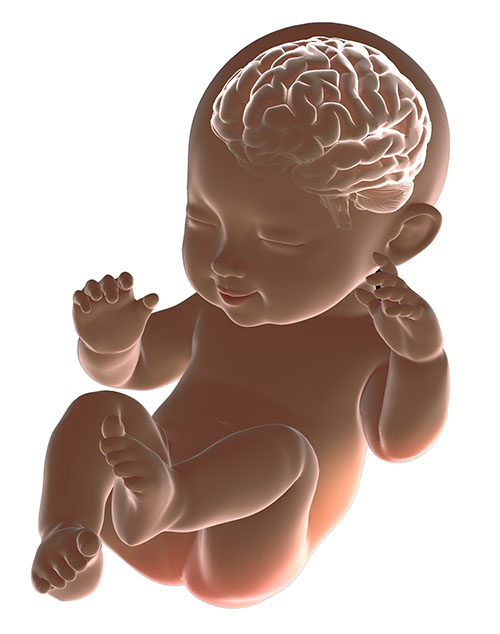
(Neuroscience News) A new study published in Scientific Reports, a Nature Research journal, shows how a one-time exposure during early pregnancy to cannabinoids (CBs) – both synthetic and natural – can cause growth issues in a developing embryo. This is the first research to show such a connection in mammals.
Related Even the Fetus Has Gut Bacteria
by Staff Writer, November 5th 2019
The study was performed in mice, which are very accurate models for the development that occurs during early pregnancy, according to the study’s senior author, Scott Parnell, PhD, assistant professor of cell biology and physiology in the UNC School of Medicine.
“The development of the embryo in this time period is very similar across all vertebrates,” said Parnell, a member of the UNC Bowles Center for Alcohol Studies. “In this study we also test a synthetic cannabinoid in zebrafish that yielded similar growth deformations as the natural CBs. Having the same results across animal models reinforces our findings.”
In this study, the brain and facial developmental effects caused by one-time exposure to CBs – CBD and THC (the primary ingredients of marijuana) – are very similar to what is seen in fetal alcohol syndrome (FAS). Parnell and colleagues also found that when CBs and alcohol were used together, the likelihood of these birth defects more than doubled. They went on to show that these drugs may be causing defects by interacting on a basic cellular level and disrupting signaling between molecules and cells that control growth and development.
“The interaction between alcohol and CBs we witnessed is very concerning,” said the study’s first author, Eric Fish, PhD, research associate in the UNC School of Medicine Bowles Center for Alcohol Studies. “Previous studies have shown that CBs and alcohol are frequently used together, and for pregnant women we’re learning that could be very dangerous to a developing child.”
Buy Book The Hug Therapy Book


Images are stained sections of fetal mouse brains. (Left) The brain of a control mouse. (Right) The brain of a mouse exposed to alcohol and a cannabinoid on the 8th day of pregnancy. Note the enlarged cerebral ventricle caused by the loss of the midline septal region (black arrow). The image is credited to UNC School of Medicine.
In the study CBs, and CBs with alcohol, were given in varying amounts on day eight of pregnancy, which is comparable to the third and fourth weeks of pregnancy in humans. This time period is when alcohol and CB exposure is especially damaging to a developing embryo, and is before some women know they are pregnant. The CBD amounts administered were within what is considered a therapeutic range for humans. The THC concentration administered was similar to levels reached by a person smoking marijuana.
“It is concerning how little we know about the use of marijuana, its CBs, and products like CBD oil during pregnancy,” Parnell said. “We know that there is no safe period to drink alcohol during a pregnancy, and I think this research shows the same is likely true of marijuana use.”
With the results of these one-time exposures, Parnell and Fish are planning to now test smaller, multiple exposures throughout a pregnancy that better mimics real-life usage in human pregnancy.
Funding: This research was supported by grants U01-AA021651 and U54-AA019765 from the National Institute on Alcohol Abuse and Alcoholism (NIAAA), part of the National Institutes of Health. This work was done, in part, with the Collaborative Initiative on Fetal Alcohol Spectrum Disorders (CIFASD), which is funded by grants from NIAAA.

Source:
University of North Carolina Health Care
Media Contacts:
Carleigh Gabryel – University of North Carolina Health Care
Image Source:
The image is credited to UNC School of Medicine.
Original Research: Open access
“Cannabinoids Exacerbate Alcohol Teratogenesis by a CB1-Hedgehog Interaction”. Eric W. Fish, Laura B. Murdaugh, Chengjin Zhang, Karen E. Boschen, Oswald Boa-Amponsem, Haley N. Mendoza-Romero, Michael Tarpley, Lhoucine Chdid, Somnath Mukhopadhyay, Gregory J. Cole, Kevin P. Williams & Scott E. Parnell.
Scientific Reports doi:10.1038/s41598-019-52336-w.
Abstract
Cannabinoids Exacerbate Alcohol Teratogenesis by a CB1-Hedgehog Interaction
We tested whether cannabinoids (CBs) potentiate alcohol-induced birth defects in mice and zebrafish, and explored the underlying pathogenic mechanisms on Sonic Hedgehog (Shh) signaling. The CBs, Δ9-THC, cannabidiol, HU-210, and CP 55,940 caused alcohol-like effects on craniofacial and brain development, phenocopying Shh mutations. Combined exposure to even low doses of alcohol with THC, HU-210, or CP 55,940 caused a greater incidence of birth defects, particularly of the eyes, than did either treatment alone. Consistent with the hypothesis that these defects are caused by deficient Shh, we found that CBs reduced Shh signaling by inhibiting Smoothened (Smo), while Shh mRNA or a CB1 receptor antagonist attenuated CB-induced birth defects. Proximity ligation experiments identified novel CB1-Smo heteromers, suggesting allosteric CB1-Smo interactions. In addition to raising concerns about the safety of cannabinoid and alcohol exposure during early embryonic development, this study establishes a novel link between two distinct signaling pathways and has widespread implications for development, as well as diseases such as addiction and cancer.

Stillness in the Storm Editor: Why did we post this?
There are a great many factors that influence human consciousness. Arguably one of the most influential is the time we’re in the womb. Modern science and psychology continues to misinterpret prenatal and familial influences as genetic. However, a new understanding is emerging. Parents are faced with incredible challenges in the modern world. The Deep State has made being a parent a hindrance, a social problem, and a laborious task instead of the sacred joy that it truly is. If parents took more time to learn about the factors that influence their children, a new generation free of the hardships of the past would emerge that will have so-called superpowers simply due to the fact their innate potentials were allowed to blossom. The preceding article discusses these more subtle and little acknowledged truths that are arguably some of the most important things to understand. With this knowledge in hand, the trials of being a parent can be alleviated simply by preparing for the child’s life before it has arrived. Additionally, the human race has yet to realize it’s full potential, but that potential is within our grasp should we choose to align ourselves to these fundamental truths.
– Justin
Not sure how to make sense of this? Want to learn how to discern like a pro? Read this essential guide to discernment, analysis of claims, and understanding the truth in a world of deception: 4 Key Steps of Discernment – Advanced Truth-Seeking Tools.
Stillness in the Storm Editor’s note: Did you find a spelling error or grammar mistake? Send an email to [email protected], with the error and suggested correction, along with the headline and url. Do you think this article needs an update? Or do you just have some feedback? Send us an email at [email protected]. Thank you for reading.
Source:
https://neurosciencenews.com/thc-cbd-fetal-development-15169/
Leave a Reply