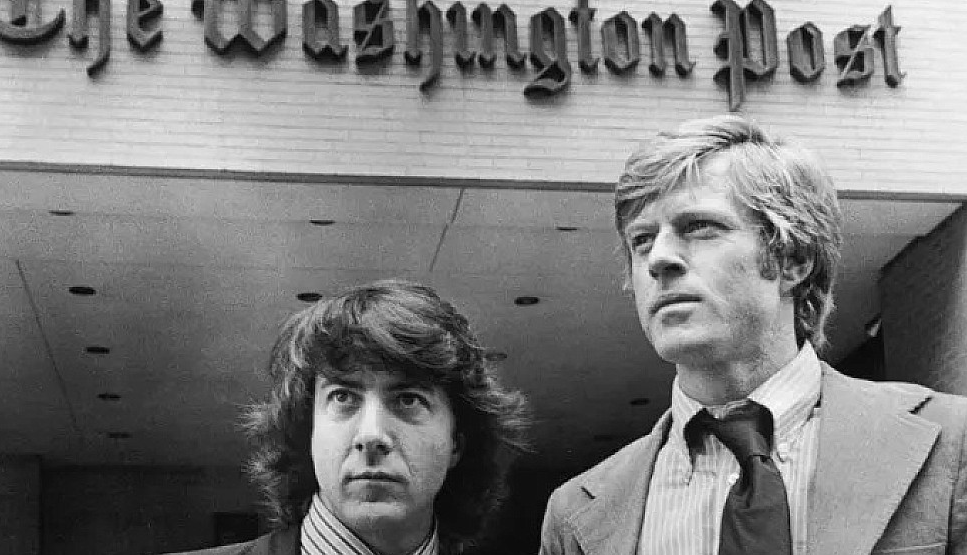
(Sophie Mann) As the Washington Post celebrates the 50th anniversary of its Watergate reporting, which shook a nation and brought a presidency to its knees, its current newsroom is hurtling through multiple dramas ranging from reporters’ public temper-tantrums to embarrassing corrections.
Related Carlson Reacts to ‘White Extremist’ Stephen Colbert’s ‘Meticulously Planned Coup’
by Sophie Mann, June 21st, 2022
Earlier this month, the Post stomached its arguably most intense news cycle yet, when national political reporter Felicia Sonmez was canned following days of excoriating her colleagues on Twitter.
Sonmez’s scorched earth internet campaign was, at least initially, the result of political reporter Dave Weigel’s decision to retweet an unseemly joke about women, which he promptly deleted and apologized for promoting. Weigel was ultimately handed a one-month suspension and Sonmez, after being chastised by some of her fellow colleagues for the “cruelty you regularly unleash against colleagues,” was fired by her employer for insubordination.
Sonmez was previously suspended in January of 2020 for tweeting, hours after his death, links to detailed allegations of sexual assault made against Kobe Bryant. The paper’s suspension of Sonmez, a self-identified survivor of sexual assault, was heavily criticized. Sonmez also sued the Post and some of her former bosses for temporarily barring her from covering stories about sexual misconduct.
The Sonmez/Weigel saga, however, is only the latest example of the famed news outlet becoming the story, rather than delivering the news to its readers.
Since luring tech reporter Taylor Lorenz from The New York Times earlier this year, her journalism has attracted unfavorable attention and corrections. From mining information from the teenage daughter of a former Trump administration official to sobbing on MSNBC about online harassment and then publicly blaming the network for making her look bad, Lorenz continues to generate increasingly negative headlines.
Most recently, Lorenz publicly duked it out with a number of media reporters attempting to understand a long series of editor’s notes inserted into a Lorenz-penned story about content creators who covered the Johnny Depp-Amber Heard trial. The big question became whether or not Lorenz reached out to two YouTubers cited in her story. Lorenz arrived at the conclusion that she was, once again, the victim of a “bad faith” campaign to discredit her, her reporting, and her outlet. She blamed the initial error on a “miscommunication” between herself and her editor.
On a recent episode of Puck’s “The Powers That Be Daily” podcast, journalist Jon Kelly discussed Post publisher Fred Ryan and owner Jeff Bezos asking candidates vying to become the paper’s next executive editor how they would take on the challenge of handling a newsroom full of young and perpetually online journalists. Specifically, they asked candidates what they would have done in the case of the now infamous Tom Cotton op-ed, in which he argued that the U.S. military should be sent in to quell the riots that destroyed parts of American cities during the summer of 2020. The op-ed was met with such abject furor from Times staffers that it led to the departure of both the editorial page editor, as well the editorial assistant who edited Cotton’s piece.
It’s unknown what response Sally Buzbee – a three-decade veteran of the Associated Press – gave the gentlemen, but she went on to secure the top job.
These last weeks, however, would appear to demonstrate that in a world of Twitter presidents, Twitter businessmen, and Twitter journalists, it is increasingly difficult to control the discourse of a staff eager to talk to the public.
Leading up to his imminent departure from his executive editorship at The New York Times, Dean Baquet warned his staff that too much time on Twitter makes for poor journalism. The warning has hardly dictated the way his staffers have behaved over the last several years, but is recognition of a problem that is not going away – though it appears to be less of an issue at the Wall Street Journal or Bloomberg.
In the post-Trump era of online discourse, even one of the star journalists who uncovered the Watergate story a half-century ago has not been able to spare himself the humiliation of the modern era of political reporting. For all that Carl Bernstein reported right about Richard Nixon, he swung and missed multiple times on former President Donald Trump’s now-discredited collusion with Russia.
It is clear that as the Post celebrates 50 years since the story that changed America, it now faces daunting challenges from a new generation of reporters eager to hear their own voice in a vitriolic world dominated by social media.
[the_ad_group id=”25840″]
Stillness in the Storm Editor: Why did we post this?
The news is important to all people because it is where we come to know new things about the world, which leads to the development of more life goals that lead to life wisdom. The news also serves as a social connection tool, as we tend to relate to those who know about and believe the things we do. With the power of an open truth-seeking mind in hand, the individual can grow wise and the collective can prosper.
– Justin
Not sure how to make sense of this? Want to learn how to discern like a pro? Read this essential guide to discernment, analysis of claims, and understanding the truth in a world of deception: 4 Key Steps of Discernment – Advanced Truth-Seeking Tools.
Stillness in the Storm Editor’s note: Did you find a spelling error or grammatical mistake? Send an email to [email protected], with the error and suggested correction, along with the headline and url. Do you think this article needs an update? Or do you just have some feedback? Send us an email at [email protected]. Thank you for reading.
Source:
[the_ad id=”121669″]
Leave a Reply