(Gary Lachman) When we think of wars, revolutions, populist uprisings, outbreaks of mass hysteria and other sudden social and political eruptions – even a popstar’s popularity or the latest fashion trend – we usually believe that at bottom there is some logical, rational explanation for them, even if we do not yet possess it. We are confident that we can understand these things through economics, psychology, race relations, religion, or as a reaction to ‘modernity’ or to some other factor that we can reason about, analyse, come to decisions on and take steps to alter and improve.
Related The Greatest Spiritual Event of Our Time According to Rudolph Steiner
by Gary Lachman, June 24th, 2020
Although the evidence sadly seems to suggest otherwise, we believe that ultimately we can learn how to control the factors that lead to these explosions. We can, if not eliminate the more catastrophic events like wars, at least minimise the disruptions they cause. In short, we believe we control our fate – or will be able to sometime soon. That is the whole modern project: man applying his intellect and will in order to make a better world, working to control events rather than be controlled by them, and steering history toward progress. We are not there yet, but it is just a matter of time.
But what if there are factors at work in these massive human events that are beyond our control? What if they are not a product of solely rational, calculable forces but are triggered by natural causes, even cosmic ones? What if the power behind these upheavals doesn’t come from the earth below but from up above, in outer space, from the moon, the stars, the planets and the sun?
We know that for a great part of human history that is exactly what many people believed. Until the advent of what we know as science in the early seventeenth century, the belief that the stars ordered our destiny was commonly accepted. Astrology, the art of foreseeing the turn of events on earth by charting the movements of the stars in the heavens, had for millennia guided emperors and kings the world over. In ancient China, India, and the Middle East, in classical Greece and Rome and throughout Europe in the Middle Ages and the Renaissance, the belief that “everything in the… cosmos was inextricably connected to everything else, no matter how great or how small” was as much common knowledge as the supposed Big Bang is today.1 And that this arrangement was hierarchical, with changes in the heavens portending those on earth, was also accepted. It was generally agreed that the earth and everything on it was open to forces coming from beyond and that the wise men of antiquity understood these forces and benefited by them.
All this changed some four centuries ago when what we know as science began to disabuse Western man of such ‘nonsense’ – notwithstanding that millions of people around the globe still accept it.2 The irony here is that some of the most significant figures in the rise of the modern scientific view of the world were well-steeped in the very ‘nonsense’ they were ostensibly freeing us from.
Hermeticism & Astrology
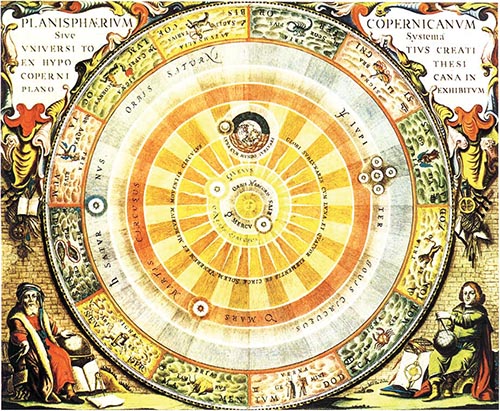
Copernican Planisphere, engraving by Andreas Cellarius, 1660
The inauguration of the modern worldview is generally credited to the Polish astronomer Nicolai Copernicus. In On The Revolutions of the Heavenly Spheres (1543) Copernicus argued – reluctantly it seems – that, as we all accept today, the sun did not orbit the earth, but the earth the sun.3 It, not ourselves, was at the centre of things, or at least that of our solar system.
Although Copernicus was a timid agent provocateur – and a mean-spirited one – his work nevertheless sparked a revolution among the heavenly spheres and our earthly one.4 Yet the idea that the sun was at the heart of things did not arrive in Copernicus’ mind fully formed. As the historian Frances Yates argued some years ago – and as has been echoed more recently by others – Copernicus was an attentive reader of the Hermetic texts in which the sun plays a dominant, we might even say, central role.5
Book Giordano Bruno and the Hermetic Tradition
Western astrology is one of the Hermetic sciences. It has its roots in the teachings of the great sage Hermes Trismegistus, father of magic and science and initiate of the perennial philosophy, collected in the Corpus Hermeticum and other texts, circa 200 CE. In Book XVI of the Corpus Hermeticum, Hermes calls the sun the “craftsman,” Plato’s name for the demi-urge, creator of the universe. In the Asclepius – a Hermetic text not in the Corpus Hermeticum – Hermes speaks of the sun’s “divinity and holiness” and calls it a “second god.”
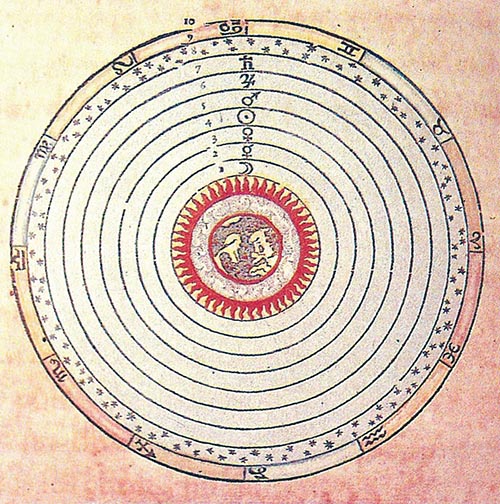
In the Corpus Hermeticum, the earth was seen as the manifest physical realm at the centre of a series of concentric spheres which represented the planets, stars and higher levels in the Divine hierarchy of Being. The Ptolemaic model – which was official theory in Europe until after the Copernican revolution – had the earth in a stationary position at the centre of the universe.
In the introduction to his work, Copernicus enlists two previous sages in support of his theory, both of whom find places in the Aurea Catena, or Golden Chain of Adepts, by whom the Hermetic wisdom, or prisca theologia, has been handed down through the ages, at least according to the Renaissance Hermeticist Marsilio Ficino. These are Pythagoras (who, we know, heard the ‘music of the spheres’) and his follower, the teacher of Plato, Philolaus. Copernicus even refers directly to the sun as a “visible god,” just as the Asclepius does. The fact that in the Hermetic cosmology the sun’s position differs from its place in the Ptolemaic system that Copernicus was ‘improving’, suggests that it was an important influence on those improvements.
Copernicus wasn’t the only one to help shape our modern universe while retaining a good amount of the ancient one. The seventeenth-century German astronomer Johannes Kepler, who discovered the laws of planetary motion, devoted much time to astrology and forecast more than one dignitary’s fortune, although he was not always happy about it. He was also for a time a guest of Rudolf II, the Hermetic Holy Roman Emperor, a patron and student of astrologers.6 “That the sky does something to man is obvious,” Kepler said, “but what it does specifically remains hidden.”7 Kepler recognised that much astrology was moonshine – at least that was true of his competition. But he also knew that the genuine baby should not be thrown out with the phony bathwater.
Perhaps the biggest surprise is that Sir Isaac Newton, whose view of the cosmos was dominant until the advent of Einstein, wrote more about alchemy – a Hermetic science directly linked to astrology – than he did about gravity. And as astrology is also known as an ‘occult science’ – ‘occult’ meaning ‘unseen’ – then Newton was a Hermeticist even when he did write about gravity which is also unseen. As with Copernicus, there is much debate today over how much Newton’s Hermetic ideas informed the Principia (1687), the blueprint for the modern, Newtonian view of the cosmos, which, ironically, ousted the earlier, more ‘magical’ one.8
Nevertheless, even with this esteemed company, astrology suffered the same fate as the other Hermetic sciences and was relegated with other forms of ‘rejected knowledge’ to the great dustbin of ideas – and also, since the 1930s, to daily appearances in most major newspapers. But it didn’t go down without a fight. As late as 1768, the German physician Franz Anton Mesmer, soon to add a word to our vocabulary, earned his doctorate with his dissertation on ‘The Influence of the Planets on the Human Body’. Mesmer did not consider himself an astrologer or occultist. He was a scientist who had discovered the medium through which the planets and the entire cosmos influence life on earth. Yet he could not escape astrology altogether. The very word ‘influence’ itself comes from astrology. It is the name Marsilio Ficino gave to the stellar fluid that flows from the stars down to earth and informs what happens here.
The medium Mesmer had discovered – to his satisfaction and that of many of his patients, if not the authorities – was what he called ‘animal magnetism’ – ‘animal’ meaning ‘animated’, not ‘beastly’. This was, like the astral influence, a fluid permeating the universe, like the nineteenth-century ‘ether’, linking everything to everything else, its cosmic flow keeping all in balance. In living things it was the source of health and vitality, and Mesmer believed he had mastered a method of guiding and encouraging its movement in his patients, many of whom agreed.
A side-effect of the ‘magnetic passes’ that Mesmer and the mesmerists that received his training made over patients was what became known as the ‘magnetic trance’. It was a student of Mesmer, the Marquis de Puységur, who in 1785 stumbled on to what was really at work.9 The ‘trance’ was not magnetic, animal or otherwise, but hypnotic – the term was coined by the Scot James Braid in 1842. When today we say someone is ‘mesmerised’ we mean they are ‘hypnotised’, not that animal magnetism is at work.
While Mesmer might not have grasped the phenomenon of hypnosis, he may not have been as wrong about magnetism as the members of the French Academy of Sciences, who in 1784 declared his work a fraud, believed.
[the_ad_group id=”3113″]
Gauquelin’s Breakthrough Survey
Astrology held on in the popular mind, along with other Hermetic ideas, but as the modern age progressed science continued to dismiss it. Then in the mid-twentieth century science, of all things, seemed to come to its aid. In 1955 Michel Gauquelin, a French psychologist and statistician with degrees from the Sorbonne, published a book L’influence des astres (‘The Influence of the Stars’) based on years of research that seemed to support some of astrology’s fundamental ideas. This work, as well as the English editions of his other books – The Cosmic Clocks (1967), Astrology and Science (1970), Cosmic Influences on Human Behaviour (1974) – made Gauquelin astrology’s most persuasive scientific defender, although, like Mesmer, he did not see himself as an astrologer. Gauquelin and his collaborator, his wife Françoise, said they simply wanted to answer a basic question: does one’s birthday have any effect on one’s future?
After submitting the 27,000 + birthdates they had gathered to statistical analysis, the initial results were disappointing. There seemed to be no substantial correspondence between one’s ‘sun sign’ (Capricorn, Aries, Pisces, etc.) – the constellation the sun is ‘in’ at the time of one’s birth – and one’s destiny. But the Gauquelins seemed to have discovered something else. There was a strong correlation between one’s future profession and the time of birth, not because of the sun, but because of the planets. The Gauquelins discovered that more famous doctors were born just after the rise or culmination of Mars or Saturn – planets related to that vocation – than chance should have allowed. Top-ranking military leaders were born just after the rise or culmination of Mars or Jupiter; again the astrological correspondence held. Professions which in traditional astrological lore were associated with the other inner planets – Mercury and Venus – showed similar correlations. As Guy Lyon Playfair and Scott Hill say in The Cycles of Heaven, “In some cases, there was only one chance in five million that such clusterings were due to chance alone.”10
And there was another odd fact: these significant results were true only of people who were highly successful at their work. The Gauquelins saw that large numbers of scientists, doctors, athletes, artists, writers and others, who were competent but not above average, fell outside their select group. It was as if the smaller number received the planetary influence – whatever it was – direct and absorbed it all, leaving very little for the stragglers. Gauquelin’s findings have come to be known as ‘the Mars Effect’.
Gauquelin’s results were examined by the psychologist and statistician Hans Eysenck. Eysenck, a tough-minded sceptic, had to admit that he was convinced. And when Eysenck and his colleagues examined some other astrological givens – that people born under ‘water’ signs tend to be emotional, that those born under ‘odd’ numbered signs tend to be extroverted while those born under ‘even’ ones are introverted – he and his team were surprised to find the evidence strongly in favour of them.11
The question remained of exactly how the planets and other cosmic bodies can affect earthly ones? Some people working in the earlier part of the last century, and in another part of the world, thought they might have a clue.
The Role of the Moon
Whether astrology can account for it or not – I don’t have the statistics on hand – it nevertheless seems that investigating the role of cosmic forces on human life is a peculiarly Russian pursuit. At least in researching this article I came across more Russians than chance may have allowed. For example, the Greek-Armenian esoteric teacher G. I. Gurdjieff may not have been Russian – his exact nationality has always been uncertain – but he certainly started his career in Russia.12 In 1914, with the First World War erupting, the Russian philosopher P.D. Ouspensky, Gurdjieff’s most famous pupil, asked him if such catastrophes could be avoided. They could, Gurdjieff told Ouspensky, but what was necessary was to understand why they start.
“What is war?,” Gurdjieff asked Ouspensky. “It is the result of planetary influences. Somewhere up there two or three planets have approached too near to each other; tension results… For them it lasts, perhaps, a second or two. But here, on the earth, people begin to slaughter one another, and they go on slaughtering maybe for several years.” The people involved feel they have perfectly good reasons for fighting – for king, country, national honour, lebensraum or to pre-empt an attack by a hostile neighbour. But “they fail to realise to what extent they are mere pawns in the game.”13
Gurdjieff also spoke to Ouspensky about the moon. Bookshelves are full of accounts of how the full moon affects some people; our terms ‘lunacy’, ‘lunatic’, ‘looney’, ‘moonshine’ are evidence of the popular acceptance of something that is still ‘officially’ dismissed. Gurdjieff took it a bit further. “The moon,” he said, “is the chief… motive force of all that takes place in organic life on earth. All movements, actions, and manifestations of people… depend on the moon and are controlled by the moon.”14 Perhaps the strangest thing was Gurdjieff’s insistence that the moon is a living being and that it is growing, and that its nourishment comes from the souls of ‘sleeping’ people who are not working to attain the true ‘waking’ state of consciousness.15
When one recognises that in the weeks surrounding the November 2016 US presidential election the moon entered a ‘perigee full moon’ or ‘supermoon’ – when it was both full and closer to the earth than it had been for nearly seventy years – one wonders if Gurdjieff knew things denied more conventional political analysts.16
Gurdjieff said that he gained his cosmic knowledge during his time with the mysterious Sarmoung Brotherhood in Central Asia.17 One wonders if he had more local sources. Helena Petrovna Blavatsky, one of the founders of the Theosophical Society, was, like Ouspensky, a full-blooded Russian. In Isis Unveiled (1877) she writes that “certain planetary aspects may imply disturbances in the ether of our planet, and certain others rest and harmony.” At times this influence promotes periods of withdrawal, of “monasticism and anchoritism”; at others frenzied action and “utopian schemes.” And where Gurdjieff speaks of the “harmony of reciprocal maintenance” operating throughout the cosmos, Blavatsky speaks of the “reciprocal relations between the planetary bodies.”18
Blavatsky got her knowledge from her Masters in Tibet. Did anyone in Russia have it too? Oddly, around the same time that Gurdjieff was enlightening Ouspensky about our place in the cosmos, it seemed someone did. But in his case, the sun, not the moon, pulled the strings.
[the_ad_group id=”3136″]
The Role of the Sun
In June 1915, the eighteen-year-old prodigy Aleksandr Chizhevsky – scientist, musician, painter, poet – noticed something. He had become fascinated with the study of sun-spots – huge dark bodies that pass across the surface of the sun – and it struck him that at the same time as a large group of spots crossed the sun’s central meridian, certain events transpired on earth. The aurora borealis that month was unusually strong, and the magnetic storms making up the spots had disrupted more radio and telephone communication than usual. But there was something else. The fiercest battles of the war coincided with the spots. Was that a coincidence?
In 1916, when he was fighting with the Russian army on the Galician front, Chizhevsky saw that the battles intensified when solar flares and geomagnetic storms were most active. In 1917, when the Bolsheviks took power, there was, he saw, another unusual burst of solar activity. Checking the records, Chizhevsky saw that there had also been one in 1905, at the time of an aborted uprising.
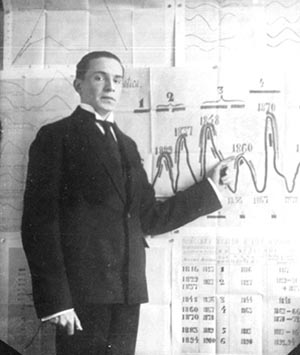
By 1922 Chizhevsky had made a chart showing, he claimed, 2,400 years of “mass movements”: wars, major battles, revolutions, uprisings, migrations, from across the globe. These, he argued, came in regular cycles which coincided almost exactly with the eleven-year sun-spot cycle. (In 1843, the German astronomer Heinrich Schwabe observed that sun-spots went through a ten-year cycle; the idea was later refined by Rudolf Wolf and Alexander Humboldt and established at eleven years.)
Chizhevsky believed he had discovered a “universal cycle of historical events,” with the sun, or whatever was behind its spots, at the wheel.19 Every major outbreak in recent history, from the French Revolution to the start of World War I, was precipitated by solar excitement. Chizhevsky was even able to predict when such things would occur. In 1926, guided by the sun-spot cycle, Chizhevky predicted important flare-ups from 1927 to ’29. What happened then? Salazar’s dictatorship began in Portugal. Chiang Kai-shek captured Peking. Mussolini was on the rise as was Hitler, and Stalin consolidated his power by exiling Trotsky. And Wall Street suffered a collapse triggering the Great Depression.
Chizhevsky’s work impressed many people, like the economist Edward Dewey, who used his ideas in his own work on economic cycles. Others, like Stalin, were not so impressed. In 1942, when he realised that for Chizhevsky sun-spots and not the irresistible march of the Marxist class war were responsible for the Soviet Union, he ordered him to retract his work. By this time Chizhevsky was a prestigious scientist, with many degrees and honours. Alongside Nicolai Fedorov, Konstantin Tsilokovsky, and V. I. Vernadsky, he was one of what is known as the ‘Cosmist’ school. Chizhevsky refused and Stalin sent him to a gulag for eight years, with eight years ‘rehabilitation’ after that. He was released during the Khrushchev ‘thaw’ following Stalin’s death and today is revered as the ‘father of heliobiology’, the study of the sun’s influence on life on earth. Other Russians who were influenced by his work or shared his belief in cosmic forces affecting the earth, were Vladimir Vernadsky, mentioned above, who popularised the ideas of the ‘biosphere’ and ‘noosphere’, and the historian Lev Gumilev, whose ideas about ‘ethnoi’ and ‘passionarity’ as agents of civilisation, also depend on cosmic forces affecting human beings.20
Chizhevsky believed that what was behind the intensified agitation during high sun-spot activity was an increase in negative ions in the atmosphere. The solar flares erupting from the sun during the intense magnetic storms making up the spots affected the earth’s own magnetic field, which in turn ‘ionised’ the air. Positive ions, he believed, had a ‘negative’ effect, making people dull, lethargic, and irritable. Negative ions did the opposite. They worked as stimulants; hence the effect of a ‘breathe of fresh air’ after a rainstorm. The ionisation too went through cycles and at the highest concentration of negative ions, things start jumping.21 Mesmer was not as wrong as his critics believed. Magnetism did have something to do with it.
Chizhevsky died in 1964. One odd fact that he missed but others, like Edward Dewey, noticed was that often things on earth occurred slightly ahead of the sun-spot cycle, as if effect preceded cause – or as if events on earth triggered the spots. If this was the case, then something else must be responsible or at least precede both. In 1949 John Nelson, an RCA engineer who had been studying the sun to ‘predict’ when its spots would interfere with communications, hit upon an answer. Somehow, the planets had a hand in it. Although most astronomers would laugh at the idea of a planet’s weak magnetic field having any effect on the sun, this is exactly the conclusion Nelson came to, and which enabled him to predict and avoid blackouts.22 The odd thing was that the planets’ effect on the sun coincided with traditional astrological notions of ‘opposition’ and ‘conjunction’. When planets were in such an arrangement with the sun and the earth, things tended to go haywire. Otherwise, things were fine.
Some contemporary thinkers see in Chizhevky’s work an argument against free will. In The Bond, Lynne McTaggart states that “if we are essentially at the mercy of the slightest move of the sun and its activity,” then Chizhevsky’s work stands “as a gigantic refutation of our misguided belief in ourselves as masters of the universe – or even of ourselves.”23 This is a not uncommon reflection on human hubris.But it goes against what Chizhevsky himself believed: that the sun does not compel us to do anything in particular, only to do something. It acts as a stimulant; what we do when stimulated is up to us. There may be increased belligerence during intense sun-spot activity, but there are always pacifists, conscientious objectors, and quiet people at home, sitting out the riots.
As astrological lore has it, ‘the stars incline, they do not compel’. This was something Gurdjieff knew when he told Ouspensky that one could choose which influences one fell under.24 Man could escape being ‘food for the moon’ by working on himself and, in his interior planetary system – spelled out in fascinating detail by Rodney Collin, a student of Ouspensky, in The Theory of Celestial Influence – could become an ‘inner sun’, under a minimum of cosmic laws.25 As its students know, this too was an aim of Hermeticism.26 The stars in their courses may spark events here on earth, but we still have the responsibility of steering our way through them.
About the Author
GARY LACHMAN is a former student of Gurdjieff’s Fourth Way, as well as a counterculture expert. In 2001 he published his first book, Turn Off Your Mind: The Mystic Sixties and the Dark Side of the Age of Aquarius, a history of the 1960s occult counterculture. During the 1980s, Lachman avidly studied philosophy, psychology, history, science, and esotericism. His public figure rose in the late 1970s as he toured with pop rock group Blondie. In March 2006, he was inducted into the Rock and Roll Hall of Fame for his outstanding work with Blondie. Lachman became a full-time writer in 1996, when he moved to London. His books include A Dark Muse: A History of the Occult and A Secret History of Consciousness, In Search of P.D. Ouspensky: The Genius in the Shadow of Gurdjieff (Quest Books, 2004), Politics and the Occult: The Left, the Right, and the Radically Unseen, Jung The Mystic: The Esoteric Dimensions of Carl Jung’s Life and Teachings and Madame Blavatsky: The Mother of Modern Spirituality.
Footnotes
1. Nicholas Campion, The Great Year: Astrology, Millenarianism and History in the Western Tradition, Arkana, 1994, 76
26. Gary Lachman, The Quest for Hermes Trismegistus, Floris Books, 2011, 135-37
If you appreciate this article, please consider a digital subscription to New Dawn.
Stillness in the Storm Editor: Why did we post this?
Consciousness is one of the most mysterious phenomena of all time. Scientists, philosophers, and mystics have been searching for the answer to the question, What is Consciousness? for most of human history. In modern times, the spiritual origins of consciousness are being replaced with a materialistic view, that awareness emerges as an additive property of electrical impulses in living things. Despite the fact this theory is assumed to be true, any self-respecting psychologist will tell you we have no idea what consciousness really is. The preceding article discusses consciousness, some of its properties, and possible origins. This is helpful to contemplate because, in the act of trying to understand the mysteries of consciousness, you develop critical thinking skills and stimulate your philosophic muscles, both which are immensely important for almost everything we do in life. Additionally, you’ll develop abstract thinking skills, the ability to explore intangible realities that govern material realms. With the power of an active mind capable of navigating the realities of consciousness, great leaps in personal attainment can be made along with preparing you for the Great Work of making this world a better place.
– Justin
Not sure how to make sense of this? Want to learn how to discern like a pro? Read this essential guide to discernment, analysis of claims, and understanding the truth in a world of deception: 4 Key Steps of Discernment – Advanced Truth-Seeking Tools.
Stillness in the Storm Editor’s note: Did you find a spelling error or grammatical mistake? Send an email to [email protected], with the error and suggested correction, along with the headline and url. Do you think this article needs an update? Or do you just have some feedback? Send us an email at [email protected]. Thank you for reading.
Source:
https://www.wakingtimes.com/2020/06/24/as-above-so-below-are-cosmic-forces-at-work-on-earth/
Leave a Reply