(Alanna Ketler) Deep inside all of us lives a wounded child who is desperate for love, attention, and validation — that child is you, it is your younger self. Even those of us who haven’t experienced severe trauma such as physical or sexual abuse most likely still have wounds that we are unknowingly carrying around with us all the time. Even though our parents might have done the best they could, and perhaps were typically loving and supportive, there could still be scars left on us and stored deep within our subconscious. These scars may lead us to experience the constant need for validation and approval, feelings of unworthiness or not being good enough, fear of abandonment, or perhaps a deep lack of self-love.
Related Biology of the Abandoned Inner Child & Enemy of the True Self with Justin Deschamps
by Alanna Ketler, February 29th, 2020
Shadow Aspects & Inner Child Healing
These wounds will often manifest as aspects of our “shadow selves” and will typically come out and be expressed within the confines of our closest relationships. Until we’ve done the work to heal these wounds, we subconsciously enter relationships that will provide us with the same dynamics we had with our parents. For example, someone who is constantly attracting emotionally unavailable partners likely had at least one parent who was emotionally unavailable to them, and so subconsciously they try to heal those wounds through seeking love from partners and relationships that resemble the dynamics we had with our parents. Maybe we can relate to this ourselves or have friends who always seem to attract the same kind of partners, which is because the healing has not yet taken place and our subconscious mind is irrational–it just continues to act out this same pattern, this same search.
There is a lot of power in embarking on inner child healing work; I have recently begun the process of healing my own wounded inner child with the assistance of a trained therapist. I have already noticed a huge difference in the ways I seek out love, and have been feeling much more secure without the constant need of approval from others because I am approving of myself and loving myself on a level that I had previously never experienced before. I have been able to accurately identify previous patterns when they arise, make the connection of where these patterns emerged from, and then go inwards and heal those wounds.
What Is This ‘Work?’
This work involves consciously going back to painful moments you may have had as a child and essentially re-parenting yourself the way you needed to be parented at that time — with all the love, support and understanding that children need to grow into healthy adults. Telling your child self that it is not your fault, that you are still loved beyond measure, and that you, as you are now, are there for your inner child. You can even comfort your inner child by imaging yourself holding your inner child in your arms and providing comfort for the child to express their pain and emotion.
Children often cannot understand why a parent is angry — maybe the parent had a rough day, and the child drops a glass on the ground and the parent yells and lashes out at them, not necessarily because of the child’s actions, but because the parent was already upset about other stressors in life. The child has no way of understanding that, and doesn’t think, “Gee, I guess Mom had a rough day and is taking it out on me.” They think that they have done something wrong, that they are not good enough, and that they are not loved. These types of situations are exactly what create these scars within the subconscious.
Artist’s Depiction Of Inner Child Healing
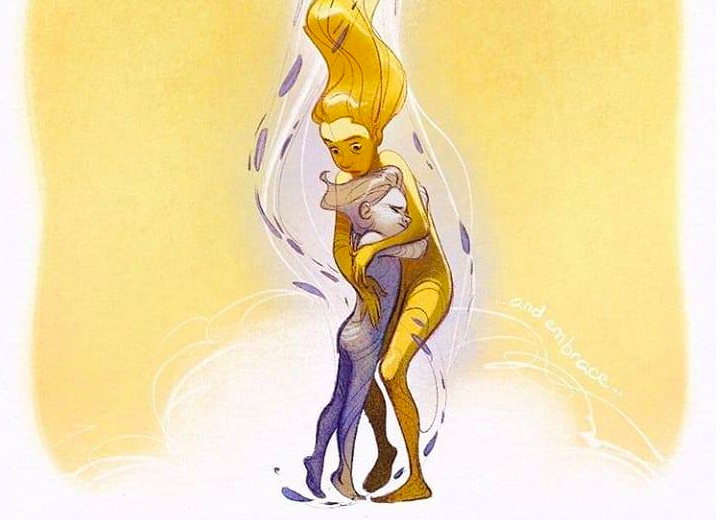
The following drawings done by artist Cécile Carre beautifully depict the process of facing your wounds and shadow self, the healing process, and then the reintegration of the healed child back to the self for inner peace.

The first drawing shows us the shadow that is constantly looming over us, creating sadness and despair, desperately waiting to be acknowledged…

The shadow becomes a lot less aggressive after we muster up the courage to turn around and face it and see it for what it is…

We then recognize that this shadow is actually us, and it has been us all along, and it is a part of us that has been denied, ignored, and suppressed for many years. All it wants is for us to love and acknowledge it…

This being is us, it is our child self, and it is so happy that we are finally attending to and recognizing its need for love…

We can then nurture and re-parent our wounded child within and give it everything it needs to feel safe, secure, supported and loved, and so this child then becomes a part of us and is with us always…

Once it has been healed and integrated back within us, it no longer needs to manifest in ways that show up as various forms of fear including unworthiness, fear of abandonment, not being ‘good enough,’ not being loved, etc. It then remains a part of us as a playful, adventurous, curious, fun-loving side of our personalities.
You can check out more of Cécile Carre’s work on her Instagram page @carrececile
Final Remarks
I feel I should note here that this is not just some airy-fairy, spiritual concept, but both Jung and Freud referred to the inner child in their work. Jung referred to it as the puer or puella complex and Freud as the unconscious part of ourselves. It became known as the “inner child” through pop psychology and the self-help movement, but the inner child is simply an archetype of who we once were. No matter what it is called, it is worth noting that as adults most of us would benefit from completing this work. There are many books on the subject and tons of information on the internet, however this work is best done with a trained therapist.
I’ll finish off with one of my favorite quotes,
“People will do anything, no matter how absurd, in order to avoid facing their own souls. One does not become enlightened by imagining figures of light, but by making the darkness conscious.” – Carl Gustav Jung
About The Author
Stillness in the Storm Editor: Why did we post this?
Why bother trying to improve yourself? Because the self the venue through which you experience everything, including, taking action in the world. But the self isn’t like a car, it doesn’t just work—it takes work to make it work for you. The self is not only the thing you use to experience the world but it’s the thing you’re discovering through your exploration of the world. What’s more, it’s also the thing you’re creating through your actions and thought processes. Oddly enough, the self is the thing we have the most control over and is the most influential in our lives, despite its elusive nature, it makes sense that trying to improve ourselves is arguably the master key to success in all areas of life. The preceding information discusses the importance of self-work, speaking to techniques, psychology, philosophy, or spirituality. Put simply, there are two choices in life: develop control and mastery over the animal self or let your animal instincts and fears control your life. For many, the tools needed to gain control and liberation therefrom are not available, and so the quest to improve the self seems worthless. But suffering in general is one of many spiritual influences that motivate the individual to become the best version of themselves. This sacred call to realize your full potential is something almost everyone feels at some point in their lives. Those who step forward in this path, despite life’s hardships, transcend suffering and become active players in the Great Work of making the world a better place through their very being.
– Justin
Not sure how to make sense of this? Want to learn how to discern like a pro? Read this essential guide to discernment, analysis of claims, and understanding the truth in a world of deception: 4 Key Steps of Discernment – Advanced Truth-Seeking Tools.
Stillness in the Storm Editor’s note: Did you find a spelling error or grammatical mistake? Send an email to [email protected], with the error and suggested correction, along with the headline and url. Do you think this article needs an update? Or do you just have some feedback? Send us an email at [email protected]. Thank you for reading.
Source:
Leave a Reply