
(Ivan) Recent archaeological excavations have revealed a set of new temples and standing stones at Göbekli Tepe, an archaeological site in Turkey, considered the oldest temple on the surface of the planet.
Related The Secret of Gobekli Tepe: Cosmic Equinox and Sacred Marriage
by Ivan, July 24th, 2018
Speaking with state-run Anadolu agency in an interview, the head of the archaeological department at Harran University in Sanliurfa, Mehmet Önal, said that 15 more mega-monumental temples and more than 200 standing stones have been discovered in a geophysical survey in the region.
“As archaeological excavations continue in the coming years, we will come across new constructions,” said Önal.

The archeological site in Turkey’s southeastern Şanlıurfa province is considered one of the oldest and largest temple complexes on Earth.
Göbekli Tepe, which means “Potbelly Hill”, is so massive that archaeologists expect that excavations to uncover Göbekli Tepe entirely will continue for at least 150 years.
Buy Book Point of Origin: Gobekli Tepe and the Spiritual Matrix for the World’s Cosmologies
The archaeological site was discovered in 1963. Since then, experts from Istanbul and Chicago universities have been actively working on the site.
Since 1963, archaeological work at the site has not stopped.

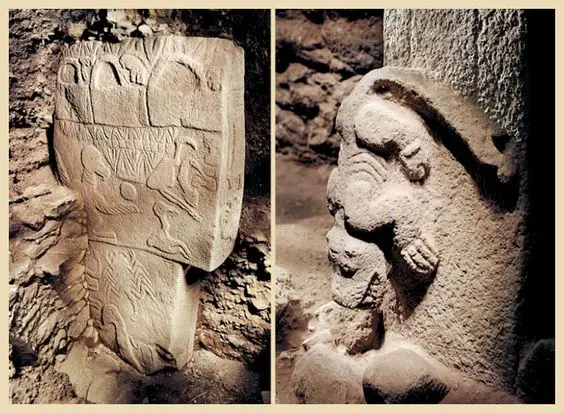
Researchers from the German archeological institute and the Şanlıurfa Museum have worked closely at the site since 1995, discovering T-Shaped stone structures dating from the Neolithic Era, and measuring three to six meters in height, weighing between 40 and 60 tons. In addition, researchers have also uncovered diverse historical artifacts like 65-centimeter-long human statues that archaeologists say, date back more than 12,000 years.
It remains a profound mystery as to how the ancients build Göbekli Tepe and an even bigger mystery as to why.
Buy Book Gobekli Tepe: Genesis of the Gods: The Temple of the Watchers and the Discovery of Eden
Despite working on the site since 1963, archaeologists have still not managed to answer important questions about the site.
Who built the megalithic complex remains a mystery.
In order to protect the site, a 4,000-square-meter steel roof was erected by experts during preparations for its candidacy.
Some of the oldest parts of the site date back to the 10th–8th millennium BCE.
During the first phase of Gobekli Tepe’s construction, belonging to the Pre-Pottery Neolithic A (PPNA), circles of massive T-shaped stone pillars were erected by the ancients. This makes them the world’s oldest known megaliths.
The exact details of the structure’s functions remain a mystery.
In 2018, the site was designated a UNESCO World Heritage site.
Göbekli Tepe is considered by countless scholars as an archaeological discovery of the greatest importance since it could drastically alter the understanding of a crucial stage in the development of human society.
The importance of Göbekli Tepe was perhaps best explained by Ian Hodder of Stanford University who said, “Göbekli Tepe changes everything”. A number of scholars argue that the construction of Göbekli Tepe may have influenced the later development of urban civilization.
Buy Book Forbidden Archeology: The Hidden History of the Human Race
Stillness in the Storm Editor’s note: Did you find a spelling error or grammar mistake? Send an email to [email protected], with the error and suggested correction, along with the headline and url. Do you think this article needs an update? Or do you just have some feedback? Send us an email at [email protected]. Thank you for reading.
Source:
[…] https://stillnessinthestorm.com/2018/07/archaeologists-find-15-temples-and-more-than-200-standing-st… […]