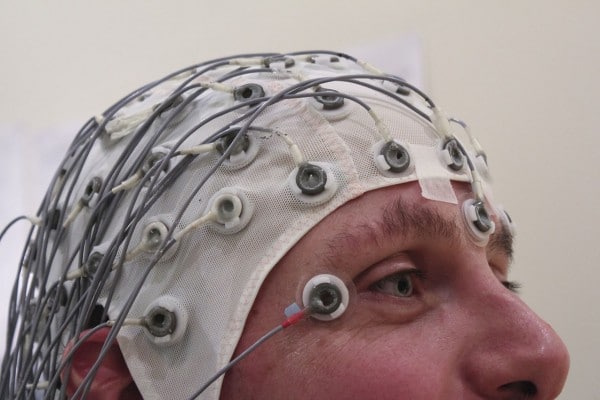
(Stillness in the Storm Editor) The acme of crime investigation is the ability to scan a person’s mind to see if they committed a crime, bypassing deception on the part of a suspect. According to the following article, this technology has been developed and is now being studied for public use. In some ways, it could clean up the rampant corruption that pervades nearly every level of the “justice system,” by verifying if a suspect has any guilt associated with an accused crime. But it can also be used to spy on a person’s thoughts in general.
In other words, this could be the public roll out of technology that was developed long ago in deep black military projects. In fact, there are several patents already on the public record that strongly relate to this technology.
Related Who Really Owns and Controls the Military-Industrial Complex and What Are They Doing? – An Extensive Research Report
Related Mind Control is Real: United States Patent 6506148 B2 Confirms Human Nervous System Can be Manipulated Through Electromagnetic Fields from Monitors
And finally, during the 2017 Mobile World Congress, technology developers revealed their plans for the 5G network, a global smart grid that has the ultimate goal of gathering, storing, and processing all information, especially about people’s habits, desires, and political views.
Related Transhumanist Agenda Revealed: Hive Mind? 5G, Smart Grid, and the Coming “Global Brain” (Audio) — The Future of Media and Agenda 2030
The powers that be are moving full speed ahead with their vision of a technocratic new world order, one where no mind is safe from the prying eyes of big brother.
But such a dystopic world can only come to pass if those with knowledge and the wisdom to see a better way remain silent.
by Jayson Veley, March 22nd, 2017
While polygraph tests tend to be accurate most of the time, what if there was a way to actually crawl inside of the mind, have a look around, and determine guilt that way? Now, thanks to a combination of brain scanning and artificial intelligence, that may just become a reality. (RELATED: Read about just how powerful the use of artificial intelligence can be.)
In a recent study, scientists concluded that this sort of mind reading technology could be used to scan the brains of criminals and determine whether or not they are knowingly committing a crime. This marks the first time that neurobiological readings have been used to determine levels of guilt, but researchers acknowledged that their brain scanning method is not currently admissible in court.
Of course, criminals are unpredictable, and there are dozens of different motivating factors that contribute to their actions. Therefore, scientists warn that brain data alone shouldn’t be used to access the mental state of defendants.
Still, the use of brain scanning and artificial intelligence to determine guilt is another step forward for the practice of neurolaw, which combines neuroscience and the law to assess criminal behavior.
At Virginia Tech, neuroscientists conducted a study in which 40 volunteers got together to simulate a drug smuggling operation. Each volunteer, called “runners” for the sake of the experiment, was given a probability that the suitcases they were asked to bring across the border contained drugs. Using Functional Magnetic Resonance Imaging (FMRI), researchers scanned the brains of each of the runners and were ultimately able to determine whether the runners knew drugs were in the suitcase, or whether they were simply taking a risk.
Dr. Read Montague, the director of the research institute’s human neuroimaging lab, explained how the mental state of criminals can be the most significant factor in determining the legal consequences. “People can commit exactly the same crime in all of its elements and circumstances and, depending on their mental states, the difference could be one would go to jail for 14 years and the other would get probation.”
He added, “Predicated on which side of the boundary you are on between acting knowingly and recklessly, you can be deprived of your freedom. In principle, we are showing these brain states can be detected when the activity is taking place.”
In other words, Dr. Montague is underscoring the potential that this new brain scanning technology holds, in that it can examine the mental state of criminals and use that to determine the appropriate legal ramifications.
In 2013, researchers found that they could use brain-scanning technology to determine the probability that offenders would repeat crimes. Neuroscientists at the Mind Research Network in Albuquerque examined 96 male prisoners as they were getting ready to be released from prison. The subjects’ brains were scanned while they performed specific tasks on computers that forced them to make impulsive decisions and react as quickly as possible. After following the subjects for four years, researchers found that those who performed poorly in the decision making process were more likely to be arrested again.
This type of technology, especially if used in the court of law, could be a potential breakthrough in the legal system when it comes to determining guilt, and therefore prison sentences. Through brain scans and the use of artificial intelligence, law enforcement and prosecutors will be able to determine whether or not criminals were knowingly committing a crime. As Dr. Montague noted, the mental state of offenders during the time the actual crime is committed could mean the difference between probation and years in prison. Once perfected, this technology could make the legal system more reasonable, more fair, and more just.
_________________________
Stillness in the Storm Editor’s note: Did you find a spelling error or grammar mistake? Do you think this article needs a correction or update? Or do you just have some feedback? Send us an email at [email protected] with the error, headline and url. Thank you for reading.
Leave a Reply