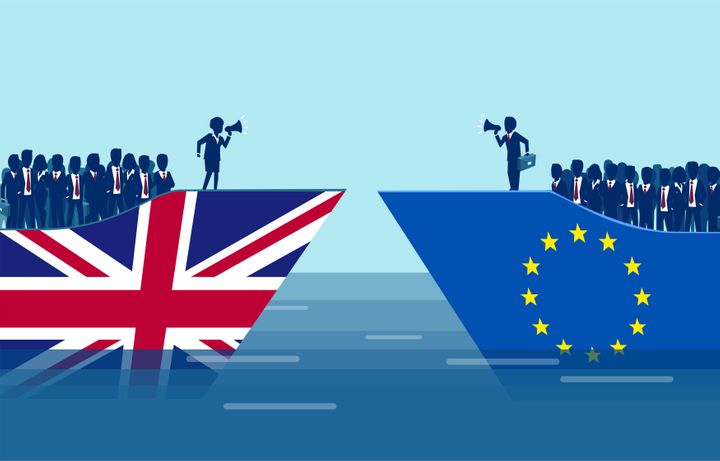
(Peter Barnes) The government’s Brexit bill has completed its passage through the House of Commons and the House of Lords and has received royal assent.
Related The European Union May Ban Facial Recognition For 5-Year Review Of Tech
by Peter Barnes, January 30th, 2020
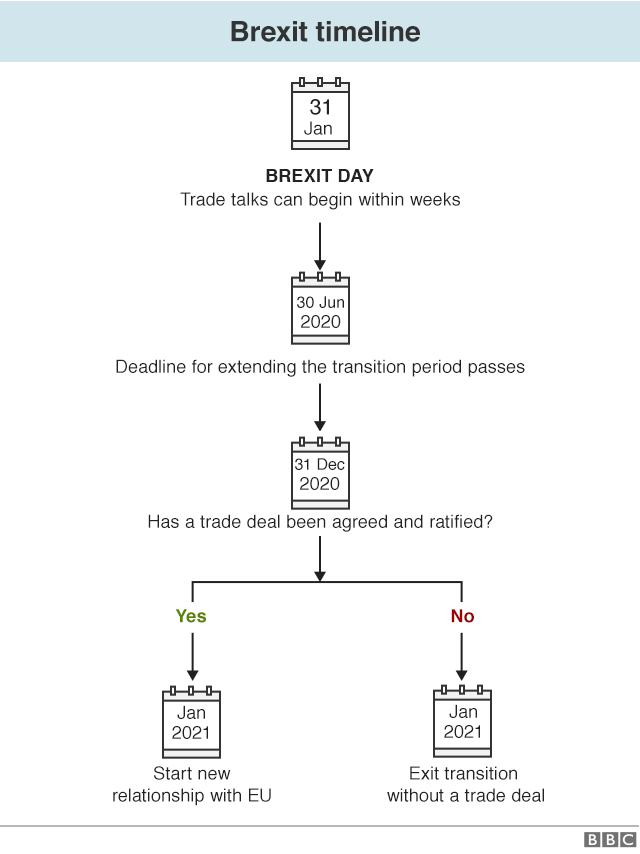
The Brexit date – when the UK leaves the EU – will be 31 January 2020.

The government’s large majority meant that the EU Withdrawal Bill sailed through the House of Commons.
Amendments to the bill were passed in the Lords but the changes were overturned by MPs.
It has now become law.
What happens after Brexit?
The European Parliament gave the green light, so the UK will formally leave the EU on 31 January with a withdrawal deal – and it will then go into a transition period that is scheduled to end on 31 December 2020.
During this period the UK will effectively remain in the EU’s customs union and single market – but will be outside the political institutions and there will be no British members of the European Parliament.
Future trade deal
The first priority will be to negotiate a trade deal with the EU. The UK wants as much access as possible for its goods and services to the EU.
But the government has made clear that the UK must leave the customs union and single market and end the overall jurisdiction of the European Court of Justice.
Time is short. The EU could take weeks to agree a formal negotiating mandate – all the remaining 27 member states and the European Parliament have to be in agreement. That means formal talks might only begin in March.
The government has ruled out any form of extension to the transition period.
If no trade deal has been agreed and ratified by the end of the year, then the UK faces the prospect of tariffs on exports to the EU.
The prime minister has argued that as the UK is completely aligned to EU rules, the negotiation should be straightforward. But critics have pointed out that the UK wishes to have the freedom to diverge from EU rules so it can do deals with other countries – and that will make negotiations more difficult.
It’s not just a trade deal that needs to be sorted out. The UK must agree how it is going to co-operate with the EU on security and law enforcement. The UK is set to leave the European Arrest Warrant scheme and will have to agree a replacement. It must also agree deals in a number of other areas where co-operation is needed.
Book Brexit: What the Hell Happens Now?
by Staff Writer, November 6th, 2019
The Conservative slogan “Get Brexit done” suggests a quick and easy path to leaving the European Union (EU), allowing the UK to focus on other things apart from Brexit. But it’s not that simple.
We know the Brexit deadline has been delayed again – this time until 31 January 2020.
If the Conservatives win a clear majority in this election, Brexit day could be earlier than that, otherwise it could be delayed again.
Either way, though, it won’t be the end of the matter.
Boris Johnson wants it to happen as soon as possible.
“It is fair to say you’re getting Brexit done because you are coming out of the EU and you’re coming out of the legal order of the EU,” the prime minister told the BBC.
“You are really taking back control of all the things – money, border, rules – you are doing all that.”
But while the day of Brexit would certainly be a big symbolic moment (loved and hated in equal measure), it would also leave an enormous amount unresolved.
That’s because Brexit is not really a single event – it’s a complex process that will go on for years.
Book Hoaxed: Everything They Told You is a Lie [Exposing the Deep State’s Fake News Operation]
What would happen on Brexit day?
The UK would no longer be a member state of the European Union.
That would be a significant change. But – and this assumes the UK left with a withdrawal agreement – only a few issues would actually have been sorted out.
Among other things:
- the financial settlement – or divorce bill – the UK has agreed to pay the EU to settle past debts and future commitments
- many (but not all) aspects of citizens’ rights – for EU citizens living in the UK and UK citizens living elsewhere in the EU
- future arrangements for keeping the land border in Ireland (which would become the only land border between the UK and the EU) as open as it is now
Almost everything else would still be up for grabs. Brexit would not be done. The legally binding deal we’re talking about at the moment covers only the divorce, not the future relationship.
That is dealt with in an accompanying political declaration, which is non-binding and sets only a direction of travel. A future government could still change course.
What about the transition?
Initially, the UK would enter a transition period during which it would continue to follow all EU rules and regulations and continue to pay the same amount of money into the EU budget.
The transition would be due to end in December 2020, but under the terms of the withdrawal agreement it could be extended by one or two years.
The government, though, has now said it will not ask for any extension.
The advantage of transition is it would be a soft landing. There would be no sudden changes to the way the economy works, which would give some certainty to businesses. And there would be time to start negotiating the shape of the future relationship between the UK and the EU.
But for as long as it lasts, the UK would have to follow all the rules policed by the European Commission, and the jurisdiction of the European Court of Justice, without having any say in making those rules.
What about the future?
There is a lot we need to talk about.
What kind of free-trade arrangements would be put in place? What kind of security and police cooperation would be negotiated with the EU? How would data be exchanged in the future?
It usually takes years to negotiate a free-trade deal but the UK and the EU would initially have a matter of months.
The withdrawal agreement says the two sides would have to decide by 1 July 2020 whether to extend the post-Brexit transition period. So if the UK was to leave on 31 January, at the end of the current extension, there would be exactly five months to negotiate a trade deal.
That’s not enough, not even close.
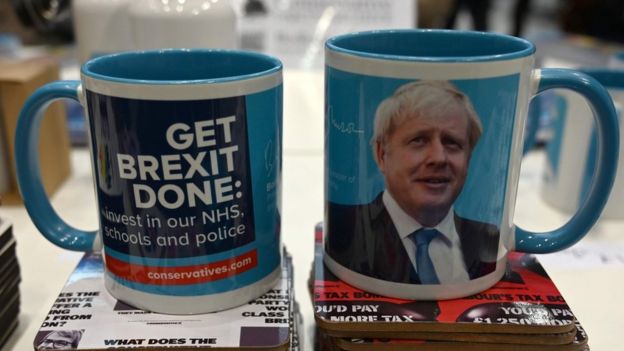 Image copyrightAFP
It’s true the two sides would start from the same place (with all the same rules and regulations). But it’s also true this would be the first trade deal in history when two parties were trying to move further away from each other rather than closer together.
Trade negotiations are not for the faint-hearted – naturally enough, everyone is looking after their own interests. Some sectors of the economy would do well but others with less political clout might suffer. The fishing industry (which represents only about 0.1% of the UK economy) is fearful of this because it knows trade deals involve trade-offs.
One other thing: as well as negotiating with the EU, the UK would also need to sign up to a series of trade agreements round the world to replace those it has as part of the EU.
All of that could take up most of the next decade. It won’t be done when the UK leaves the EU – it will only just have begun.
What about no-deal?
If the UK were to leave with no withdrawal agreement, of course, there would be no transition period. Supporters of no-deal call it a clean break – we’ve looked at what that would entail here.
The UK would certainly be free of EU rules and regulations straight away.
But it would be a sudden jolt that government forecasts and the vast majority of independent economists say would do serious damage to the economy.
All those negotiations about the future would still have to take place but they would do so in a much less harmonious political atmosphere.
And if the government sticks with its pledge to rule out any extension to the transition period, its opponents fear a new kind of no-deal could happen at the end of next year – ending the transition without any free trade deal in place.
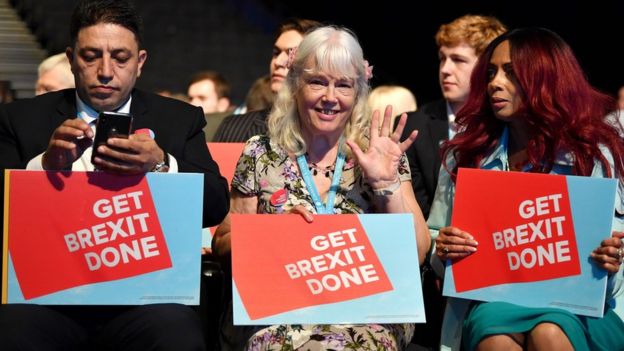 Image copyrightGETTY IMAGES
What about healing the divisions?
Talking of harmony, part of the government’s “Get Brexit done,” argument is it would help heal the divisions in society that have emerged since the Brexit referendum.
But many people are opposed to the government’s proposed Brexit deal. Those who support remaining in the EU would continue to campaign for another referendum – a final say before Brexit happens. And if they were to fail, they could transform their campaign into a movement to try to rejoin.
On the other side of the argument, those who favour a clean break could continue to argue that the compromises the government has had to make to come to an agreement with the EU amount to a betrayal of their Brexit vision.
Leave and Remain has become a more important dividing line in many ways than UK party politics and it doesn’t feel like that will suddenly come to an end.
Whatever happens in the next few months, the fallout from the Brexit referendum will remain with us for years to come.
Stillness in the Storm Editor: Why did we post this?
The news is important to all people because it is where we come to know new things about the world, which leads to the development of more life goals that lead to life wisdom. The news also serves as a social connection tool, as we tend to relate to those who know about and believe the things we do. With the power of an open truth-seeking mind in hand, the individual can grow wise and the collective can prosper.
– Justin
Not sure how to make sense of this? Want to learn how to discern like a pro? Read this essential guide to discernment, analysis of claims, and understanding the truth in a world of deception: 4 Key Steps of Discernment – Advanced Truth-Seeking Tools.
Stillness in the Storm Editor’s note: Did you find a spelling error or grammatical mistake? Send an email to [email protected], with the error and suggested correction, along with the headline and url. Do you think this article needs an update? Or do you just have some feedback? Send us an email at [email protected]. Thank you for reading.
Source:
https://www.bbc.com/news/uk-politics-46393399
https://www.bbc.com/news/uk-50222315
London and England leaving the EU is more important than anyone realizes. In Revelations 17, it talks of the EU as the 10 Kings to come who will serve Satan for a time. And then they will have war with “the Lamb”…and “the Lamb” will win. And then will they will willingly all serve “the Lamb”…who is Jesus Christ. In Cecil Rhodes plan for the One World Government, London & England were set to be the center for world power. Later he says London and Washington DC in 5 year periods. So look at how the whole One World Government plan has a big “HOLE” in it with its place of control and world domination willingly leaving the EU with other nations now to follow. It is literally a fulfillment of Revelations 17 in my humble opinion….a complete change in power and the “Deep State” power is now going to be on the decline. There is great hope for the world in what has happened. The NWO plan is being shredded…by Trump and the Brexit coming to past.