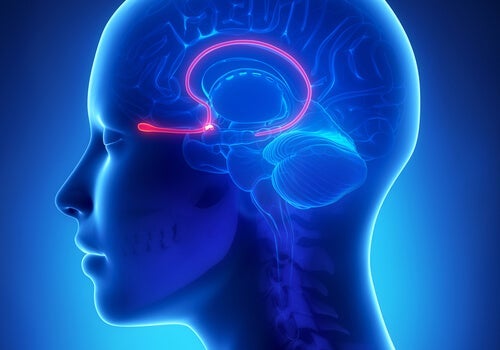
(Exploring Your Mind) Smells have the power to evoke fond memories. Not only can your sense of smell transport you to the past, but it also helps you make important decisions every day. Today, we’re going to talk about an essential part of your sense of smell: the olfactory bulb.
Related New Baby Smell: How Newborn Babies’ Head Odor Facilitates Bonding
by Staff Writer, October 15th, 2019
To help you understand this important part of the brain, we’ll define it, talk about its functions, and each of its parts. Then, we’ll share some interesting facts about your sense of smell. Let’s dive in!
Your sense of smell
Many people underappreciate their sense of smell. After all, your nose helps identify things that are toxic and dangerous for your body. What happens if you smell smoke, for example? Your sense of smell helps you identify the origin and makes sure you stay safe.
In addition to alerting you to potential dangers, your sense of smell plays a role in your day-to-day decision making. For example, which clothes are clean enough to keep using or the kinds of foods you like.
Buy Book Inside of a Dog: What Dogs See, Smell, and Know
Smells can also influence your emotions. Some smells are so pleasant that they have a positive effect on your well-being. Aromas have such a significant effect on your mood, in fact, that some brands use them in marketing campaigns to attract costumers.

What’s the olfactory bulb?
According to o Bear, Connors, and Paradiso, authors of the book Neuroscience: Exploring the Brain, the olfactory bulb is an encephalic structure. It stems from the telencephalon (more commonly known as the cerebrum) and is responsible for receiving information from the olfactory receptor neurons.
You actually have two olfactory bulbs, one in each hemisphere of your brain. They also connect to the interior of your nasal cavities.
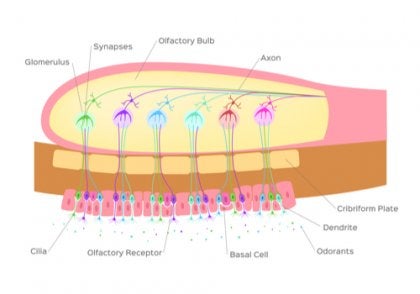
Before we talk about the functions of the olfactory bulb, we should point out that although this part of the brain is responsible for capturing smells, the process doesn’t start there. Smells enter through the nostrils, are absorbed by the nasal mucosa, and information about the smells is processed by the neurons through sensory transduction. Then, that information passes through the olfactory nerve and reaches the olfactory bulb.
The functions of the olfactory bulb
In the olfactory bulb, neurons make synaptic connections with the mitral cells in the glomerulus, a group of neurons in the olfactory bulb that have different activation patterns and help you identify different smells. The activation depends on the speed with which the substance is transported as well as what it’s made of.
After the information is processed by the glomeruli, it’s transmitted to different parts of the brain, such as the primary and secondary olfactory cortex, the orbitofrontal cortex, the hippocampus, and the amygdala.
Parts of the olfactory bulb
The olfactory bulb is made up of layers. Each layer is made up of different types of cells.
- Glomerular layer. This layer contains the glomeruli. It’s also where the synapses occur according to the perceived stimulus. In fact, the glomeruli form groups so that certain neuron groups can detect similar smells.
- External plexiform layer. It consists of interneurons, which connect the neurons to each other and make the lateral inhibition process possible. This layer also contains the tufted cell somas.
- Mitral cell layer. In this layer, the mitral cells transmit the olfactory information to the other structures connected to the bulb. Thus, this is the layer where the cells receive the receptor information.
- Internal plexiform layer. In this layer, you find the tufted cell and mitral cell axons. Here, the information is re-transmitted.
- Granule cell layer. The deepest layer that’s made up of granule cells that help mitral cells connect their dendrites.
Buy Book Supernormal: Science, Yoga, and the Evidence for Extraordinary Psychic Abilities
The center of olfactory information
The olfactory bulb is the primary processing center of olfactory information. It allows you to:
- Perceive olfactory information.
- Distinguish between different smells.
- Process smells and relate them to your emotions and memories.
- Inhibit certain stimuli to be able to focus on just one at a time.
- Capture tastes.
- Regulate sexual behavior by processing pheromones.
Did you know that your olfactory bulb did all of this? It’s pretty impressive, right? Your olfactory bulb is so essential because, without it, you’d lose your sense of smell.
Now that you know what your olfactory bulb does, you probably have a greater appreciation for the importance of your sense of smell. It’s crucial for your survival, decision-making, emotions, behaviors, and memories.
Stillness in the Storm Editor: Why did we post this?
Psychology is the study of the nature of mind. Philosophy is the use of that mind in life. Both are critically important to gain an understanding of as they are aspects of the self. All you do and experience will pass through these gateways of being. The preceding information provides an overview of this self-knowledge, offering points to consider that people often don’t take the time to contemplate. With the choice to gain self-awareness, one can begin to see how their being works. With the wisdom of self-awareness, one has the tools to master their being and life in general, bringing order to chaos through navigating the challenges with the capacity for right action.
– Justin
Not sure how to make sense of this? Want to learn how to discern like a pro? Read this essential guide to discernment, analysis of claims, and understanding the truth in a world of deception: 4 Key Steps of Discernment – Advanced Truth-Seeking Tools.
Stillness in the Storm Editor’s note: Did you find a spelling error or grammar mistake? Send an email to [email protected], with the error and suggested correction, along with the headline and url. Do you think this article needs an update? Or do you just have some feedback? Send us an email at [email protected]. Thank you for reading.
Source:
https://exploringyourmind.com/the-olfactory-bulb-function-and-characteristics/
Leave a Reply