(Andrew Griffin) A rock at the far reaches of our solar system might actually be a dwarf planet, scientists have said.
Related Scientists Bewildered by “Mysterious Crystals” Found in the Core of Giant Alien Planets
by Andrew Griffin, October 30th, 2019
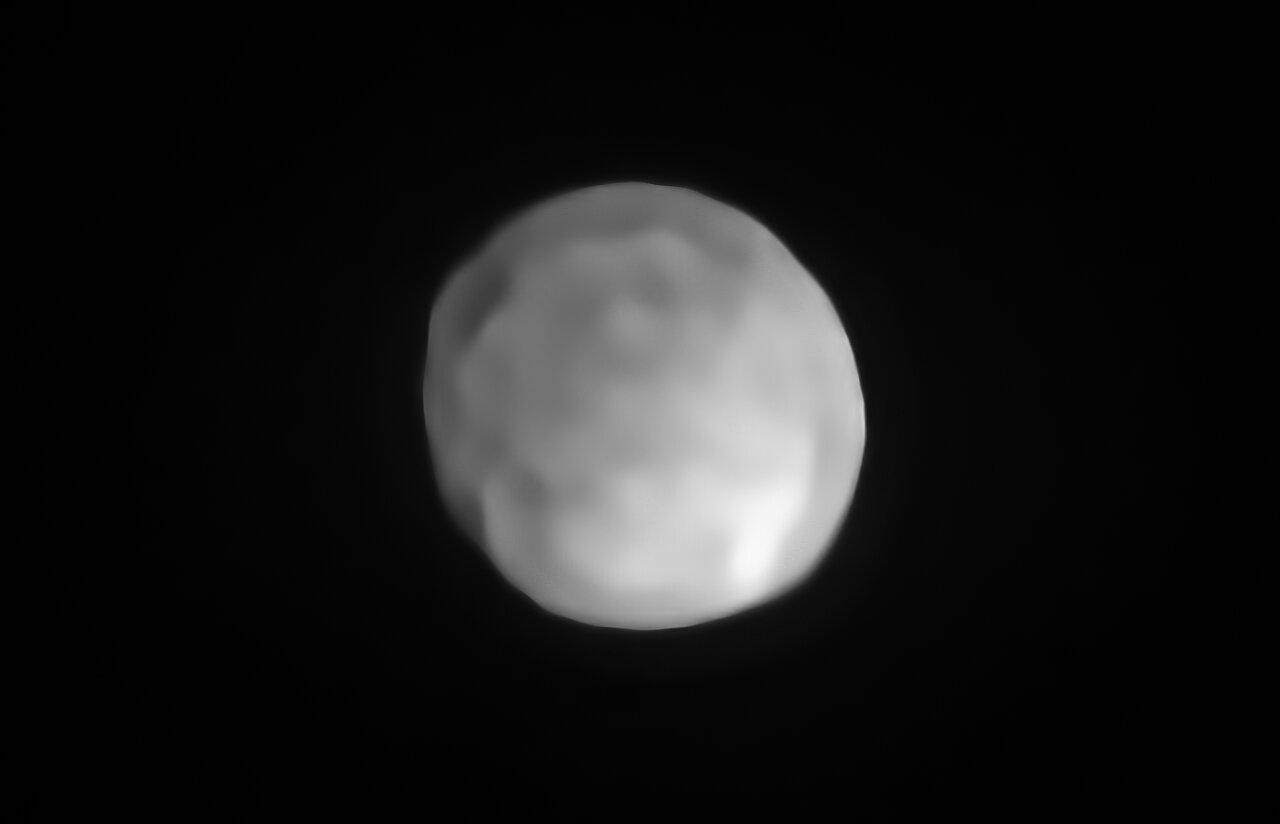
New research – using the Very Large Telescope in northern Chile – has shown that Hygiea may not actually be an asteroid, as previously thought, but a dwarf planet.
That would make it the smallest dwarf planet in our solar system, according to the findings published in the journal Nature Astronomy.

The potential change in category comes as astronomers have observed Hygiea in better resolution than ever before, finally allowing them to see its surface, and find out its shape and size.
Buy Book Alkaline Plant Based Diet: Reversing Disease and Saving the Planet with an Alkaline Plant Based Diet
Those observations showed that the asteroid is a sphere, which could allow it to graduate to being known as a dwarf planet rather than an asteroid. It is already the fourth largest object in the asteroid belt after other objects Ceres, Vesta and Pallas.

Since it sits in the asteroid belt, Hygiea already has three of the four things needed to be classified as a dwarf planet. It orbits around the Sun, is not a moon or satellite of another planet – but unlike a full planet, it has not cleared space around its orbit.
The new observations suggest that it satisfies the fourth and final requirement. Scientists say that a dwarf planet must have enough mass that gravity pulls it into a sphere, which the new images show are the case.
“Thanks to the unique capability of the Sphere instrument on the VLT, which is one of the most powerful imaging systems in the world, we could resolve Hygiea’s shape, which turns out to be nearly spherical,” lead researcher Pierre Vernazza from the Laboratoire d’Astrophysique de Marseille in France said in a statement. “Thanks to these images, Hygiea may be reclassified as a dwarf planet, so far the smallest in the Solar System.”
Buy Book When Giants Were Upon the Earth: The Watchers, The Nephilim, and the Cosmic War of the Seed
Other observations allowed the researchers to learn more about Hygiea’s size, and determine it is just bigger than 430km in diameter. That would make it a relatively small object among its fellow dwarf planets: Pluto, which was famously downgraded, has a diameter of 2,400km, and Ceres is 950km across.
Astronomers expected to be able to see a huge crater across the surface of Hygiea, since it is thought to have been involved in a collision that gave birth to almost 7,000 asteroids that are part of the same family. But despite surveying 95 per cent of the object’s surface, they saw nothing that looked like evidence of that collision.
“This result came as a real surprise as we were expecting the presence of a large impact basin, as is the case on Vesta,” said Mr Vernazza.
Instead, astronomers think the family of asteroids will have been formed during a collision with a big projectile, about two billion years ago. That would have completely shattered the asteroids’ parent, with the pieces eventually reassembling and giving Hygiea its round shape as well as forming its thousands of siblings.
“Such a collision between two large bodies in the asteroid belt is unique in the last 3-4 billion years,” said Pavel Sevecek, a PhD student at the Astronomical Institute of Charles University, who also participated in the study.
Stillness in the Storm Editor: Why did we post this?
The news is important to all people because it is where we come to know new things about the world, which leads to the development of more life goals that lead to life wisdom. The news also serves as a social connection tool, as we tend to relate to those who know about and believe the things we do. With the power of an open truth-seeking mind in hand, the individual can grow wise and the collective can prosper.
– Justin
Not sure how to make sense of this? Want to learn how to discern like a pro? Read this essential guide to discernment, analysis of claims, and understanding the truth in a world of deception: 4 Key Steps of Discernment – Advanced Truth-Seeking Tools.
Stillness in the Storm Editor’s note: Did you find a spelling error or grammar mistake? Send an email to [email protected], with the error and suggested correction, along with the headline and url. Do you think this article needs an update? Or do you just have some feedback? Send us an email at [email protected]. Thank you for reading.
Source:
Leave a Reply