
| The trackways have been found on the island of Crete, quite some distance from the plains of east Africa. Andrzej Boczarowski |
Related: Forbidden History: Vatican’s Long Plot to Cover up the History of the Pre-flood World
Source – Humans Are Free
by Josh Davis, September 13th, 2017
If the discoveries over the past few decades have told us anything, it’s that the evolution of humans is anything but simple.
Now, a new discovery on the Mediterranean island of Crete might be about to put yet another cat among those pigeons, as researchers claim that hominin footprints found on the island date back some 5.7 million years.
The tracks are bipedal, and seem to indicate that the creature that made them had a prominent ball of the foot, a large forward facing big toe, and a lack of claws, all of which are indicative of a hominin creator.
Published in the journal Proceedings of the Geologists’ Association, the researchers argue that despite lacking any other fossil bones, the footprints indicate that bipedal apes, with hominin features were clearly present in Europe some 5.7 million years ago.
This assertion is likely to be heavy picked apart by other anthropologists, not least because 4.4 million years ago the oldest hominin known from a fairly complete fossil, Ardipithecus ramidus, was still walking on ape-like feet in Ethiopia.
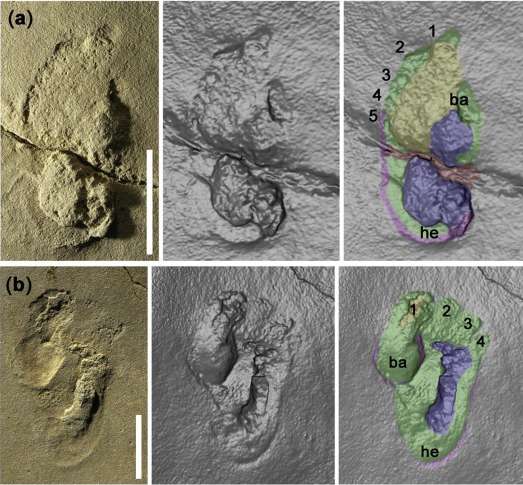 |
| The researchers argue that the big toe (1) is indicative of hominins, rather than apes. Gierliński et al. 2017 |
“This discovery challenges the established narrative of early human evolution head-on and is likely to generate a lot of debate,” explains Per Ahlberg, co-author of the latest paper, in a statement.
“Whether the human origins research community will accept fossil footprints as conclusive evidence of the presence of hominins in the Miocene of Crete remains to be seen.”
Interestingly, the timing of this latest discovery fits somewhat with another that was announced earlier this year, in which researchers suggest that our ancient ancestors may not have split from chimpanzees in the savanna’s of Africa, but instead in the grasslands of Europe.
This notion was based on two fossil jaw bones dating to 7.2 million years old in which the teeth are like modern humans’ rather than chimpanzees’.
As more and more finds are made, the history of us gets more and more complicated. Rather than just a nice, simple evolutionary line from ape to human, the picture that emerges is one of a dense thicket of species that form a convoluted and confusing image of our past.
This latest study simply adds to that tangle, and as newer finds are made, hopefully more sense will be able to be made of it.
_________________________
Stillness in the Storm Editor’s note: Did you find a spelling error or grammar mistake? Do you think this article needs a correction or update? Or do you just have some feedback? Send us an email at [email protected] with the error, headline and url. Thank you for reading.
Leave a Reply