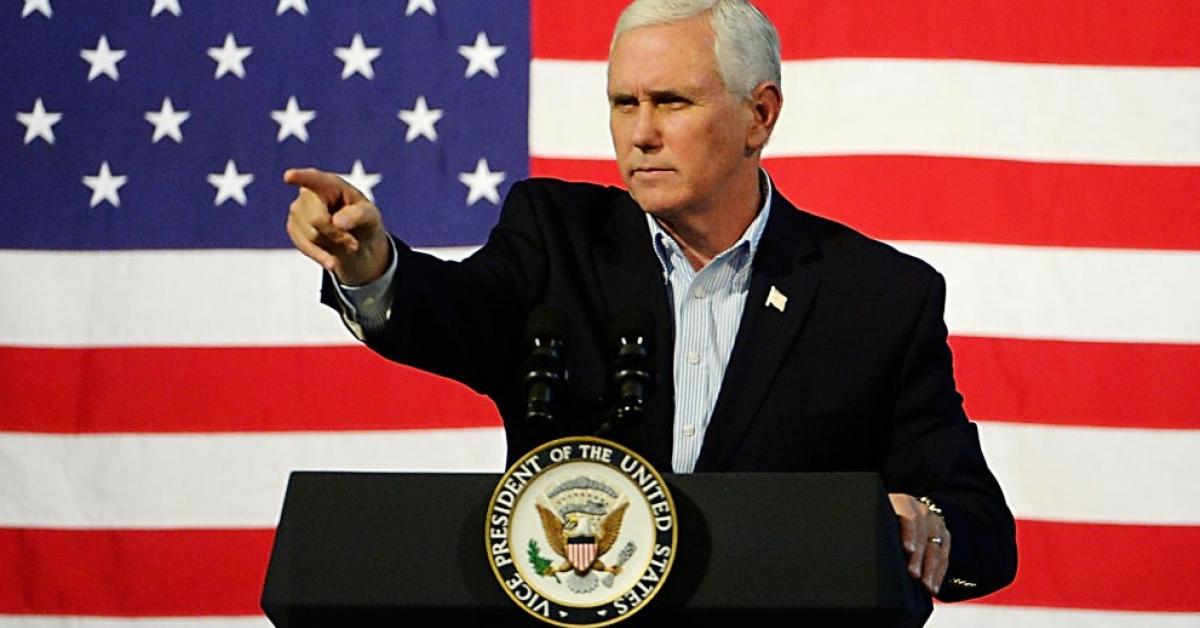
(Carrie Sheffield) Two law professors are arguing the U.S. Constitution’s 12th Amendment could empower Vice President Mike Pence to reject contested electors and pave the way for the U.S. House to re-elect President Trump under what’s known as a contingent election.
Related Pence Campaigns At ‘Defend The Majority’ Rally In Georgia
by Carrie Sheffield, December, 8th, 2020
In an October 19 essay at “The American Mind,” John Yoo, a law professor at the University of California-Berkeley, and Robert J. Delahunty, a law professor at St. Thomas University, argue that Pence, as presiding officer of the joint congressional session on electors, can refuse to “count” the electoral votes from disputed states.
However, this legal analysis empowering the Vice President faces headwinds as states continue to certify results for Joe Biden over President Trump.
The scholars argue that while the Electoral Count Act of 1887 appears to create “safe harbors” for a state’s report of its Electoral College votes, the Act itself might be unconstitutional, because under the 12th Amendment, “the President of the Senate [i.e., the Vice President] shall, in the Presence of the Senate and House of Representatives, open all the certificates [of the electoral votes of the states] and the votes shall then be counted.”
Yoo and Delahunty say that “unclear is who is to ‘count’ the electors’ votes and how their validity is to be determined. Over the decades, political figures and legal scholars have offered different answers to these constitutional questions. We suggest that the Vice President’s role is not the merely ministerial one of opening the ballots and then handing them over (to whom?) to be counted. Though the 12th Amendment describes the counting in the passive voice, the language seems to envisage a single, continuous process in which the Vice President both opens and counts the votes.”
The check on error or fraud in the count is that the Vice President’s activities are to be done publicly, “in the presence” of Congress, wrote Yoo and Delahunty, and if “counting” the electors’ votes is the Vice President’s responsibility, then “the inextricably intertwined responsibility for judging the validity of those votes must also be his. If that reading is correct, then the Electoral Count Act is unconstitutional. Congress cannot use legislation to dictate how any individual branch of government is to perform its unique duties: Congress could not prescribe how future Senates should conduct an impeachment trial, for example. Similarly, we think the better reading is that Vice President Pence would decide between competing slates of electors chosen by state legislators and governors, or decide whether to count votes that remain in litigation.”
In this scenario, for example, when counting Pennsylvania electors, Pence could choose to “count” the slate of electors from the Republican legislature in Harrisburg and not the slate of electors from Democratic Governor Tom Wolf.
“We think so, but it’s never happened before,” Yoo, a visiting fellow at the Hoover Institution, and a visiting scholar at the American Enterprise Institute, told radio host John Batchelor on October 24. “I think my view would be that Vice President Pence, when he opens the votes and counts them, he decides which ones are valid and which ones are invalid.”
However, Yoo’s comments took place prior to the November 3 election, and a representative for Yoo and Delahunty himself did not respond to a request for comment from Just the News on Monday to provide updated analysis of the more current situation at hand. A spokeswoman for Pence also did not respond to a request for comment from Just the News on Monday.
Norman J. Ornstein, a resident scholar at the American Enterprise Institute, told Just the News via email Monday that he vigorously disagreed with the idea that Pence could reject electors.
“The idea that the Framers wanted a Vice President with a direct interest in the outcome of an election to decide unilaterally its outcome is ludicrous on its face,” Ornstein said.
Attorney Richard Roth of The Roth Law Firm, a New York-based litigation firm, told Just the News in an email that while the professors’ essay “raises several very valid – and very controversial – issues, they all rest on one fact: the certification of election results.”
Noting that the article was written three weeks before the election, Roth said he doesn’t think that as of Monday evening there is sufficient “controversy or contest” to invoke the provisions outlined by Yoo and Delahunty because states’ certifications of electors have continued apace, with the Trump campaign and its associates repeatedly facing defeats in court.
“Sitting here, the day before the state deadline, it is clear that those potential delays will not come into play,” Roth said. “Each of the states which Trump is trying arduously to overturn, has not only completed counting their ballots but also completed the recount. More importantly, each of them – Georgia, Pennsylvania, Michigan, Wisconsin, Nevada and Arizona – have officially certified those results. Thus, because those states worked arduously to complete the tasks in which they were obligated, and because those states, as well as all other states, have certified those results, the dire consequences of the article simply will not come to pass.”
About The Author
Carrie Sheffield is White House Correspondent for Just The News and anchor of the nationally-syndicated TV show, “Just the News AM,” airing live Mon.-Fri. from 9-10 AM EST on DISH Network Channel 219, PlutoTV Channel 240, Roku, Apple TV, FireTV and online at http://AmericasVoice.news.
Carrie earned a master’s in public policy from Harvard University, concentrating in business policy. She earned a B.A. in communications at Brigham Young University and completed a Fulbright fellowship in Berlin. She managed municipal credit risk at Goldman Sachs and rated healthcare bonds at Moody’s Investors Service.
Stillness in the Storm Editor: Why did we post this?
The news is important to all people because it is where we come to know new things about the world, which leads to the development of more life goals that lead to life wisdom. The news also serves as a social connection tool, as we tend to relate to those who know about and believe the things we do. With the power of an open truth-seeking mind in hand, the individual can grow wise and the collective can prosper.
– Justin
Not sure how to make sense of this? Want to learn how to discern like a pro? Read this essential guide to discernment, analysis of claims, and understanding the truth in a world of deception: 4 Key Steps of Discernment – Advanced Truth-Seeking Tools.
Stillness in the Storm Editor’s note: Did you find a spelling error or grammatical mistake? Send an email to [email protected], with the error and suggested correction, along with the headline and url. Do you think this article needs an update? Or do you just have some feedback? Send us an email at [email protected]. Thank you for reading.
Source:
Leave a Reply