Before we begin, lets consider that this entire contract was void from the start for the same reasons all bank loans are fraud; the Car Dealership, Auto-Mate, never actually lent any money. What they did was transfer right, title and ownership to me, of their real property, based on my promise to pay over time. This is not a loan, although our world today has conditioned us to believe that contracts similar to these can be enforced, in law, as such.
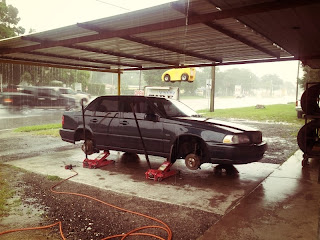 |
| Julian’s Car getting new tires |
This is what actually happened: I walked into the dealership with a desire to purchase a car, and my promise to pay, in addition to my $800 deposit, which was the collateral I brought to the table. The Dealer did not ‘lend’ me anything to purchase the vehicle. My promise to pay was the thing that created the ‘loan.’ The dealer did agree to receive the total payments for his real value, the vehicle, over a course of time. This is actually a repayment schedule for real property, and since no money was ever provided to the purchaser, by a lender or third party, this is not a lawful loan.
Lets consider the definition of a loan from blacks law dictionary:
What is a LOAN?
A bailment without reward ; consisting of the delivery of an article by the owner to another person, to be used by the latter gratuitously, and returned either in specie or in kind. A sum of money confided to another. Ramsey v. Whitbeck. 81 III. App. 210; Xicliols v. Fearson, 7 Pet. 109, S L. Ed. 023; Rodman v. Munson, 13 I’ ah. (X. Y.) 75; Booth v. Terrell. 10 Ga. 25; Payne v. Gardiner, 29 N. Y. 107. A loan of money is a contract by which one delivers a sum of money to another, and the latter agrees to return at a future time a sum equivalent to that which he borrowed. Civ. Code Cal.
Law Dictionary: What is LOAN? definition of LOAN (Black’s Law Dictionary) http://thelawdictionary.org/loan/#ixzz2bsUaesiw
Here we can plainly see in order for a Loan to exist ‘one must deliver a sum of money to another.’ Since that never actually took place, there is no loan. The fact that the Seller sold the promise to pay as a loan is fraud on their part, and it also breaks one of the terms in the contract between us, more on this later.
If I had went to a third party, a bank, gotten a loan and then went to the Dealer, this would constitute a ‘lawful loan.’ Mind you the bank would be committing the fraud in this case, unless they can provide 3 generations of right title and ownership, of the funds they ‘lent’ to me but that the banks fraud, and a whole other story.
“Wait wait” you may be saying, Car dealerships use Title Loans, so thats a different animal.. right? Lets look at the definition:
What is a CAR TITLE LOAN?
A car title loan, or simply title loan, is a loan where the borrower provides their car title as collateral for a loan.
Law Dictionary: What is CAR TITLE LOAN? definition of CAR TITLE LOAN (Black’s Law Dictionary) http://thelawdictionary.org/car-title-loan/#ixzz2bsYHOOTB
Therefore, if this is a valid Title Loan, I would have had to have the right, title and ownership of the car before I bought it?? Yes this is exactly how it works. During the transaction I became the lawful owner of the vehicle, the Title is in my name. The Dealer then takes this title and uses it as collateral for a loan to pay the dealer. Since there is no valid lending party in this case, and since the only thing binding me to pay anything back is a Contract, which again is void by definition, then this entire agreement falls under deceptive acts and practices. Further, The seller sold the their interest in the agreement to a third party. Therefore, I am the rightful owner, with title, and the Auto Dealer has committed theft by conversion because of they broke the terms of their own contact.
General breakdown of events
– I purchased my Volvo s70 from a buy here pay here in late 2012, out of need and in hopes to improve my credit.
– I was making regular payments for over a month, when I received a phone call from an unidentified person, whom began asking questions about my car and it’s condition.
– I then questioned this person, “who are you? why are you calling me?” I found out it was Mid-Atlantic Finance who had purchased my auto note. This, as you will see, violates one of the terms of the contract. Further, since the original seller now has recouped any funds they lent me (and as we just discussed there never was any funds) then any risk or loss which they may suffer by my lack of payment does not exist.
– Come to find out, my auto note was sold to this company, to better help my credit! (they said)
– an Email sent to me:

– I emailed Auto-Mate about this sudden change, originally I was upset about the potential damage to my credit score, I was still interested in building my credit.


– I continued to make regular payments, until I was terminated from my job in April 2013.
– At this point I contact Mid-Atlantic Finance about my loss of employment and we schedule a payment based around my potential reemployment benefits.
– On the day I was scheduled to make a payment July 20th, I am contacted by Mid-Atlantic Finance where I again explain my situation. I was/am still waiting for the appeal of the unemployment benefits, I was denied.
– I plainly ask Mid-Atlantic if they are going to repossess my car due to my non-payment, they answer no.
– I am contacted by Auto Mate on August 1st, even though I had already spoken to Mid-Atlantic Finance. I explain my situation, including that I was also going through an eviction…Auto Mate was trying to use fear against me to force a payment.
– Sometime within this time frame Auto Mate supposedly re-purchases the auto note, somehow thinking they are reactivating a contract that has already been satisfied and then steals my car from my home. This again, violates the contract.
– I immediately call Mid-Atlantic Finance where they informrd me they had sold the loan, yet again, to Auto-Mate.
– I contact AutoMate, demanding a true bill or some sort of documentation outlining the fees, charges, and any other info regarding this account.
– I was told from Miss Jennie Perez that I already knew how much I owed (how could I possibly with this note changing hands so many times), and how I could resolve this. That I should call back when I am ready to pay to get my car back. I then told her I was attempting to resolve this, thats what my call was all about. She then hung up on me.
– Per the contract I have with the original lender, Auto-Mate, there are 2 stipulations:
1. they can sell off the note to a finance company at anytime without my consent, [this item is voided by florida law, as you will discover below by Florida Statute 537.013]
2. any change made to the contract must “be written and signed by both you, and us.”
– Sounds a little contradictory to me. Also, this contract is a standardized contract from Wisconsin, and in regard to this it states:
“the law of the state of the sellers place of business shown in this contract applies to this contract.”
– Meaning Florida law applies over any other term if there is a conflict. The contract goes on to say:
“If that law does not allow all the agreements in this contract, the ones that are not allowed will be void. The rest of this contract will still be good.”
– According to their contract, changes must “be written and signed by both you, and us.” This is why the below Florida Statute applies:
537.013 Prohibited acts.—(1) A title loan lender, or any agent or employee of a title loan lender, shall not:(a) Falsify or fail to make an entry of any material matter in a title loan agreement or any extension of such agreement.(b) Refuse to allow the office to inspect completed title loan agreements, extensions of such agreements, or loan property during the ordinary operating hours of the title loan lender’s business or other times acceptable to both parties.(c) Enter into a title loan agreement with a person under the age of 18 years.(d) Make any agreement requiring or allowing for the personal liability of a borrower or the waiver of any of the provisions of this act.(e) Knowingly enter into a title loan agreement with any person who is under the influence of drugs or alcohol when such condition is visible or apparent, or with any person using a name other than such person’s own name or the registered name of the person’s business.(f) Fail to exercise reasonable care, as defined by commission rule, in the safekeeping of loan property or of titled personal property repossessed pursuant to this act.(g) Fail to return loan property or repossessed titled personal property to a borrower, with any and all of the title loan lender’s liens on the property properly released, upon payment of the full amount due the title loan lender, unless the property has been seized or impounded by an authorized law enforcement agency, taken into custody by a court, or otherwise disposed of by court order.(h) Sell or otherwise charge for any type of insurance in connection with a title loan agreement.(i) Charge or receive any finance charge, interest, or fees which are not authorized pursuant to this act.(j) Act as a title loan lender without an active license issued under this act.(k) Refuse to accept partial payments toward satisfying any obligation owed under a title loan agreement or extension of such agreement.(l) Charge a prepayment penalty.(m) Engage in the business of selling new or used motor vehicles, or parts for motor vehicles.(n) Act as a title loan lender under this act within a place of business in which the licensee solicits or engages in business outside the scope of this act if the office determines that the licensee’s operation of and conduct pertaining to such other business results in an evasion of this act. Upon making such a determination, the office shall order the licensee to cease and desist from such evasion; provided, no licensee shall engage in the pawnbroker business.(2) Title loan companies may not advertise using the words “interest free loans” or “no finance charges.”History.—s. 12, ch. 2000-138; s. 647, ch. 2003-261.
Main reasons for fighting this are:
1. The ‘Loan’ was sold on 2 separate occasions without my notification or signature/acceptance; this voids the contract per the contract wording itself and Florida law.
2. AutoMate sold the loan, and therefore they have already recovered their original investment; if there was one at all.
3. The second servicer, whom per the contract was an unlawful one because they did not notify me, stated they were NOT going to repossess the car. Several days later this new company, Mid-Atlantic Finance, sold the note back to the original servicer, again without notification to me.
4. The original servicer Auto-Mate, made no effort to collect on the past amount or to honor the original agreement not to repossess the vehicle, and as such unlawfully stole my vehicle on the 8th of August 2013. Theft by conversion.
Here is the Demand Letter sent to Auto-Mate with a copy forwarded to the Attorney General of the State of Florida:


I wanted to simply breakdown this letter as to why all these statutes apply:
I feel this matter is serious and
wish to deal with it in writing. I do not give you permission to contact me by
telephone. I will be logging the dates and times of your calls and messages and
should they continue, I must warn you that they will now constitute
‘harassment’ and I may take action under The Fair Debt Collection Practices
Act.
Please provide verification of your
claim, by providing me with true and certified copies (Not photocopies) of the
Deed of Assignment (NOT Notice of Assignment) and Deed of Novation. Please also
provide me with the name of the individual who is the duly authorized
representative from your company, who has seen the Original Note and is
certifying these assignments as certified copies and that your company now has
the Original Note (Credit Agreement) under penalty
of perjury and with unlimited
liability and confirm that the Note has never been sold prior to your
company purchasing this account. Please also confirm the name of the individual
who is the duly authorized representative from your company, who has carried
out due diligence under the Money Laundering Control Act of 1986 and what
actions s/he has taken in relation to this account.
constitutes notice that AUTO MATE, is in violation of Federal and FLORIDA
adopted statutes, which made it unlawful for a used car dealer (1) to
engage in Unfair and Deceptive Acts and Practices, (2) to commit fraudulent auto repossession, and (3) to Falsify or fail to make an
entry of any material matter in a title loan agreement or any extension of such
agreement pursuant to FLORIDA STATUTES
and CODES Chapter(s) § 537.008 Fla. Stat., § 537.012 Fla. Stat., and § 537.013 Fla. Stat.
Why these apply:
§ 501.204 Fla. Stat. (Unfair and Deceptive Acts and Practices) (1) Unfair methods of competition, unconscionable acts or practices, and unfair or deceptive acts or practices in the conduct of any trade or commerce are hereby declared unlawful.
(2) It is the intent of the Legislature that, in construing subsection (1), due consideration and great weight shall be given to the interpretations of the Federal Trade Commission and the federal courts relating to s. 5(a)(1) of the Federal Trade Commission Act, 15 U.S.C. s. 45(a)(1) as of July 1, 2001.
History.–s. 1, ch. 73-124; s. 1, ch. 83-117; s. 4, ch. 85-63; s. 2, ch. 90-190; s. 3, ch. 93-38; s. 2, ch. 2001-39; s. 23, ch. 2001-214.
– From this section I am referencing the fact that Auto-Mate is engaging in unconscionable acts and practices in the conduct of commerce.
§ 537.008 Fla. Stat. (4) Upon execution of a title loan agreement, the title loan lender may take possession of the loan property and retain possession of such property until such property is redeemed. The borrower shall have the exclusive right to redeem the loan property by repaying all amounts legally due under the agreement. When the loan property is redeemed, the lender shall immediately return the loan property and commence action to release any security interest in the titled personal property. During the term of the agreement or any extension of the agreement, a title loan lender may retain physical possession of the loan property only. A title loan lender shall not require a borrower to provide any additional security or guaranty as a condition to entering into a title loan transaction.
– Because the ‘loan’ has been paid for I am now the rightful owner, the loan was paid for by Mid-Atlantic Finance.
§ 537.012 Fla. Stat. (1) If a borrower fails to repay all amounts legally due under the title loan agreement on or before the end of the title loan’s maturity date or any extension of such date and fails to make a payment on the loan within 30 days after the end of the loan’s maturity date or any extension of such date, whichever is later, the title loan lender may take possession of the titled personal property. A lender may take possession of the titled personal property only through an agent who is licensed by the state to repossess motor vehicles.
(2) Prior to engaging a repossession agent, the lender shall afford the debtor an opportunity to make the titled personal property available to the lender at a place, date, and time reasonably convenient to the lender and the borrower. Prior to taking possession of titled personal property, the lender shall afford the borrower a reasonable opportunity to remove from the titled personal property any personal belongings without charge or additional cost to the borrower. After the lender takes possession of the titled personal property, the lender, at the lender’s sole expense and risk, may authorize a third party to retain physical possession of the titled personal property.
– Again this loan has been paid for multiple times over at this point. According to subsection 2 I was also supposed to be afforded an opportunity to make the titled property available to the lender but was never contacted about this.
§ 537.013 Fla. Stat. (1)A title loan lender, or any agent or employee of a title loan lender, shall not:
(a) Falsify or fail to make an entry of any material matter in a title loan agreement or any extension of such agreement.
(b) Refuse to allow the office to inspect completed title loan agreements, extensions of such agreements, or loan property during the ordinary operating hours of the title loan lender’s business or other times acceptable to both parties.
(c) Enter into a title loan agreement with a person under the age of 18 years.
(d) Make any agreement requiring or allowing for the personal liability of a borrower or the waiver of any of the provisions of this act.
(e) Knowingly enter into a title loan agreement with any person who is under the influence of drugs or alcohol when such condition is visible or apparent, or with any person using a name other than such person’s own name or the registered name of the person’s business.
(f) Fail to exercise reasonable care, as defined by commission rule, in the safekeeping of loan property or of titled personal property repossessed pursuant to this act.
(g) Fail to return loan property or repossessed titled personal property to a borrower, with any and all of the title loan lender’s liens on the property properly released, upon payment of the full amount due the title loan lender, unless the property has been seized or impounded by an authorized law enforcement agency, taken into custody by a court, or otherwise disposed of by court order.
(h) Sell or otherwise charge for any type of insurance in connection with a title loan agreement.
(i) Charge or receive any finance charge, interest, or fees which are not authorized pursuant to this act.
(j) Act as a title loan lender without an active license issued under this act.
(k) Refuse to accept partial payments toward satisfying any obligation owed under a title loan agreement or extension of such agreement.(l) Charge a prepayment penalty.
(m) Engage in the business of selling new or used motor vehicles, or parts for motor vehicles.
(n) Act as a title loan lender under this act within a place of business in which the licensee solicits or engages in business outside the scope of this act if the office determines that the licensee’s operation of and conduct pertaining to such other business results in an evasion of this act. Upon making such a determination, the office shall order the licensee to cease and desist from such evasion; provided, no licensee shall engage in the pawnbroker business.
(2) Title loan companies may not advertise using the words “interest free loans” or “no finance charges.”
History.—s. 12, ch. 2000-138; s. 647, ch. 2003-261.
– Because in our contract it stipulated that any changes to the contract needed to be written and signed by both parties Auto-Mate has falsified an entry of material matter in a loan agreement or the extension thereof.
– If Auto-Mate fails to return my vehicle then subsection G applies:
(g) Fail to return loan property or repossessed titled personal property to a borrower, with any and all of the title loan lender’s liens on the property properly released, upon payment of the full amount due the title loan lender, unless the property has been seized or impounded by an authorized law enforcement agency, taken into custody by a court, or otherwise disposed of by court order.
This letter specifically references the fraudulent auto repossession of my VOLVO S70/GT 1998, VIN # YV1LS5531W2480001, from my residence, on August 8th, 2013 and the subsequent misrepresentations regarding alleged ‘debt’. Please be advised that this document is to make known such grievances and attempt resolution of this matter. If such resolution fails I will seek all remedies available at law, including seeking of damages in excess of $20,000. Your unlawful possession constitutes Theft by Conversion § 812.014, Fla. Stat.
§ 812.014, Fla. Stat.(1) A person commits theft if he or she knowingly obtains or uses, or endeavors to obtain or to use, the property of another with intent to, either temporarily or permanently:(a) Deprive the other person of a right to the property or a benefit from the property.(b) Appropriate the property to his or her own use or to the use of any person not entitled to the use of the property.
I am the owner of this vehicle by right of purchase § 320.001, Fla. Stat.
§ 320.001, Fla. Stat.(3) “Owner” means any person, firm, corporation, or association controlling any motor vehicle or mobile home by right of purchase, gift, lease, or otherwise.
Due to the
seriousness of this matter, I demand you return my vehicle, with removal of
your tracking device/GPS, with the title to vehicle and all my personal property
contained therein in the condition all items were fraudulently repossessed
within 2 days of receipt of this letter.
I demand, you pay $4150 by August 30th 2013 for physical and
emotional damages sustained as a result of the wrongful repossession.
This
letter serves as evidence that I have attempted to resolve this matter
informally.
1-308
I just sent this letter certified mail today, August 13th 2013. They should receive the letter on Thursday. I will issue updates about this as they are received. If anyone else has dealt with this in the past or has a success story regarding this please send me an email via [email protected].

2013 Florida Statutes:
http://www.leg.state.fl.us/statutes/index.cfm?StatuteYear=2013&Tab=statutes&Submenu=1
More on Fraudulent Loans:
https://stillnessinthestorm.com/2013/08/salon-your-mortgage-documents-are-fake/
The preceding commentary was spam and therefore deleted. Feel free to share any thoughts you have of genuine import =)
So….what happened? I am currently dealing with a similar situation, only itsvwith AC Autopay and they aren’t even a lender or a car dealer. They are a 3rd party. The repo guy tried to run me over, it’s Bern 38 days of not knowing where my car is located and it contained my deceased mother’s jewelry. We have disputed the item they reported on our credit and transunion investigated and ultimately deleted it.
I’m drafting a demand letter right now, and that’s how I got here. But what happened in this situation??