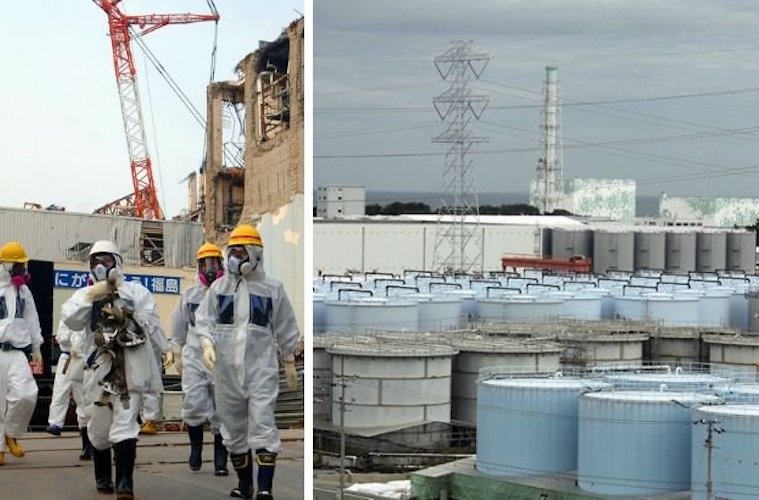
(Phillip Schneider) The Japanese government is refusing to allow independent testing of contaminated water found in the nuclear power plant at Fukushima, which has been leaking ever since a tsunami and earthquake devastatingly hit the facility in March 2011.
Related Former Mainstream Media Journalist Blows Whistle on 9/11 & Fukushima
by Phillip Schneider, January 2nd, 2020
The decision not to allow independent testing was allegedly arrived to over “safety concerns” in relation to the storing and transportation of the radioactive water.
“Other organizations are not permitted to carry out tests of the water…If we are going to allow external organizations to test the treated water then we would need to go through very strict procedures and due process because that water is contaminated. If it is taken outside this facility, then there need to be strict regulations.” – Hideki Yagi, a spokesman for the Tokyo Electric Power Company (TEPCO)
However, independent environmental groups including Greenpeace and Citizens’ Nuclear Information Centre (CNIC) assert that this is indeed a cover-up against the true level of contamination in the water used to cool three damaged reactors.
“There would need to be lots of checks because there is a lot of water, but right now it looks very much to the outside world that they are trying to cover something up – as they have a long history of doing.” – Hideyuki Ban, co-director of CNIC
Although the contaminated water is deemed too dangerous to test for potency, the government of Japan and TEPCO both regard it as not too dangerous to dump into the pacific ocean as they likely plan to do as soon as their storage tanks reach maximum capacity in the summer of 2020.
The amount of contaminated water at Fukushima is astounding. On top of an undisclosed amount which we still don’t know the potency of, ground water continues to seep into the basement levels of the facility with an additional 120 tons accumulating every day, according to the London Telegraph.
Book Pyramid Power: The Science of the Cosmos (The Flanagan Revelations) (Volume 1)
The decision not to allow third-party testing of the contaminated water at Fukushima is not only causing the public to lose faith in the government’s ability to safely manage emergencies, but whether Japanese citizens can trust them to tell the truth about the dangers they face as a country.
“Tepco has lost trust across society in Japan as well as in the international community, including in South Korea, and providing samples for analysis would be in their best interests – unless they are covering something up…so providing samples that could verify their reports on content would go some way to demonstrating their commitment to transparency.” – Shaun Burnie, Senior Nuclear Specialist for Greenpeace
In 2016, the Japan government estimated the cost of the Fukushima disaster to be about 21.5 trillion yen ($188 billion), nearly doubled compared to their previous projection of 11 trillion yen in 2013.
[the_ad_group id=”3115″]
In 2012, exactly one year after the disaster, 79.6% of polled Japanese citizens favored phasing out nuclear power altogether. This led to the then-prime minister Yoshihiko Noda announcing a plan to phase out Japanese nuclear power completely by 2040. However, current prime minister Shinzo Abe walked back that statement in 2016, announcing that Japan “cannot do without” nuclear power as anywhere from 3.1-4.7% of Japan’s electricity is supplied by nuclear. By 2030, the government that number to be between 20-22%.
Since Abe’s government took power in late 2012, they have given the green light to several nuclear power plants, including the Onagawa reactor which was also damaged by the earthquake on March 11, 2011.
They claim that the disposal of Fukushima’s radioactive water will have only a “small” impact on humans, but how do we know that’s true without independent testing? How do we know what impact the radiation will have on marine life, fish, and in turn, humans who eat fish caught near the dumping site?
The Japanese government and nuclear companies want you to believe that what they’re doing is completely safe, “but that has to be full of caveats because the way that information has been presented is confusing and not transparent so ordinary people do not understand and cannot make informed decisions,” says Azby Brown, lead researcher for Safecast Japan, a Tokyo-based group which monitors radiation.
Book The Psychobiology of Mind-Body Healing: New Concepts of Therapeutic Hypnosis (Revised Edition)
About the Author
Phillip Schneider is a student as well as a staff writer and assistant editor for Waking Times. If you would like to see more of his work, you can visit his website, or follow him on the free speech social network Minds.
This article (1000’s of Tons of Radioactive Fukushima Water to be Dumped in Pacific as Independent Testing Banned) as originally created and published by Waking Times and is published here under a Creative Commons license with attribution to Phillip Schneider and WakingTimes.com. It may be re-posted freely with proper attribution, author bio, and this copyright statement.
Stillness in the Storm Editor: Why did we post this?
The news is important to all people because it is where we come to know new things about the world, which leads to the development of more life goals that lead to life wisdom. The news also serves as a social connection tool, as we tend to relate to those who know about and believe the things we do. With the power of an open truth-seeking mind in hand, the individual can grow wise and the collective can prosper.
– Justin
Not sure how to make sense of this? Want to learn how to discern like a pro? Read this essential guide to discernment, analysis of claims, and understanding the truth in a world of deception: 4 Key Steps of Discernment – Advanced Truth-Seeking Tools.
Stillness in the Storm Editor’s note: Did you find a spelling error or grammatical mistake? Send an email to [email protected], with the error and suggested correction, along with the headline and url. Do you think this article needs an update? Or do you just have some feedback? Send us an email at [email protected]. Thank you for reading.
Source:
[…] Update on Fukushima, 01.25.2020, almost 9 years later: it is now being reported that independent testing of radioactive water at Fukushima has been banned because of safety concerns, and yet, observers of the situation are expecting that thousands of tons of radioactive water at the Fukushima power plant will be dumped into the Pacific Ocean when the water storage tanks reach capacity by the summer of 2020. […]