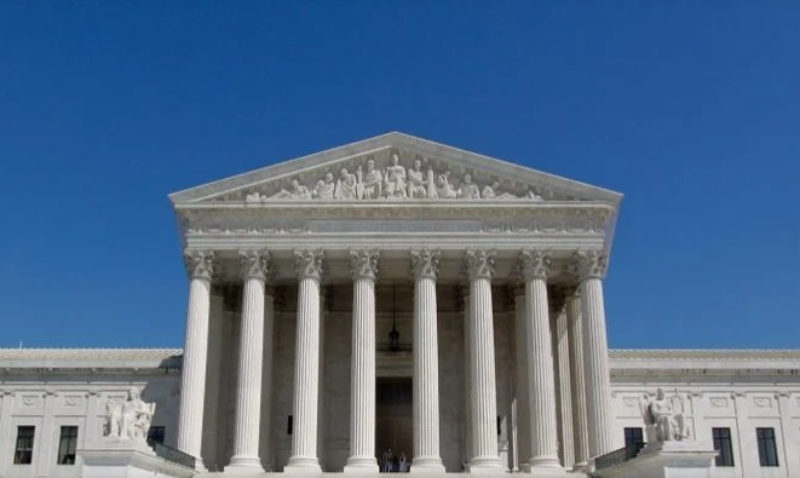
(Margot Cleveland) It is hard to believe the justices put the constitutional question above their desire to avoid appearing to meddle in the 2020 election.
by Margot Cleveland, December 14th, 2020
Late Friday, the Supreme Court rejected Texas’s election-related lawsuit against fellow states Pennsylvania, Michigan, Wisconsin, and Georgia. The Supreme Court was right—and wrong.
A week ago today, Texas filed a Motion for Leave to file a Bill of Complaint in the U.S. Supreme Court against the four states, charging constitutional violations related to the 2020 election. Texas also sought preliminary injunctive relief to prevent the putative defendant states from taking further actions related to the election.
Two days later, the attorneys general for the named states filed their responses, all asserting Texas lacked “standing” or the right to sue, because Texas, as a state, suffered no injury from the claimed violations of the election code. Texas countered with a reply brief early Friday.
A bevy of additional filings also hit the Supreme Court’s docket, with states, legislators, governors, even random Americans seeking to file amicus curiae, or friend of the court, briefs either supporting or condemning Texas’ lawsuit. President Trump and a few states also sought to intervene or join in the case.
But Friday evening the Supreme Court closed the case by denying Texas’s request to file its complaint against the four swing states. “Texas has not demonstrated a judicially cognizable interest in the manner in which another State conducts its elections,” the unsigned short order, agreed to by seven justices, read. Accordingly, the Supreme Court denied Texas’s motion for leave to file a bill of complaint “for lack of standing under Article III of the Constitution.”
Must the Supreme Court Address State Complaints?
Justice Samuel Alito issued a separate statement, joined by Justice Thomas, explaining that in their view the Supreme Court lacks the “discretion to deny the filing of a bill of complaint in a case that falls within our original jurisdiction,” and thus Alito and Thomas would have granted Texas’s “motion to file the bill of complaint.” Significantly, the two-justice statement continued: “but [we] would not grant other relief, and [we] express no view on any other issue.”
The Supreme Court’s resolution thus “addressed” two separate questions, the first a narrow procedural question: Whether the U.S. Supreme Court must allow a state to file a complaint against another state.
Current Supreme Court precedent holds the high court retains discretion to decide whether to accept a lawsuit between two or more states. The Constitution provides the Supreme Court “original jurisdiction,” or the power to hear the case initially for such cases. The Supreme Court has “exclusive jurisdiction” for such lawsuits, meaning no other court has the power to hear a case when a state sues another state.
Nonetheless, the Supreme Court has held that it is not required to accept a complaint filed by one state against another. That is why, to initiate its lawsuit, Texas filed a “Motion for Leave,” or a motion asking permission to file its complaint. Procedurally, then, what the Supreme Court did on Friday was to deny Texas “leave” or permission to file the complaint against the four putative defendant states.
Behind the Alito-Thomas Separate Statement
Several points on this apparent procedural-punting merit mention: First, the outcome of the case would have been no different had the Supreme Court granted Texas permission to file the Bill of Complaint because the reason for the denial of leave—Texas’s lack of standing—would equally demand the dismissal of the complaint once accepted.
Second, while in the Alito-Thomas statement both jurists stressed their view that the Supreme Court lacked the “discretion to deny the filing of a bill of complaint in a case” between states, that only two justices expressed this view does not mean that more do not agree.
Rather, given the compressed time frame for resolution, the other justices may have believed prudence dictated the Supreme Court apply its current precedent and leave reconsideration—and comment—on the procedural question to another day. Also, as mentioned above, there was no need for the Supreme Court to revisit this precedent because, even had the court granted Texas permission to file the complaint, the court’s ruling on standing would have required prompt dismissal of the complaint in any event.
Third, while Justices Alito and Thomas would have granted Texas’s “motion to file the bill of complaint,” the two conservative justices made clear that they “would not grant other relief.” Thus, a unanimous Supreme Court would have denied Texas what it sought—a ruling that the state legislatures must name electors anew.
Justices Alito and Thomas, however, added that they “express[ed] no view on any other issue,” showing their views on the merits proved more nuanced than many have reported, including the court’s view that Texas lacked standing to sue.
Texas’s Complaints Go Unanswered
The procedural question Texas’s lawsuit raised, however, holds little import to Americans concerned about the integrity of the 2020 election. However, because the court rejected Texas’s case for lack of standing, the court left unanswered Texas’s complaints.
Article III of the Constitution limits the power of federal courts to decide “cases” and “controversies.” Supreme Court precedent makes clear that for a dispute to fall within the Article III power of a court, a plaintiff must have “standing,” and at its “constitutional minimum” standing requires: (1) the plaintiff to have suffered a concrete injury; (2) that the injury be fairly traceable to the defendant’s actions; and (3) a favorable decision by the court will redress the injury.
In Friday’s order, the Supreme Court, without elaboration, held that “Texas has not demonstrated a judicially cognizable interest in the manner in which another State conducts its elections,” and thus concluded the Lone Star State lacked Article III standing.
The justices were correct that Texas lacks an “judicially cognizable interest in the manner in which another State conducts its elections,” but it was the framing of the issue that made the answer self-evident: The court’s abbreviated decision failed to address Texas’s true complaint—that Pennsylvania, Michigan, Wisconsin, and Georgia violated the Equal Protection, Due Process, and Elector’s Clauses of the Constitution, and in doing so harmed Texas as a state.
Of course, because the justices had Texas’s bill of complaint, by declining to exercise jurisdiction over the case, the seven justices all concluded that the facts Texas alleged were insufficient to confer standing. (The same cannot be said for Alito and Thomas, who expressed no opinion on standing, the court’s framing of the issue, or the merits of Texas’s claims.)
Supreme Court Leaves the Constitution Defenseless
But by failing to mention Texas’s constitutional claims, and by not providing any reasoning for its decision—omissions likely needed for the court to maintain its near-unanimous agreement—the Supreme Court created the appearance that it does not care about constitutional violations. When the question of standing is considered against Texas’s allegations of violations of the Elector’s Clause, it is hard to believe the court does. Or, rather, given their refusal to address Texas’s Elector’s Clause claim, it is hard to believe the justices put the constitutional question above their desire to avoid appearing to meddle in the 2020 election.
The Elector’s Clause claim presented the court a much different scenario than the Equal Protection and Due Process claims Texas also raised. As the responding states stressed in their briefs, both the Equal Protection Clause and the Due Process Clause protect only “persons,” providing: “Nor shall any state deprive any person of life, liberty, or property, without due process of law; nor deny to any person within its jurisdiction the equal protection of the laws.” Clearly, Texas is not a “person.”
While Texas argued it could represent its citizens and its electors’ rights under the Equal Protection and Due Process Clauses, Pennsylvania, Michigan, Wisconsin, and Georgia provided some strong counter-arguments in their response briefs. A few sentences by the court on its reasoning would provide Americans concerned with the legitimacy of the election some assurance.
Texas’s Elector’s Clause claim, however, required more: It required the court to accept the complaint and address, in detail, the merits of Texas’s claim, because Texas was not merely challenging the manner of the other states’ elections.
Understanding the Elector’s Clause
The Elector’s Clause of the Constitution, in Article II, Section 1, Clause 2, provides that “[e]ach state shall appoint, in such manner as the Legislature thereof may direct, a number of electors, equal to the whole number of Senators and Representatives to which the State may be entitled in the Congress.”
In Bush v. Gore, in a three-justice concurrence, Justice William Rehnquist explained that this clause of the Constitution “convey[s] the broadest power of determination” and “leaves it to the legislature exclusively to define the method” of appointment of electors. Also, “a significant departure from the legislative scheme for appointing Presidential electors presents a federal constitutional question.”
Based on these principles in Bush v. Gore, the three-justice concurrence reasoned that because the Florida Supreme Court’s decision conflicted with the legislative mandate, it violated Article II. Texas’s bill of complaint tracked this reasoning, arguing that Pennsylvania, Wisconsin, Michigan, and Georgia all departed from the election rules mandated by their respective legislative bodies and thus violated the Elector’s Clause.
Texas’s complaint and briefs then detailed the various extra-legislative modification or violations of the legislatively established election mandates. For example, Pennsylvania election officials violated the rules established by the state legislature in multiple ways, including by inspecting absentee ballots before election day then providing third-party identifying information for the voters, with those third parties then contacting the voters, whom election officials permitted to “cure” the ballots, even though curing was not authorized by the legislative body. Texas provided similar examples of extra-legislative changes to the election rules for Wisconsin, Michigan, and Georgia.
Standing Was a Pretense
Why was that not enough for the Supreme Court? What was lacking? The justices said standing—“a judicially cognizable interest”—but how can the state of Texas not have a judicially cognizable interest in her sister states living up to the compact they entered when they entered the Union?
Texas attempted in its briefs to crystalize the harm by stressing its interest in who serves as vice president, given the vice president’s tie-breaking status in the Senate and senators’ role as the representatives of the states. But a simpler and stronger argument came in a brief submitted by would-be amicus curiae Citizen’s United:
When one state allows the Manner in which Presidential Electors be chosen to be determined by anyone other than the state legislature, that state acts in breach of the presuppositions on which the Union is based. Each state is not isolated from the rest—rather, all states are interdependent. Our nation’s operational principle is E pluribus unum. Each state has a duty to other states to abide by this and other reciprocal obligations built into Constitution. While defendant states may view this suit as an infringement of its sovereignty, it is not, as the defendant states surrendered their sovereignty when they agreed to abide by Article II, § 1. Each state depends on other states to adhere to minimum constitutional standards in areas where it ceded its sovereignty to the union—and if those standards are not met, then the responsibility to enforce those standards falls to this Court.
On Friday, the Supreme Court voted not to enforce those standards.
Maybe there is a good reason. Maybe Rehnquist’s view was wrong. Maybe the court found the alleged violations not “significant” enough to reach the level of a constitutional violation. (How “significant” would a violation have to be?) Maybe the court viewed a violation of the compact on which our country was founded as beyond its purview.
There might be a satisfactory answer, but Americans have yet to hear it. And that was wrong, both for the court and the country.

Stillness in the Storm Editor: Why did we post this?
The news is important to all people because it is where we come to know new things about the world, which leads to the development of more life goals that lead to life wisdom. The news also serves as a social connection tool, as we tend to relate to those who know about and believe the things we do. With the power of an open truth-seeking mind in hand, the individual can grow wise and the collective can prosper.
– Justin
Not sure how to make sense of this? Want to learn how to discern like a pro? Read this essential guide to discernment, analysis of claims, and understanding the truth in a world of deception: 4 Key Steps of Discernment – Advanced Truth-Seeking Tools.
Stillness in the Storm Editor’s note: Did you find a spelling error or grammar mistake? Send an email to [email protected], with the error and suggested correction, along with the headline and url. Do you think this article needs an update? Or do you just have some feedback? Send us an email at [email protected]. Thank you for reading.
Source:
Leave a Reply